
Microsoft Files Patent to Trace Which Coworker Inspired Your Email
You write an email, and software tells you which coworker's words most shaped it. Microsoft's patent application describes exactly that, down to the highlighter colors.
What Microsoft's influence-tracking patent does
Imagine you send a project update after a week of meetings, chats and shared documents. One sentence in it sounds a lot like something a teammate said on Tuesday, though you can't remember where it came from.
Microsoft has filed a patent application for software that tries to answer that question. It turns each part of your message into a list of numbers that captures its meaning, then compares those numbers against what other people wrote or said earlier. The parts that match most closely get marked as most influential.
The result could show up as colored lines under your text, a score for each person who shaped it, or a nudge to thank a colleague. The filing calls it an estimate of influence, since nobody can see everything a person has read or heard.
… compare the semantic embeddings against second semantic embeddings associated with prior communications of other users, to determine an indication of influence for each portion of content of the communication; …
Translation: It checks your writing against what your coworkers said to see who rubbed off on you.
How the system scores each passage you write
The system starts by splitting a message, document or meeting transcript into pieces, such as sentences or paragraphs. A language model then turns each piece into an embedding, a long list of numbers that captures meaning, so two sentences with different words but the same idea end up with similar numbers.
Next, those embeddings are compared against embeddings of what other people wrote or said earlier: emails, chat messages, documents and meeting transcripts. Each piece of your message gets an influence score, which can be a percentage, a ranking or a plain score. The strongest matches are flagged as most influential and shown on screen, for example with color-coded lines (green for the most influential, yellow for less).
The description adds a more careful version of the idea. It estimates two probabilities: that a passage came from the author's own past writing, and that it came from someone else's material the author had access to. If the second is higher, influence is likely. It names a statistics method called Kolmogorov-Smirnov (a test of whether two sets of data follow the same pattern) for this step. A user-set window, such as 14 or 30 days, limits which earlier messages count.
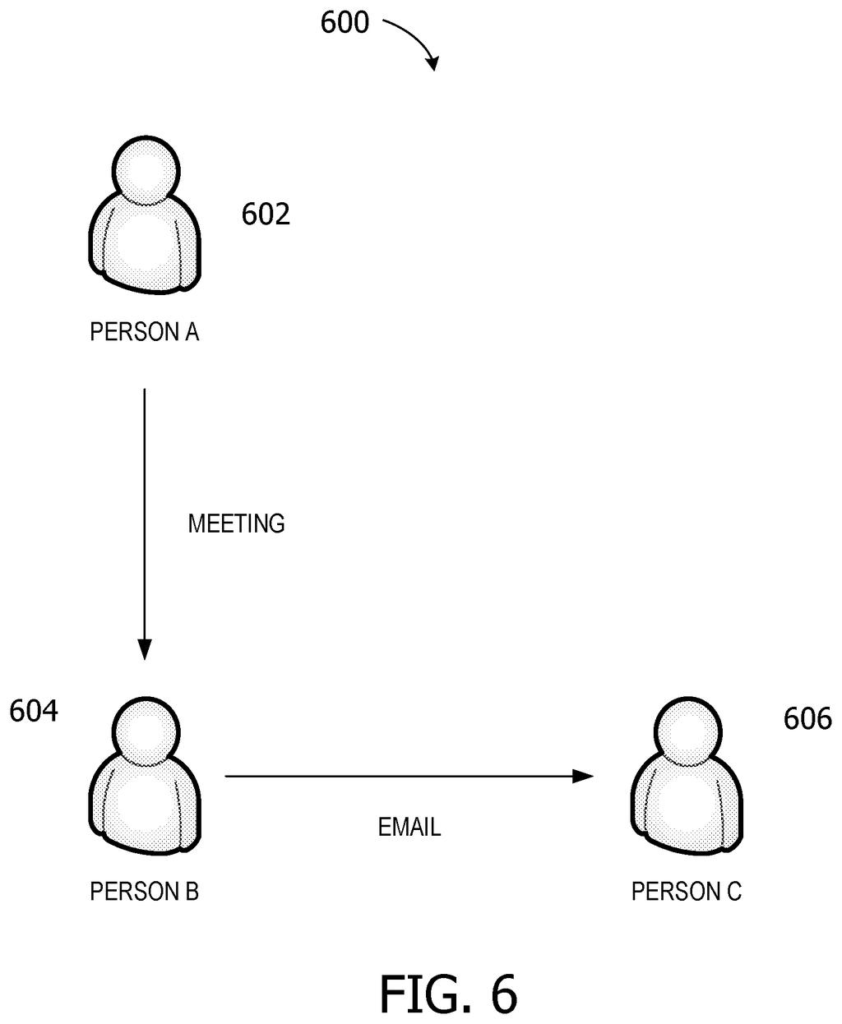
Other add-ons include a timeline of messages, a graph of how an idea spreads between people, and suggestions such as thanking or contacting the influencer.
… determine if communication content originated in a person's own prior knowledge or new information more recently obtained from interaction with communications of others.
Translation: The software figures out if you thought of something yourself or just copied a colleague.
Why workplace credit and privacy both come up
For you, the most direct effect would be a feedback tool: a view of where your ideas come from and who picks up yours. The filing's examples include a prompt to thank a colleague, a report for a team manager, and a pie chart of your top influencers over a set period. The description also suggests plagiarism and cheating checks as another use.
The catch is that this works by scanning emails, chats, documents and meeting transcripts. The filing says users opt in and that only the number lists may be stored to protect privacy. It also admits the result is an estimate of influence, since nobody can see everything a person has read or heard. How an employer would use those scores is the open question.
Microsoft's 23rd filing we've tracked since July in our AI safety guardrails watch adds to a pattern that includes one on flagging bad prompts early and one on consistent chatbot behavior.
Claim 1 asks for less than the abstract promises. The abstract talks about weighing your own past writing against what you recently read, but the claim never requires that step. It only requires scoring each piece of a message against what other people wrote earlier, picking the pieces that match most, and marking them on screen.
The specifics sit in the dependent claims: the color-coded lines, the time window, the timeline, the idea-spread graph. That leaves the main claim describing a broad pattern, software that compares your text to your colleagues' earlier messages and highlights the overlap. If it is granted in this form, its wording would cover a lot of ground, including tools that flag copied passages, which the description itself mentions.
Whether people want a work tool that tallies who influenced whom is a separate question. The filing's own talk of opt-in consent shows Microsoft has seen it coming.
Get our take in your Top Stories
Liked this breakdown? Add Patentlyze as a preferred source on Google, and our plain-English take shows up more often in your Top Stories the next time Microsoft patent news breaks.
There are more where this came from
We read every patent application Big Tech publishes and send you the ones worth knowing. Plain English, free, every week.
The drawings
20 drawing sheets from US 2026/0330341 A1 · click any drawing to enlarge


Show the other 12 sheets


Want this weekly breakdown for a company we don't cover? Patentlyze Pro →
Be the first to weigh in