
Amazon
Amazon · AI / ML · Filed Mar 31, 2025 · USPTO published Oct 1, 2026 · Oct 1 release
Amazon Patents a System That Watches Its Own AI for Suspicious Inputs
What happens when someone feeds an AI model garbage, or when the AI itself starts producing garbage? Amazon is patenting a system that watches AI models in real time and catches bad data before it ever reaches users.
- Publication number
- US 2026/0300817 A1(US20260300817A1)
- Applicant
- Amazon Technologies, Inc.
- Filed · Published
- Mar 31, 2025 · Oct 1, 2026
- Inventors
- Garrett Ryan Galloway, Zinnur Gucu, Matthew Richard Schwartz, David Alan Mattson
- Status when we published
- Waiting for an examiner
- Document
- 21 claims
- US classification
- 706/12
What Amazon's AI self-monitoring system actually catches
Ever asked a customer service chatbot something totally normal, only to get a response that felt completely off? That gap between what you asked and what you got is the kind of problem Amazon is trying to catch automatically.
The idea here is a monitoring layer that sits alongside an AI model and watches what goes in and what comes out. Every time the model processes a request, it produces internal fingerprints called embeddings (think of them as a unique numerical signature for a piece of information). Amazon's system compares those fingerprints against a stored library of what "normal" looks like for that specific model. If something doesn't match, the system flags it and decides how to handle it, whether that means blocking the request, flagging the response, or routing things differently.
The practical payoff for you: AI services built on this kind of monitoring should be less likely to produce wild, harmful, or nonsensical outputs, and less vulnerable to people trying to trick the AI with malicious inputs.
… determine a manner of processing a second set of data associated with the machine learning model based on comparing the vector embedding generated by the machine learning model with the second plurality of vector embeddings and based on one or more of a query vector, a key vector, or a value vector associated with an attention mechanism of the machine learning model …
Translation: The system decides how to handle data based on mathematical comparisons inside the AI.
How vector comparisons flag bad prompts in real time
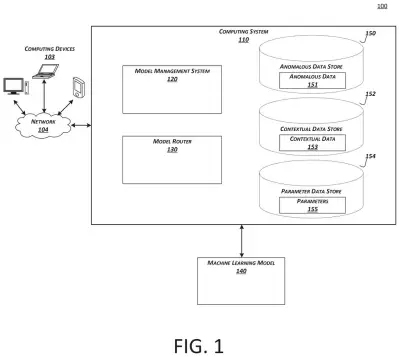
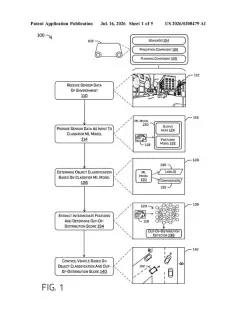
The patent describes a computing system that monitors an AI model's behavior by inspecting the internal representations the model generates as it works.
When a user sends a request, the system builds a prompt (a structured input that may include the user's words plus additional context) and sends it to the AI model. As the model processes that prompt, it generates vector embeddings (numerical arrays that encode meaning in a form the model understands). The monitoring system grabs those embeddings in real time.
It then compares those embeddings against a stored reference set tied to that specific model. Crucially, the comparison also uses components of the model's attention mechanism (the part of a modern AI that decides which pieces of information to focus on) including what the patent calls query, key, and value vectors. This gives the monitor a richer picture of whether the model is behaving normally.
Based on that comparison, the system decides how to handle the data:
- Flag or block a suspicious input before the model generates an answer
- Intercept a suspicious output before it reaches the user
- Route the data through a different processing path entirely
Each AI model in a fleet gets its own reference library, so the monitor can be tuned per model rather than relying on one-size-fits-all rules.
Systems and methods are provided to detect anomalous data obtained from and/or to be routed to a machine learning model.
Translation: The technology watches for strange inputs or outputs moving through an artificial intelligence model.
What this means for people who use AI-powered services
If you use any Amazon-hosted AI service, such as a shopping assistant, a customer support bot, or an enterprise tool built on AWS, this system would operate invisibly beneath the surface. Its job is to catch two categories of trouble: bad inputs (attempts to manipulate or exploit the AI, sometimes called prompt injection attacks) and bad outputs (cases where the model drifts into producing harmful, inaccurate, or out-of-scope responses).
For everyday users, the clearest payoff is reliability. AI services that monitor themselves in real time can fail more gracefully, catching problems before they reach you rather than after. For businesses running AI on AWS, it offers a way to keep deployed models within guardrails without retraining them from scratch every time something goes wrong.
Amazon's fifth filing we've tracked in the AI guardrails race since July builds on earlier applications like one that scores AI responses and one that blocks harmful content.
Source: US 2026/0300817 A1 at the USPTO (PDF). Full patent text and figures are in the official publication.
Get our take in your Top Stories
Liked this breakdown? Add Patentlyze as a preferred source on Google, and our plain-English take shows up more often in your Top Stories the next time Amazon patent news breaks.
Add Patentlyze on Google
One click.
There are more where this came from
We read the new patents from Big Tech, carmakers and more and send you the ones worth knowing. Plain English, free, every week.
The drawings · 9 sheets
9 drawing sheets from US 2026/0300817 A1 · click any drawing to enlarge


Show sheet 9

More from Amazon
All 114 Amazon patents →
More in AI recommendation
All 91 AI recommendation patents →
Samsung
Samsung Patents a System That Double-Checks Its Own Health Advice Before Sending It
Samsung
Samsung Patents an AI That Builds a Personalized Recap When You Resume a Paused Show
Google
Google Patents a Way to Reshape Ads So They Fit Any Webpage's Look
IBM
No comments yet