
A New Apple Patent Lets Websites Wrap You in Their Own 3D Worlds
Apple's new filing describes a button that appears on certain webpages in a headset. Tap it, and the site replaces the room around you with a scene its developer built, like a night sky full of stars that move as you scroll.
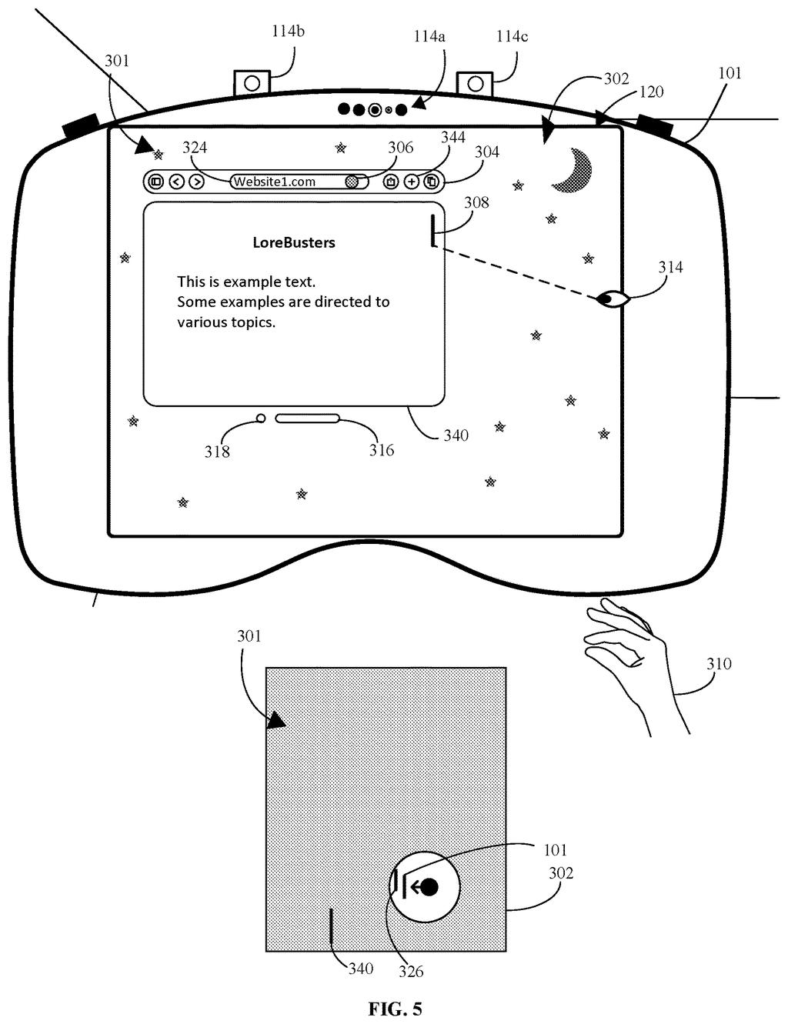
What Apple's website-built 3D scenes actually do
You're wearing a headset, reading an article about the night sky on a floating browser window. A small icon in the address bar lights up. You pinch the air, and your living room fades away. Stars and a moon appear on every side of you, and as you scroll, they drift and grow.
That's the idea in this Apple filing. A website's developer can attach a hidden note to the page saying a 3D environment is available. Your headset reads that note and shows you a button. Nothing takes over until you choose it.
Once you're inside, the scene can follow the page. Scroll to a paragraph about one star and that star can light up the text. Open a new tab on the same site and the world stays. Visit a different site and it can go away.
… displaying, via the one or more displays, the virtual environment with a level of immersion relative to a three-dimensional environment of the electronic device that is greater than a threshold level of immersion.
Translation: Stepping inside a website takes over your view to fully pull you into its digital world.
How a webpage tells a headset to surround you
The core claim is a three-step flow. A headset shows a virtual content object (for example, a floating web browser window). If that content is linked to a virtual environment, the headset shows a selectable option for it. When you pick it, the environment appears at a level of immersion above a set threshold, meaning it covers a large share of what you see.
The filing says the link comes from the site's own developer, who can embed metadata (hidden labels in the page's code) pointing to images, 3D models, or scene files. The environment can be built by projecting developer-supplied images onto a 3D shape that wraps around you, such as a sky box (a giant cube) or a sphere.
The description adds several extras that the claims also touch on:
- Animation: parts of the scene can move, such as stars shifting as you scroll.
- Virtual lighting: a glowing object in the scene can light up part of the browser window.
- Tabs: switching to another tab tied to the same environment leaves it untouched.
- Reader mode: choosing a plain reading view can switch the environment off.
The description also says developers might control where you stand in the scene, such as in the middle of a lake or on its shore. It also mentions a crown-style dial that could raise or lower how immersive the scene is, unless the developer fixes the level.
Some examples of the disclosure are directed to systems and methods for displaying virtual environments associated with developers of webpages.
Translation: This technology lets website creators build immersive virtual spaces for their visitors.
Why web developers could care about this Apple filing
If you wear a headset, this could make websites feel more like places than pages. A museum site could put you under a starry sky, or a travel site could drop you on a lake shore, without you downloading a separate app. The filing itself points to this: it says it reduces reliance on separate downloads and frees up storage.
For web developers, it hands them a new design tool, a full surrounding scene, on top of the usual text and images. The button-first approach keeps you in charge, since the scene only appears after you pick it. The filing also describes a prompt that asks for confirmation when a scene is triggered by a button inside the page, so a site can't surprise you.
That makes this Apple's 111th filing we've tracked in our AR glasses watch since May, adding to work like blurring 3D objects and fixing clipping windows.
The problem here is small but real. Websites on a headset are flat windows floating in your room, and that wastes the one thing a headset does best: surround you. Developers who want to build something richer today often have to make a full app, which means a download, an install, and storage space.
A label in a webpage that says "a 3D world is available" is a modest fix, and it fits the size of the problem. The worry with any site-controlled immersion is annoyance, and the opt-in button and the option to close the scene when you leave address that.
It matters only if headset owners spend real time browsing the web in 3D, and the filing offers no evidence of that. But as a way to let a storyteller or a store build a mood without asking you to install anything, it is a sensible, well-scoped idea.
Get our take in your Top Stories
Liked this breakdown? Add Patentlyze as a preferred source on Google, and our plain-English take shows up more often in your Top Stories the next time Apple patent news breaks.
There are more where this came from
We read every patent application Big Tech publishes and send you the ones worth knowing. Plain English, free, every week.
The drawings
15 drawing sheets from US 2026/0340949 A1 · click any drawing to enlarge


Show the other 7 sheets


Want this weekly breakdown for a company we don't cover? Patentlyze Pro →
Be the first to weigh in