
Apple Files Patent to Show Headset Users Where a Friend Went Behind a Wall
Headsets can make the person standing three feet away vanish the moment a wall gets in the way. Apple's new patent application describes a way to keep that person visible as a marker or avatar, even when you can't see them.
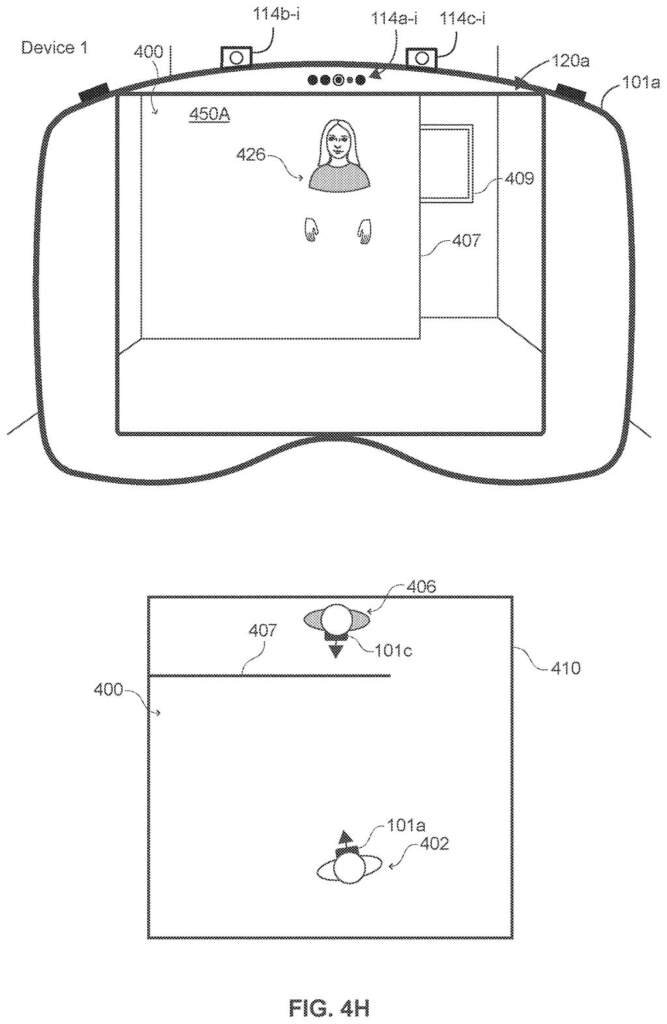
What Apple's see-behind-the-wall marker does
You're wearing a headset in a living room, sharing a virtual session with a friend who has one on too. Your friend steps around a partition to grab a drink, and from where you stand, they simply vanish.
Apple's filing describes a fix. Each headset keeps sending the others a stream of body-position data: where its wearer is, which way they face, how tall they are, and how their arms and hands are positioned. When your friend ducks behind the wall, your headset still knows exactly where they are, so it can draw a marker or an avatar at that spot, an outline you can see through the wall.
When your friend walks back into view, the marker disappears. If they're busy on a private call, your headset can show a plain marker instead of a detailed avatar, so nothing personal leaks out.
… displaying, via the one or more displays, a visual indication corresponding to the at least the portion of the user of the second electronic device at a location in a three-dimensional environment corresponding to the at least the portion of the first physical environment based on the first data …
Translation: The headset shows a marker where your friend was just before they walked behind a wall.
How headsets share body data across a room
The patent covers two or more headsets that are in the same physical space and joined in a shared session. The filing says they count as sharing a space if they are within a set distance of each other, can see each other, or sit in the same room. Each headset sends the others skeletal data, a digital description of its wearer's body. That includes the pose of their body parts, their height and size, and the position of upper-body joints like fingers, hands and arms. It can also include things like glasses, a wheelchair or a cane.
- Your headset receives that data from the other person's headset.
- It notices when the person moves somewhere a wall or other part of the room blocks your view of them.
- It then shows a visual indication of them at the matching spot in your 3D view.
That indication can be an avatar (a digital stand-in for the person) or a simple interface marker. The filing says the marker can be chosen for privacy, for example when the person is on a private call. The indication goes away once either of you moves and the person is no longer blocked. When people are in the same room, you see them directly through the headset's camera view, so no avatar is drawn for them in normal circumstances.
The filing also describes other uses of the same body data. Shared video windows can fade where a person walks through them, and a virtual chess piece can sit in a friend's hand.
… displaying a visual indication of a participant within a multi-user communication session based on skeletal data associated with the participant in the multi-user communication session …
Translation: The system uses body-tracking data to show where people are during a shared chat session.
Why this matters for shared headset rooms
If you share a room with other headset wearers, one of the biggest everyday problems is losing track of them. Apple's filing gives your headset a way to keep tabs on people who are physically close but hidden, so you can move around furniture, partitions and doorways with a better sense of who is where.
The same body data also helps with smaller jobs the filing describes: placing a menu above the right person, fading a shared window when someone walks through it, and showing a game piece in a friend's hand. These are the details that make a group session in one room feel less awkward. It's only a patent application, so nothing here says when or whether it will ship.
Apple's 101st patent application we've tracked since May joins one on motion sickness and one on skipping eye scans in our Apple AR glasses watchlist.
Walking around a room in a headset gets risky when you can't see everyone. If your view is full of virtual windows and a friend slips behind a wall, you won't notice them until you nearly collide at a doorway. A marker that follows them heads off that problem before it happens.
You would notice this most in a room with furniture, partitions and doorways, such as an office or classroom where several people wear headsets together. The privacy detail helps too: someone on a private call shows up as a plain marker instead of a detailed avatar.
The limit is that every person has to wear a compatible headset and join the session. Anyone without one stays outside the system, so it covers only part of the problem.
Get our take in your Top Stories
Liked this breakdown? Add Patentlyze as a preferred source on Google, and our plain-English take shows up more often in your Top Stories the next time Apple patent news breaks.
There are more where this came from
We read every patent application Big Tech publishes and send you the ones worth knowing. Plain English, free, every week.
The drawings
27 drawing sheets from US 2026/0330773 A1 · click any drawing to enlarge


Show the other 19 sheets


Want this weekly breakdown for a company we don't cover? Patentlyze Pro →
Be the first to weigh in