
Microsoft Files Patent to Lock Away Only the Password in a Message, Leaving the Rest Readable
Microsoft's filing describes software that catches a password mid-message and swaps it for a locked link, so the rest of what you wrote stays readable. It aims to replace the error-message block that pushes people toward risky workarounds.
What Microsoft's inline secret-swapping does
Today, when someone pastes a password into a chat or an email, one of two things usually happens: it goes out as plain text for anyone to read, or a security filter blocks the message and shows an error. People often get around that block by adding spaces to the password or zipping it up, which defeats the point.
Microsoft's patent filing describes a third option. Software spots the secret as you send the message, pulls out just that piece, and puts something else in its place, such as a link to a locked vault where the real password now lives. Everything else you wrote stays readable.
The person on the other end can still get the password back, but only if they pass the vault's checks. The filing even describes links that expire after fifteen minutes, so a shared secret can't sit around forever.
detecting a sensitive data item which is embedded in a digital document, the sensitive data item being less than an entire human-readable portion of the entire digital document …
Translation: The system scans a file to find a hidden secret while leaving the rest of the text alone.
How a password becomes a locked reference
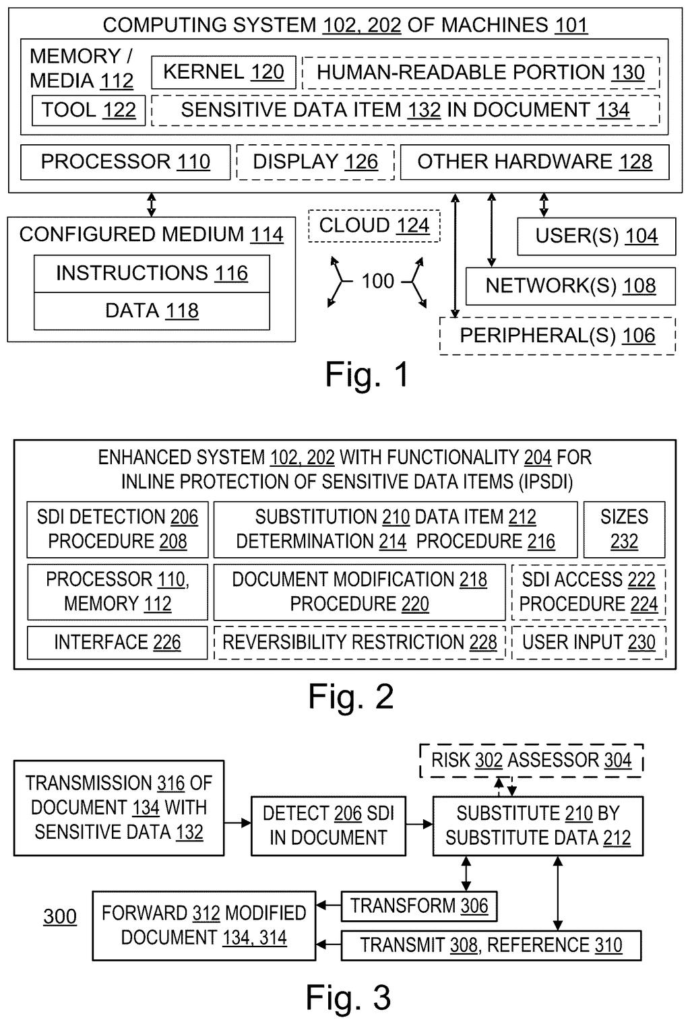
The method has three steps, and they run before a message leaves. First the software detects a secret hiding inside a larger document. Second it swaps that piece for a stand-in. Third it forwards the edited document.
Detection can use pattern-matching rules (called regular expressions, basically search templates for things that look like keys), a language model that judges what counts as sensitive, or decoding of text disguised in formats like base64. The stand-in can take a few forms:
- Encryption or reversible scrambling of the secret, which the right person can undo.
- Reversible pseudonyms, where a fake value stands in and a lookup table maps it back.
- A reference, such as a web address or file name, pointing to a copy kept in a secure store (a locked vault).
The key detail in the claims is that the swap is reversible: nothing is blacked out for good. The vault can even be created on the spot, and the filing says the system can pick one using clues baked into the secret, like its expiry time or the cloud region it belongs to. Access can be limited to a time window, a user account, a machine, a location, or even a named AI agent. Documents can also be handled mid-stream, such as a live video-call chat.
Why Microsoft wants secrets handled in-line
If you have ever pasted a password into a work chat because it was the fastest way, this is aimed at that habit. The filing points to tools where people send each other sensitive data: video conferencing and collaboration apps, office programs, and software development tools. Instead of stopping you with an error, the tool would handle the secret for you and let the message through.
For companies, the pitch is consistency and speed. Protection no longer depends on which channel someone picks on the spur of the moment, and only a small slice of each document gets processed instead of the whole file. The examiner's first review rejected the claims as filed, which is routine at this stage and usually followed by amendments, so the final scope may look different.
This is the 574th Microsoft filing in our Microsoft coverage since May, adding to work like the privacy screen patent and the fact-checking one.
Only the secret gets swapped out, so the rest of a message stays readable and quick to send. In exchange, the whole scheme depends on software spotting the secret in the first place. A password it misses goes out in plain text like always, and a harmless phrase it flags gets locked up for no reason (the filing admits false alarms happen and lets an owner reverse them).
Two more costs sit in the design. The vault holding the real secrets becomes an attractive target, so its own protection has to be excellent. And the readable parts of the message still tell a snooper what the secret is for, since the surrounding text is left alone.
Against today's habit of pasting passwords into chat, the trade is worth making. Most people will not leave a conversation to open a separate password manager, and a tool that does the safe thing automatically beats a warning people learn to dodge.
Get our take in your Top Stories
Liked this breakdown? Add Patentlyze as a preferred source on Google, and our plain-English take shows up more often in your Top Stories the next time Microsoft patent news breaks.
There are more where this came from
We read every patent application Big Tech publishes and send you the ones worth knowing. Plain English, free, every week.
The drawings
5 drawing sheets from US 2026/0340187 A1 · click any drawing to enlarge


Want this weekly breakdown for a company we don't cover? Patentlyze Pro →
Be the first to weigh in