
Microsoft Files Patent to Fact-Check Documents Before Its AI Summarizes Them
Most AI summaries repeat whatever a document says, wrong dates and all. A new Microsoft patent application describes one that checks the facts first.
What Microsoft's fact-checking summarizer does
Ever handed an AI a long report and wondered whether the report itself had its facts straight? Today's summarizers usually don't wonder. They shrink the document down and repeat whatever it says, mistakes included.
A new Microsoft patent application describes a summarizer that checks first. You upload a document, and the system picks out statements that can be proven true or false, such as a date or a research finding. It looks them up in trusted sources (think NASA for a moon-landing date) and scores how well the document's claim matches.
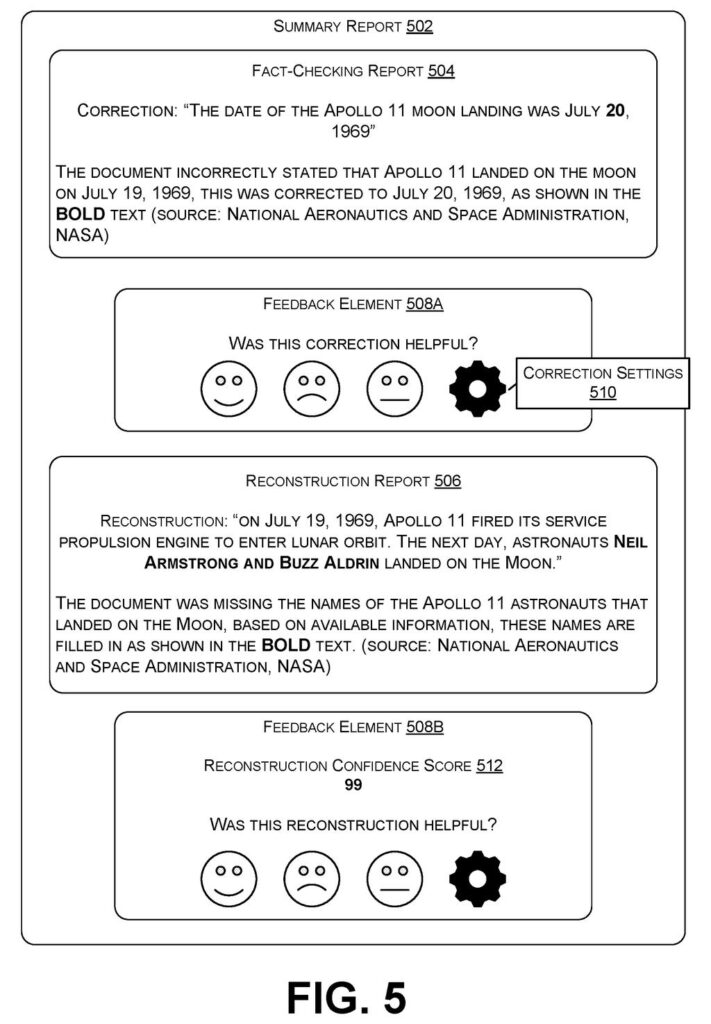
If a claim fails, the summary carries the fix, and a separate report shows what was wrong, what replaced it, and where the right answer came from. The system can also try to fill in gaps, like a torn page in a scanned textbook.
… synthesizing the summary of the text document, wherein the summary incorporates a correction to the factual claim in accordance with the verified information retrieved via the information query …
Translation: The system automatically fixes false statements in the summary using verified facts.
How the credibility score triggers a correction
You upload a document, and a first model turns it into structured text (text organized so software can read its meaning). That can be an OCR model (software that reads scanned or handwritten pages) or an embedding model (one that turns text into numbers capturing its meaning).
A second model, such as a large language model (the kind behind chatbots), picks out factual claims: dates, named people, research findings. For each one, the system queries trusted sources chosen for relevance, like NASA or NOAA, and ranks them with a reliability score. In the filing's earnings example, the SEC outranks a company's internal books.
Next comes a credibility score, built by comparing meanings, for example on a 0 to 10 scale. Alternate spellings and loose date ranges can pass. A wrong date or a debunked conspiracy theory falls below the threshold and gets corrected.
A user setting picks the correction style:
- Rewrite the claim with the verified fact.
- Show the document's claim next to the verified one.
- Keep the claim and add a disclaimer with evidence.
The summary also carries a report with the error, the fix (highlighted, such as in bold) and the source. Output can be text or an audio narration, and a second set of claims covers filling in missing information.
… this lack of functionality can lead to the propagation of inaccurate and/or misleading information as well as a disjointed, confusing user experience …
Translation: Current AI summarizers often spread false information and confuse users.
What this means for AI summaries you rely on
If summarizers worked this way, you would stop getting a tidy recap that repeats a wrong date or an outdated study as fact. The report shows what changed and where the right answer came from, so you can check the fix yourself. Settings let a student get strict corrections while an expert only gets flags.
For Microsoft, the filing targets a known weakness of AI summaries: they trust whatever they are fed. It also covers audio narration, such as an AI-generated podcast that adjusts itself mid-narration, and rebuilding torn or smeared pages in scans. The filing describes a method, not a product, and says nothing about where it would be used.
That makes this Microsoft's 26th filing we've tracked since July in our AI guardrails race watchlist, joining an answer key for catching errors and a self-checking content filter.
The biggest cost here is that someone has to decide which sources count as trustworthy, and a wrong or outdated source now gets to silently overwrite a document that may have been right. The filing handles an obvious case well, setting a source aside when a claim is actually about that source, but every such list is a judgment call baked in by the designers.
The second cost is what the summary actually is. A summary that edits claims is no longer a faithful short version of what the author wrote, so readers who skip the correction report are reading the AI's opinion of the facts, presented in the author's voice.
The trade reads as worth it. Showing the fix and the source beats repeating errors and keeping disputed material visible rather than deleting it is the right instinct. The hardest case is research that is simply out of date, where no single source has the right answer yet.
Get our take in your Top Stories
Liked this breakdown? Add Patentlyze as a preferred source on Google, and our plain-English take shows up more often in your Top Stories the next time Microsoft patent news breaks.
There are more where this came from
We read every patent application Big Tech publishes and send you the ones worth knowing. Plain English, free, every week.
The drawings
9 drawing sheets from US 2026/0340262 A1 · click any drawing to enlarge


Show the other 1 sheets

Want this weekly breakdown for a company we don't cover? Patentlyze Pro →
Be the first to weigh in