
Microsoft Files Patent for Spotting Passwords Split Across Separate Emails
A username in one email and a password in another look harmless alone. Microsoft's patent describes a system that connects the two and flags the pair.
What Microsoft's split-password detector actually does
Imagine you email a coworker an account name on Monday, then send the password in an attachment on Thursday. Neither message looks scary by itself. Together, they hand over the keys.
That is the gap this Microsoft filing goes after. Old-style tools hunt for secrets by matching fixed text patterns, which misses anything that doesn't look the way the tool expects. Microsoft's system instead breaks documents into sentences, turns each sentence into a set of numbers that captures its meaning, and compares new content against sentences already confirmed to contain real secrets.
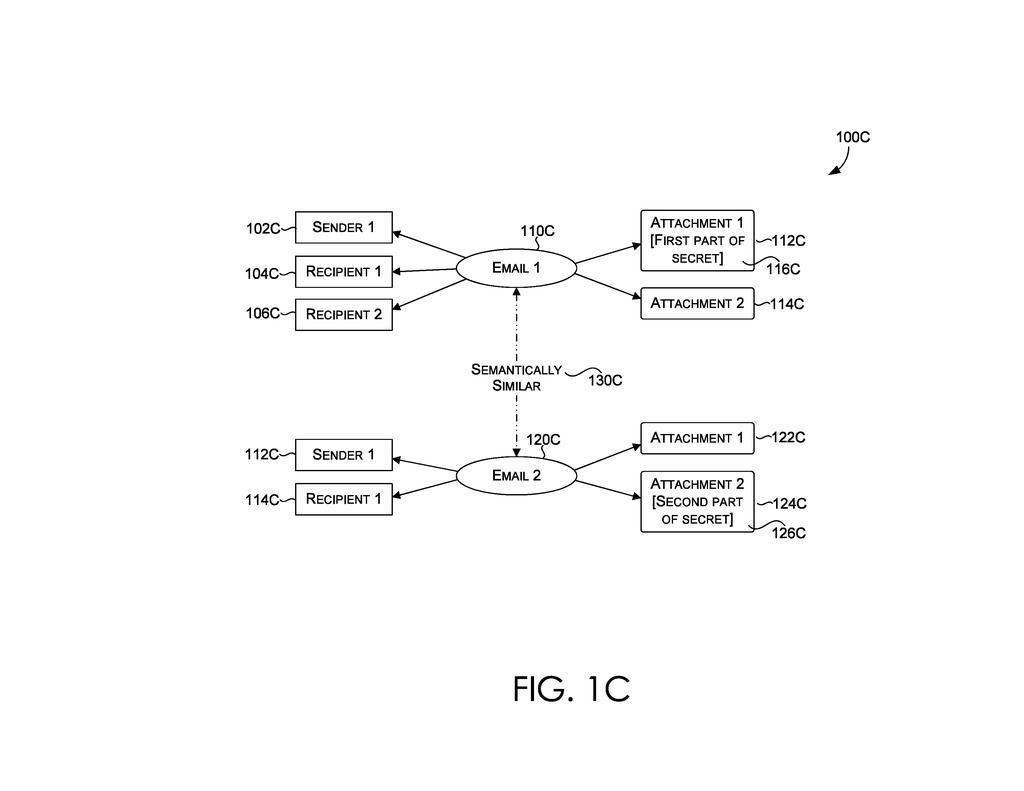
It also builds a map linking related emails, using things like sender, recipients and subject. When two pieces from different messages fit a known pattern for a login pair, the system sends an alert about both. The filing describes it as a toolkit for investigators sorting through breached data.
… identifying a third set of unique content instances in the first data item and the second data item based on de-duplicating the first set of unique content instances and the second set of unique content instances based on the corresponding priority values …
Translation: The system removes duplicate information across multiple emails to find split passwords.
How the engine links sentences, emails and secrets
The filing bundles three ideas into one "modular cybersecurity engine." Each independent claim covers a different one.
1. A priority queue for reading huge piles of text. Breach data is far too big to run through an AI model in full. So the system splits each document into sentences, gives each a priority score (based on things like file type and where the sentence sits), and removes duplicates within a document and across documents, keeping the highest-priority copy. It then turns the survivors into embedding vectors (lists of numbers that capture what a sentence means), highest priority first. Sentences already processed are skipped.
2. A detector that teaches itself. Once a sentence is confirmed to contain a real secret, the system saves a signature of it and writes a new search query from it. That query goes into a database an AI model uses to spot similar sentences later.
3. A map that joins the halves. The system scans for half of a login pair in one item and the other half in another. It builds a semantic graph (a web of items linked by meaning and details like sender) and checks whether the pieces together match a signature. The filing also describes testing candidate logins against a simulated sign-in endpoint to confirm they work.
The modular cybersecurity engine includes a modular distributed system, a credential detection system, and a credential semantic graph system.
Translation: The security software combines multiple specialized subsystems to detect compromised credentials.
Why this matters for breach investigators and your inbox
If you work in security, the practical pitch is fewer missed leaks. Rule-based scanners only catch what someone wrote a rule for, and the filing says its engine writes and refines its own detection rules as it goes. The filing's examples center on emails and breach dumps, though it says the approach could reach other uses like privacy-policy checks.
For everyone else, the takeaway is that sensitive details scattered across messages are easier to piece back together than you might think, and that's true for defenders and attackers alike. The filing frames this as a tool for investigators, with permission controls and audit logs built in so only the right people see what it finds.
Microsoft's 549th filing in our Microsoft coverage since May continues its AI work, adding to patents like the nurse coaching tool and the AI grading reducer.
Everything here runs on existing cloud computers and software, so the usual delays around building new physical infrastructure do not apply. The shortest path to a working product is essentially: take what is described, plug it into a security team's existing setup, and start running.
The main thing that has to work before this becomes useful is trust. Analysts drowning in false alarms quickly stop paying attention, so the document builds in two safeguards: investigators can flag errors so the system learns over time, and suspected passwords are tested against a decoy login before any alert goes out.
The most likely first home for this is a company that has already suffered a data breach and needs help sorting through what leaked. For security teams doing that kind of painstaking work, the design looks close to ready and the gap between filing and shipping appears small.
Get our take in your Top Stories
Liked this breakdown? Add Patentlyze as a preferred source on Google, and our plain-English take shows up more often in your Top Stories the next time Microsoft patent news breaks.
There are more where this came from
We read every patent application Big Tech publishes and send you the ones worth knowing. Plain English, free, every week.
The drawings
13 drawing sheets from US 2026/0330049 A1 · click any drawing to enlarge


Show the other 5 sheets


Want this weekly breakdown for a company we don't cover? Patentlyze Pro →
Be the first to weigh in