
Google Files Patent to Let You Circle Several Things and Search Them Together
Screen search tools today mostly let you pick one spot at a time. Google's filing lets you circle several, signal which matters most by how you draw it, and search them all together.
What Google's multi-circle visual search does
Ever tried to search for two things in the same photo at once? Say a friend sends a picture of a living room, and you want to know about the lamp and the rug. Most screen-search tools let you circle one spot at a time, so you end up running two searches or typing out a clumsy description.
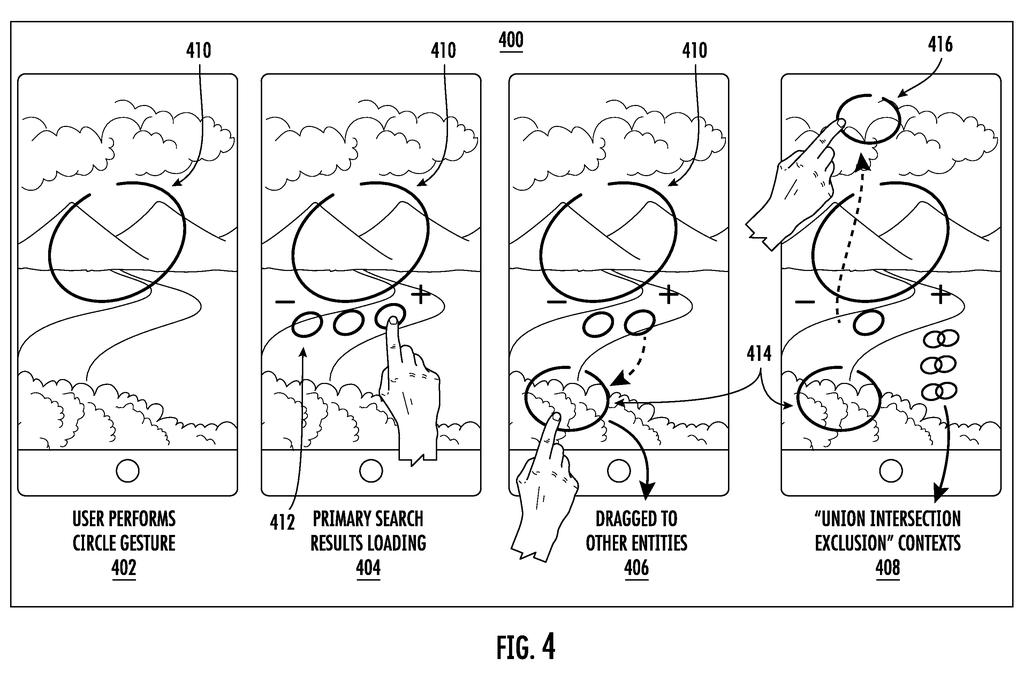
This Google filing describes an overlay that lets you pick several parts of whatever is on your screen. Circle one area, and a marker appears along with little draggable bubbles. Drag a bubble onto a second area, or draw one long looping squiggle that circles several things in a single stroke. Google then cuts out each piece and searches them together.
You can also signal what matters most. The filing describes pressing harder, drawing different shapes, or circling something twice to give that piece more weight in the results.
… obtaining a first gesture input, wherein the first gesture input selects a first portion of the display content, wherein the first gesture input encloses at least a portion of the first portion of the display content provided within a first shape; …
Translation: The system captures your first circling motion to select an initial item on your screen.
How the loops and bubbles become one search
The patent application describes an overlay interface (a layer that sits on top of whatever app you're in) that captures what is on your screen when you call it up. You draw a shape around one area, and the system puts a visible indicator, an outline of your shape, over it. Then you pick a second area, and a second indicator appears next to the first.
There are two ways to add areas. One is dragging bubbles, which appear after your first circle, onto new spots. The other, covered by a separate claim, is a single continuous gesture with several loops. A model that works out what you meant (an intent determination model) decides which loop covers which object and builds a mask, an outline of just that object.
- Each selected area is cut out as its own segmented image.
- Each image is turned into an embedding, a string of numbers that captures what the picture shows so similar things can be matched.
- The embeddings can be blended into a third one, or weighted, and then used for the search.
Weighting can come from touch pressure, shape, size, or the moment a loop was drawn. In one variation, a hard press on the first circle makes it fetch the candidate results, and the second area filters them. The description also mentions a circle-and-slash gesture to exclude something from the results.
The plurality of portions of the display content can be segmented to generate the plurality of image segments. The plurality of image segments may then be searched to determine one or more search results.
Translation: The circled items are cropped out and combined to run a single unified search.
Why searching two things at once matters
If you've ever screenshotted a photo, cropped it, searched, then repeated the whole routine for a second item, this is aimed at that habit. The filing says searching one portion can miss the full context, searching the whole screen gives too little direction, and typed text lacks the specificity of a visual search. A multi-circle query could mean fewer searches per question.
The description places the interface at the operating system level, so it could work across social media, browsers, photo galleries and even games. It is a patent application, so nothing here says it will ship. It does show where Google is taking visual search: from pointing at one thing to asking a question about several.
This is the 965th Google filing in our Google coverage since May, adding to work like step-by-step AI reasoning and cheaper AI audio.
The problem is small each time but shows up constantly. A photo of a room, an outfit or a plate of food holds several things you might ask about, and single-selection search forces you to split one thought into separate searches or fall back on typing.
The fix matches that size well. Circles and draggable bubbles are things your thumb already knows how to do, and the pressure and double-circle tricks add emphasis without opening a menu.
The risk is a pile of weighting gestures nobody remembers. If shape, size, pressure and timing all mean something, most people will circle twice and hope for the best.
Get our take in your Top Stories
Liked this breakdown? Add Patentlyze as a preferred source on Google, and our plain-English take shows up more often in your Top Stories the next time Google patent news breaks.
There are more where this came from
We read every patent application Big Tech publishes and send you the ones worth knowing. Plain English, free, every week.
The drawings
35 drawing sheets from US 2026/0340027 A1 · click any drawing to enlarge


Show the other 27 sheets


Want this weekly breakdown for a company we don't cover? Patentlyze Pro →
Be the first to weigh in