
Samsung Patents a Voice-Search TV Interface That Sorts Results by Content Type
Ask your Samsung TV for a show by voice and some results show up front while others hide behind an extra tap. This patent explains how that hierarchy would work and, more importantly, who decides the order.
What Samsung's content-ranking voice search actually does
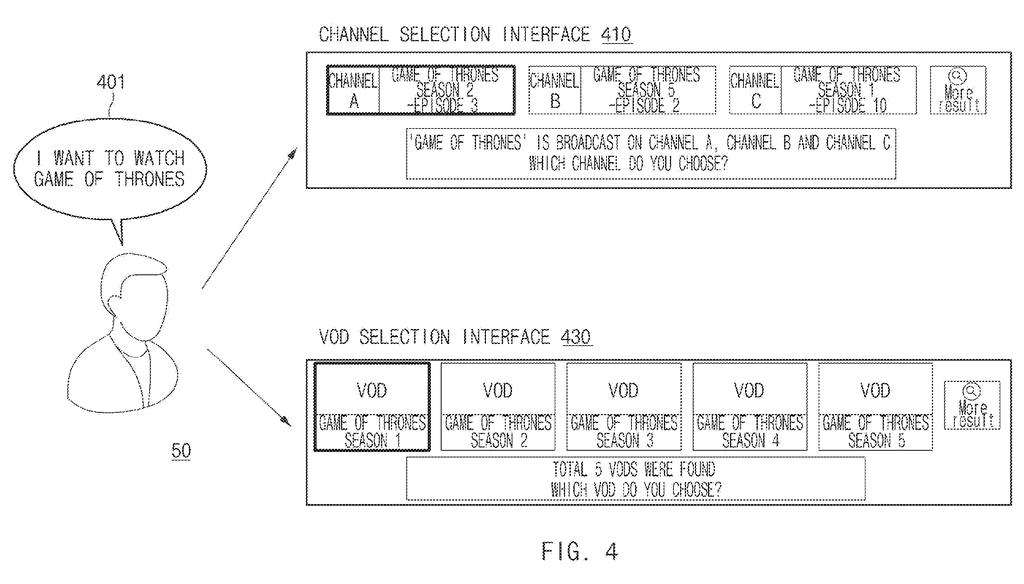
A person asks their TV to find a movie, just by speaking. The TV returns a screen full of results, but not all results are treated equally. Some titles appear immediately; others require an extra button press to even see. That split is exactly what this patent covers.
Samsung's system sends your voice query to a server, gets back a batch of matching content, then splits those results into two groups with different display "priorities." The higher-priority group fills the main screen. The lower-priority group is tucked behind a separate button or panel. You, the viewer, may never realize you're seeing a filtered view unless you go looking.
The patent does not spell out what separates a "first type" from a "second type" of content, which is the most important detail the filing leaves open. It could be free versus paid, partner content versus non-partner, or live versus on-demand. The architecture is built to enforce a hierarchy; the business logic that fills it in is not shown here.
… receive, through the communicator, a search result for a plurality of contents corresponding to the first user voice input from the at least one external server, wherein the plurality of contents includes at least one content of a first type and/or at least one content of a second type …
Translation: The TV gets back a mixed batch of search results containing different media categories from a remote server.
How the display device sorts and layers the two content types
At the hardware level, the device is a display with a voice input receiver, a network communicator, and a processor. When you speak a query, the processor ships that audio to an external server, which runs the actual search and returns a list of matching content files split into at least two categories.
The patent calls these "first type" and "second type" content. First-type content gets displayed in a fully rendered first UI (a main results screen with titles, artwork, and metadata). Second-type content does not appear alongside it. Instead, only an item (think: a button or a collapsed panel) appears, which the user has to activate to open a separate second UI showing those results.
The critical detail is the word priority. The claim explicitly states that first-type content carries a higher priority than second-type content. Priority is enforced at the display layer, not at the search layer. The server returns everything; the device decides what to show and what to bury.
The patent covers display devices broadly, which in Samsung's product line includes smart TVs and likely large-screen home displays. The communication circuit is designed to talk to at least one external server, suggesting the ranking rules could be set or updated server-side rather than baked permanently into the TV's firmware.
… at least one memory storing an application supporting a contents providing service and storing instructions, a communication circuit communicating with at least one external server supporting the contents providing service …
Translation: The television has built in memory and network hardware to talk to cloud servers that power media streaming services.
What this means for how TVs surface streaming vs. Paid content
Your TV's voice search already feels neutral, like a library catalog that just finds things. This patent formalizes a system where that neutrality is, at minimum, optional. If Samsung deploys this, the content you see first after speaking a query is the content someone has decided deserves to be seen first. The content behind that extra tap could be cheaper, more relevant, or simply from a partner who didn't pay for placement, the filing doesn't say, and that ambiguity is the real story.
For viewers, the practical effect is that voice search on a Samsung TV could consistently surface certain streaming services or content formats over others without making that preference visible. For content providers, this architecture creates a two-tier system where ranking in search results depends on something other than relevance to your actual query.
Samsung's 1320th filing in our Samsung coverage since May adds to a run that includes a TV recap tool and a dual-task camera chip.
The engineering choice here splits search results into a visible layer and a hidden secondary layer, and that split costs viewer trust. A single honest list is harder to monetize but easier to believe. Two layers give Samsung a dial to turn, and nothing in this document says who controls it or why.
The definitions of "first type" and "second type" content are left completely open, which is almost certainly deliberate. That flexibility can serve viewers well (free content up front, paid content one tap deeper) or serve partners instead (favored content up front, everything else buried). The patent supports both outcomes equally.
The trade only reads as worth it if viewers can see some signal about why results are ranked the way they are. A label like "Sponsored" would rebalance things. This document contains no such label, and no suggestion one is planned.
There are more where this came from
We read every patent application Big Tech publishes and send you the ones worth knowing. Plain English, free, every week.
The drawings
8 drawing sheets from US 2026/0292304 A1 · click any drawing to enlarge


Want this weekly breakdown for a company we don't cover? Patentlyze Pro →
Be the first to weigh in