
Google Files Patent to Cut the Computing Cost of AI-Generated Speech and Audio
Google's filing breaks AI sound generation into two jobs: a big model sketches each tiny slice of time, and a much smaller one fills in the details. In the company's own test, that made the process at least twice as fast as older methods of its kind.
What Google's two-level audio generator does
Every time an AI model talks back to you, it builds the sound one tiny slice at a time, often just a fraction of a second long. Each slice holds a whole stack of pieces: a rough version of the sound, then finer corrections, and sometimes matching text or meaning on top. Tracking all of that is expensive.
Google's new patent application splits the work in two. A big model plans each slice with a single summary token, one stand-in for everything inside it. Then a much smaller model fills in the individual pieces, looking only at the slice it's working on instead of everything that came before.
Picture an editor outlining a chapter while an assistant writes the sentences. In the filing's example test on speech, that setup made fewer transcription errors than rival methods and ran at least twice as fast as older approaches of its kind, with similar audio quality.
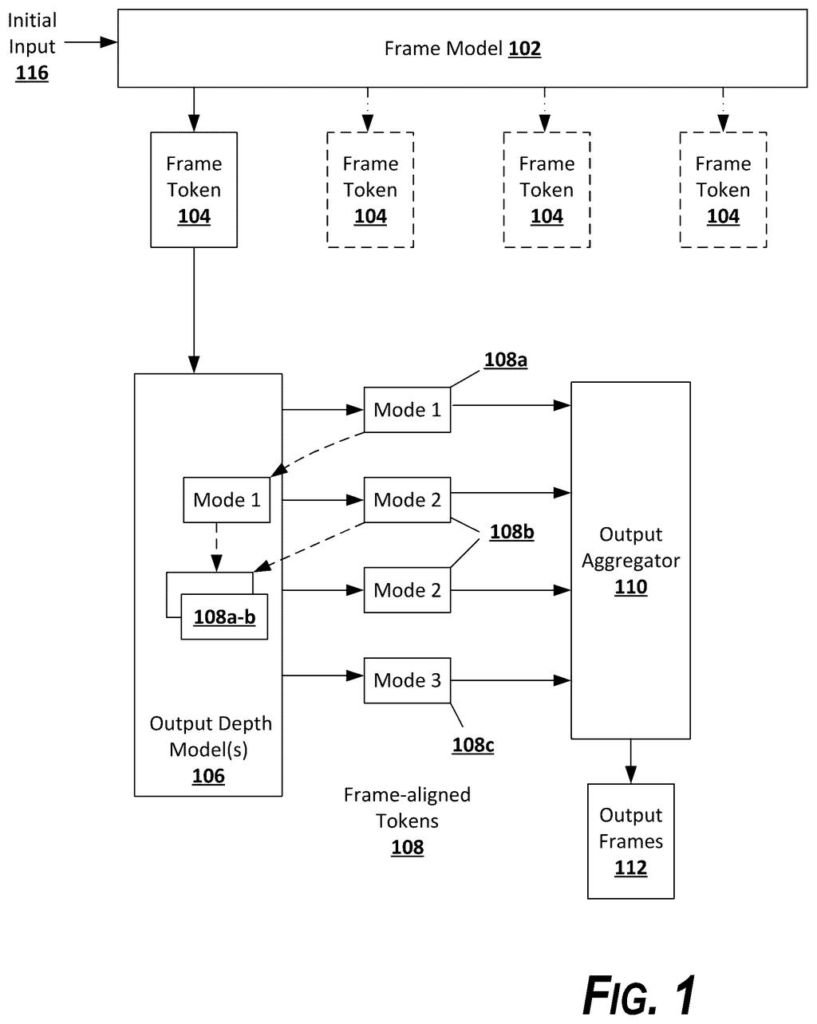
A first machine-learned model (a “frame model”) can generate a frame token representative of an entire frame (e.g. a time frame), and one or more additional models (“depth models”) can generate individual tokens associated with the frame based on the frame token.
Translation: A primary AI model handles broad time blocks while secondary models fill in the detailed audio data.
How the big and small models split each slice
The system works in two levels. A large frame model produces one frame token (a single stand-in chunk of data) for each slice of the output, such as a tenth of a second of audio.
Smaller depth models then use that token to produce the individual tokens inside the slice. The claims call for tokens of two different modes (kinds of data, like audio or text), with at least one in residual vector quantization form. That format builds a value in layers: to approximate 3.71386, one token says 4.0, the next adds a correction of -0.3, the next 0.01.
Where the savings come from:
- The frame model only tracks one token per slice.
- Depth models ignore earlier slices and clear their memory for each new one.
- Depth models can be 5 to 100 times smaller than the frame model.
- Later, less important tokens can come from faster methods such as discrete diffusion (refining many tokens at once).
An output aggregator adds the layers into the finished frame, and an input depth model folds the finished tokens back into one token so the frame model can plan the next slice.
What cheaper audio generation means for you
If you use AI voices, music tools or audio features, the practical effect would be speed and cost. Generating sound this way is expensive because every tiny slice carries many layers of data, and older methods compare each new piece against everything before it. Google's filing reports lower transcription errors and similar audio quality in its example test, while running at least twice as fast as earlier step-by-step methods. Cheaper generation also means less electricity, which the filing itself highlights.
The design is also flexible. The same two-level setup could handle audio, text, images or meaning tokens within one slice, and engineers can pick the size of the helper models to trade quality against cost. The filing's only test covers speech, so other uses remain possibilities on paper.
That makes this Google's 33rd filing we've tracked since May in our AI teams working together watchlist, which already includes their photo-piece specialist router and satellite map answer system.
The shortest path to a product here needs no new hardware, only software and a fresh training run. The filing's test used a 12-layer main model, a 2-layer helper and an existing audio format called SoundStream, so the pieces are already real.
What has to exist first is a trained model and a way to chop sound into tokens. A team with a working speech or music generator would retrain it with this two-level layout, which costs time and computing but leaves the rest of the product alone.
The catch is evidence. The one test covers speech rebuilt from meaning tokens, so video, text and images stay on paper. Still, a speed-up of at least twice in the filing's own test is a short trip from lab to feature.
Get our take in your Top Stories
Liked this breakdown? Add Patentlyze as a preferred source on Google, and our plain-English take shows up more often in your Top Stories the next time Google patent news breaks.
There are more where this came from
We read every patent application Big Tech publishes and send you the ones worth knowing. Plain English, free, every week.
The drawings
16 drawing sheets from US 2026/0340354 A1 · click any drawing to enlarge


Show the other 8 sheets


Want this weekly breakdown for a company we don't cover? Patentlyze Pro →
Be the first to weigh in