
Google Files Patent for Car Screens That Adapt to Weather, Battery and Crashes
Google's new filing teaches a car's software to read the situation: in the cold it can shut off screens to save battery, and after a crash it lights them all up with a panic button.
What Google's context-aware car mode actually does
Imagine you're driving an electric car on a freezing night with the battery running low. The back-seat screens are playing video, and the cold is already shrinking your range. Most car software follows fixed safety rules that don't care about any of that.
Google's filing describes a car operating system that checks the situation first: who is in the car, what the weather is like, how much battery is left, and whether there has been a crash. Then it switches into a protected mode that changes what the screens and speakers do. In the cold, it could switch off entertainment screens to stretch the battery so you reach your destination.
After a crash, it goes the other way. Every screen could light up with a panic button that calls for help, and if the driver can't act, passengers could take over the audio controls to phone emergency services.
… entering, by the instance of the vehicle operating system, and based on the operating context, a protected operating mode in which the vehicle operating system dynamically adapts one or more operational features of the vehicle operating system to facilitate safety of an operator of the vehicle.
Translation: The car software switches to a safe mode to protect the driver based on what is happening around it.
How the car decides when to go protected
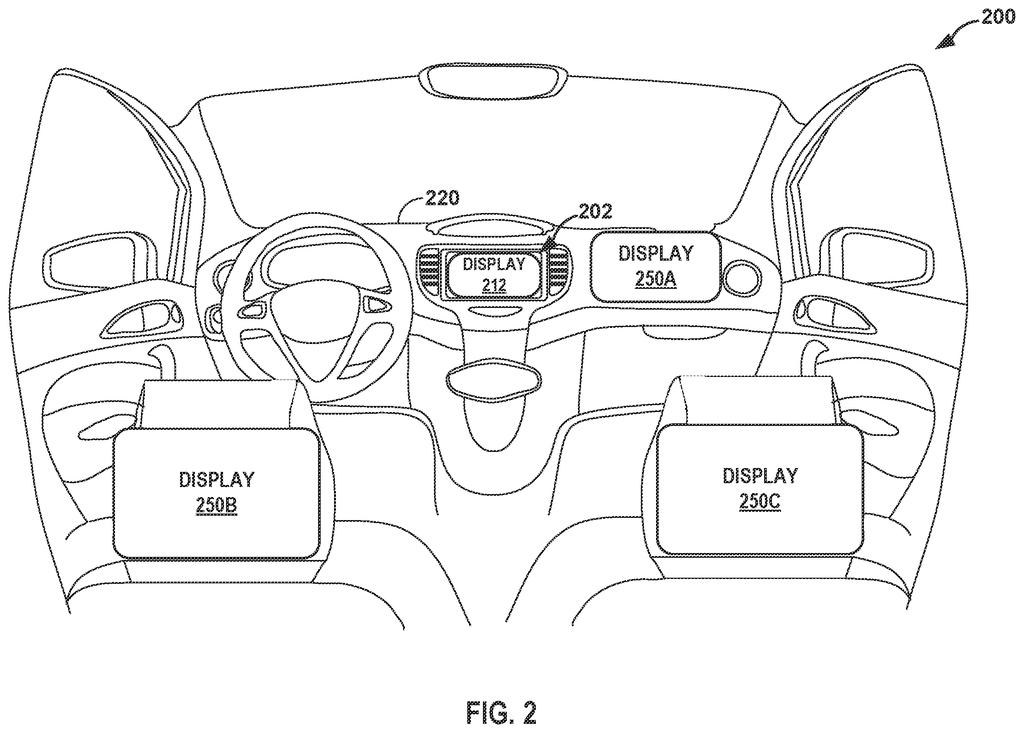
The filing covers software that runs on a car's head unit (the dashboard computer that handles music, maps, calls and climate controls). The software first works out the car's operating context, meaning its current situation, using whatever sensors the car has: speed, GPS, seat sensors that detect weight, cameras, microphones, weather and temperature sensors, and tire pressure.
Based on that context, it enters a protected operating mode and adjusts its own features. The description gives several examples:
- In very cold weather with low battery, it can switch off or limit screens, or run apps in dark mode, to save power.
- After a crash or flat tire, it turns on every screen, shows a panic button that calls emergency services, and silences audio.
- If the driver is incapacitated, passengers can take over audio control to make an emergency call.
- When the car is crossing into oncoming traffic to pass, it lowers the volume.
It can also relax the usual driving lockout. If the car is moving, a seat sensor shows a front passenger, and a physical button out of the driver's reach is pressed, that passenger can use the main screen. If the button is already on at startup, the system assumes it is broken and ignores it.
What this means for battery range and crash response
Electric car owners know cold weather eats into range. A system that trims screen power when the battery is low and the weather is harsh could help you reach a charger instead of getting stranded, which is the scenario the filing itself describes. The crash mode matters too: every screen becomes a way to call for help, and passengers can act if the driver can't.
For carmakers, it offers a way to swap hard-coded distraction rules for ones that respond to the situation. The description refers to Android, and the filing shares a starting point with a companion application about letting several people use one in-car system at once. The examiner's first review rejected the claims as filed, which is routine at this stage and usually followed by amendments.
That makes this Google's 978th filing in our Google coverage since May, a corpus that spans ideas like rule-based car keys and step-by-step route grading.
Most of this could ship as a software update. The sensors it reads (speed, seat occupancy, outside temperature, tire pressure) already sit in many modern cars, so the main work is writing the rules and testing them.
The hard part is trust. Loosening a driver-distraction lockout is a decision carmakers will want to make themselves, and the filing's own fix, a physical button out of the driver's reach, means new hardware on the door panel. The crash-time panic button and cabin-wide screens are the easiest piece to picture in a real car.
The main claim is wide: adapt features for safety based on context. That breadth explains why the examiner pushed back, and narrowing is likely. The cold-weather battery idea is concrete and useful, and it needs the least new equipment to build.
Get our take in your Top Stories
Liked this breakdown? Add Patentlyze as a preferred source on Google, and our plain-English take shows up more often in your Top Stories the next time Google patent news breaks.
There are more where this came from
We read every patent application Big Tech publishes and send you the ones worth knowing. Plain English, free, every week.
The drawings
7 drawing sheets from US 2026/0336408 A1 · click any drawing to enlarge


Want this weekly breakdown for a company we don't cover? Patentlyze Pro →
Be the first to weigh in