
Waymo Files Patent for Predicting Where a Car Will Turn From Its Front Wheels
A car's front wheels turn before the car does. Waymo's patent application describes teaching a self-driving car to read that angle and guess where another vehicle is headed before it moves.
What Waymo's wheel-reading patent actually does
Imagine you're driving past a row of parked cars, and one driver has already cranked the steering wheel to pull out. The car hasn't moved an inch. A system that only watches motion would assume it's staying put, but a sharp-eyed human would spot the angled front tire and ease off.
Waymo's patent describes giving a self-driving car that same instinct. The car keeps a cheat sheet of where wheels usually sit on cars, buses and bicycles of different sizes. It uses the size of the outline it has drawn around another vehicle to guess where a front wheel should be, then measures how that wheel is tilted.
From that tilt, the car can estimate where the other vehicle is about to go, and decide whether to slow down, speed up or change lanes.
… identifying, by the one or more processors from the stored data, based on the representation of dimensions, an area that is likely to correspond towhere a wheel of the particular type of the road user; predicting, by the one or more processors, a trajectory or heading of the road user based, in part, on the identified area …
Translation: The computer figures out where the vehicle's wheels should be to guess where it is going.
How the car finds and measures a wheel
The system starts with what a self-driving car's sensors already produce: a bounding box (a 3D outline drawn around another road user) and the cloud of laser points (distance readings bounced off surfaces) that fall inside and just outside it. The claims cover road users such as a passenger car, a bus or a bicycle.
Next, the car looks up stored data, such as a table or database, that links box sizes and vehicle types to where wheels usually sit. In the description's example, a box 8 feet by 5 feet puts the wheel 2 feet 4 inches back from the front corner. That gives the car a small search area, described as a disc or cylinder (for a small car, roughly 12 inches in radius and 7 inches thick).
The description then walks through the measurement:
- Fit the laser points inside that area to a flat plane, an average of the surface they hit.
- Compare that plane with the plane of the box's side.
- Treat the angle between them as the wheel orientation.
Combined with the vehicle's speed, that angle indicates how sharply its path will curve. The filing also describes using how reflective the wheel is (a black tire returns weak laser signals), camera images, or a machine-learning model trained on hand-labeled wheel points.
Based on dimensions of the bounding box, an area corresponding to a wheel of the object may be identified. An orientation of the wheel may then be estimated based on the sensor data points having locations within the area.
Translation: Sensor data helps the system locate the wheels and check which way they are pointed.
Why a parked car's wheels give it away
The practical payoff is lead time. The description points to cases where motion history says little: a car about to pull out of a parking spot, or a stopped car in the next lane whose driver suddenly wants your lane. In its example, a wheel angle of around 15 degrees flags a vehicle likely to enter your lane within about a second, early enough for the car to slow, speed up or change lanes.
The filing is also frank about limits. The estimate improves when the other vehicle is close and its wheel faces the sensors head-on. This filing is the latest in a chain of continuations reaching back to 2017, which fits Waymo's track record in perception patents. It describes a refinement to how a self-driving car reads other road users, not a new kind of car.
One more thing to know: the patent examiner has already issued a final rejection on this application. Waymo can still amend the claims or appeal, and nothing described here has been approved yet.
Google's 66th filing we've tracked since May in our robotaxi sensing watchlist builds on earlier applications like two-radar heading detection and turn signal vs. movement checks
Every shortcut costs something, and this one costs certainty. A wheel is a small target, and the filing admits the estimate gets better only when the other vehicle is close and its wheel faces the sensors head-on. A thin bicycle tire, or a car seen from far away at a shallow angle, gives the system few laser points to work with.
The lookup table adds a second cost. It assumes a vehicle of a given size keeps its wheels in a standard place, so an oddly built vehicle could throw the guess off.
The trade still reads as worth it. The wheel reading is an extra clue that raises or lowers confidence in paths the car already expects, so a weak reading does limited damage. For the price of a table and a quick calculation, the car gets a hint it would otherwise lack when a parked car is about to pull out.
Get our take in your Top Stories
Liked this breakdown? Add Patentlyze as a preferred source on Google, and our plain-English take shows up more often in your Top Stories the next time Google patent news breaks.
There are more where this came from
We read every patent application Big Tech publishes and send you the ones worth knowing. Plain English, free, every week.
The drawings
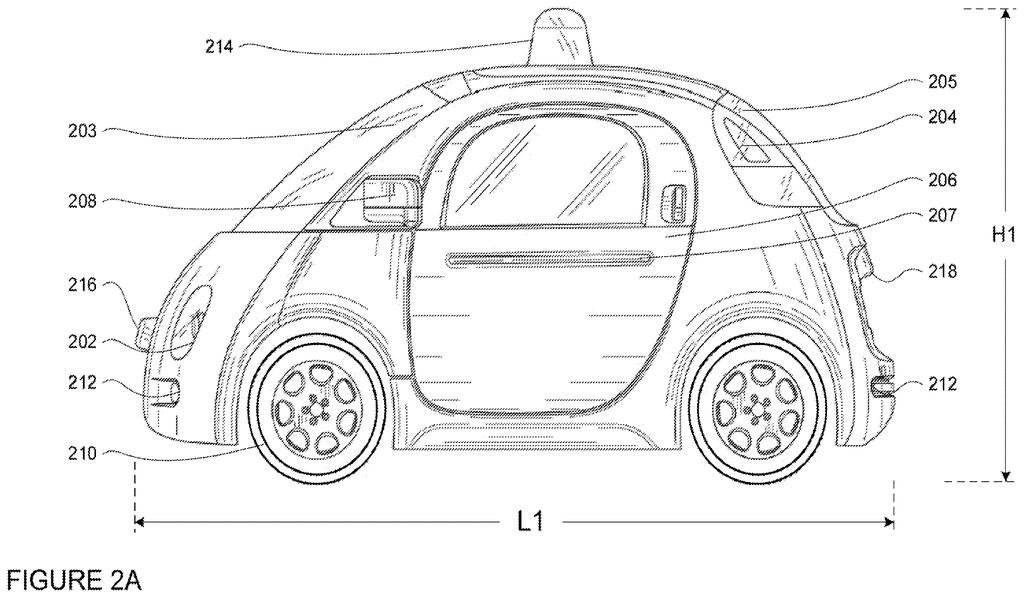
11 drawing sheets from US 2026/0307683 A1 · click any drawing to enlarge


Show the other 3 sheets


Want this weekly breakdown for a company we don't cover? Patentlyze Pro →
Be the first to weigh in