
AR Headset Sensors Auto-Calibrate While Charging
Your AR headset's motion sensors drift over time — and most devices never fix that. Google's new patent describes a system that quietly recalibrates everything while the headset sits on its charger.
What Google's idle-time IMU calibration actually does
Imagine your AR headset gradually developing a slight lean — objects that should appear anchored in space start drifting because the motion sensor inside has gone a little out of tune. It's not a dramatic failure, just the kind of slow degradation that happens as hardware ages and temperatures shift.
Google's patent describes a fix that runs without you doing anything. While you wear the headset, it quietly stores snapshots of motion data and camera images. When you plug it in and set it down, the device detects it's idle — either because it's charging or because it's been perfectly still for a while — and uses that downtime to run a math-heavy optimization routine that fine-tunes how the sensors talk to each other.
The next time you put it on, the headset is working with a fresher, more accurate set of calibration values. No factory reset, no recalibration app, no manual steps. It just gets better in the background.
How the optimizer re-tunes sensors between sessions
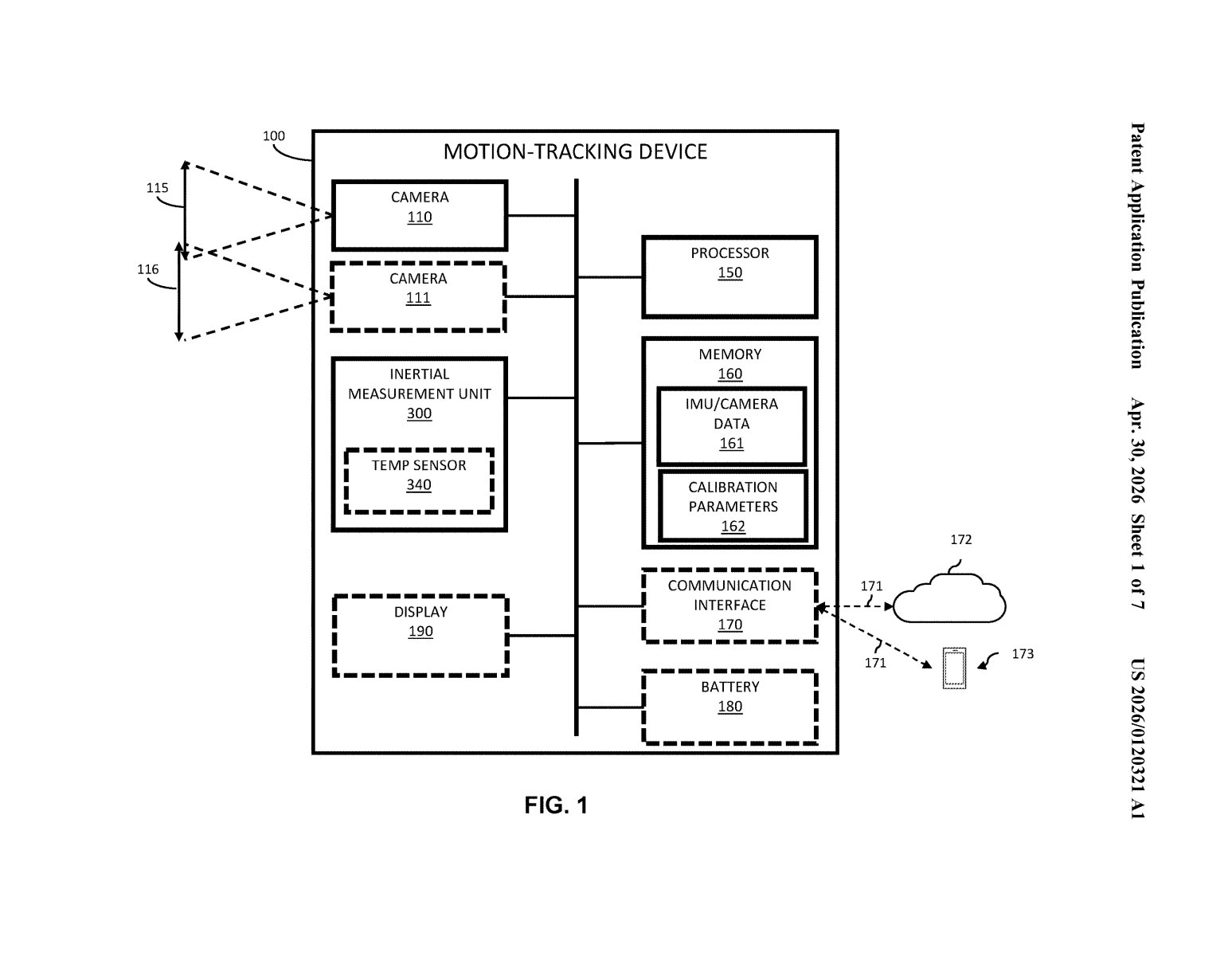
The system centers on an Inertial Measurement Unit (IMU) — the chip that tracks acceleration and rotation — paired with one or more cameras. Both are used together for visual-inertial odometry (the technique of combining camera frames and motion readings to figure out where your head is in 3D space). The problem is that the IMU and camera each accumulate small errors, and the spatial relationship between them can shift slightly over time.
While the headset is in active use, the system continuously logs motion data and camera images to an on-device database, tagged with timestamps. When the headset goes idle — detected via charging status, camera stillness, or flat IMU readings — it pulls that stored data back out and runs an optimization process.
The optimization is a bundle adjustment using a least-squares minimization (essentially: keep tweaking the calibration values until the pose estimated from IMU readings matches the pose estimated from camera images as closely as possible). The parameters it tunes include:
- IMU intrinsics: bias, misalignment, and scale for each gyroscope and accelerometer axis
- Camera intrinsics: focal length, principal point, and lens distortion
- Extrinsics: the precise spatial transform between where the IMU sits and where the camera sits on the device
The resulting calibration set is saved and loaded automatically when the headset wakes back up.
What this means for long-term AR headset accuracy
Motion-tracked AR lives or dies on sensor accuracy. A miscalibrated IMU causes drift — virtual objects that slowly swim or jitter instead of staying locked in space — which is one of the most disorienting experiences in spatial computing. Traditionally, fixing this requires either a manual recalibration procedure or a trip back to the factory. Google's approach makes calibration an ongoing, invisible maintenance task, which is especially valuable as headsets age past their first year of use.
For Google's AR ambitions — whether that's a future consumer headset or enterprise devices — this kind of background housekeeping is exactly what separates a device that stays reliable at month 18 from one that quietly degrades. If this ships in real hardware, you'd likely never notice it working, which is precisely the point.
This is quiet, unglamorous engineering that solves a real problem with AR hardware. The math isn't new — bundle adjustment and IMU calibration are well-understood — but packaging it as an automated idle-time process that runs without user intervention is a smart productization move. It's the kind of detail that separates a polished consumer product from a dev kit.
There are more where this came from
We read every patent application Big Tech publishes and send you the ones worth knowing. Plain English, free, every week.
Want this weekly breakdown for a company we don't cover? Patentlyze Pro →