
Adobe Patents a Neural Material Encoding System for Lightweight 3D Assets
Adobe wants to let you take a richly detailed 3D object — complex curves, intricate surface materials — and compress its visual fidelity into a lightweight package that runs comfortably on a phone or in a browser tab.
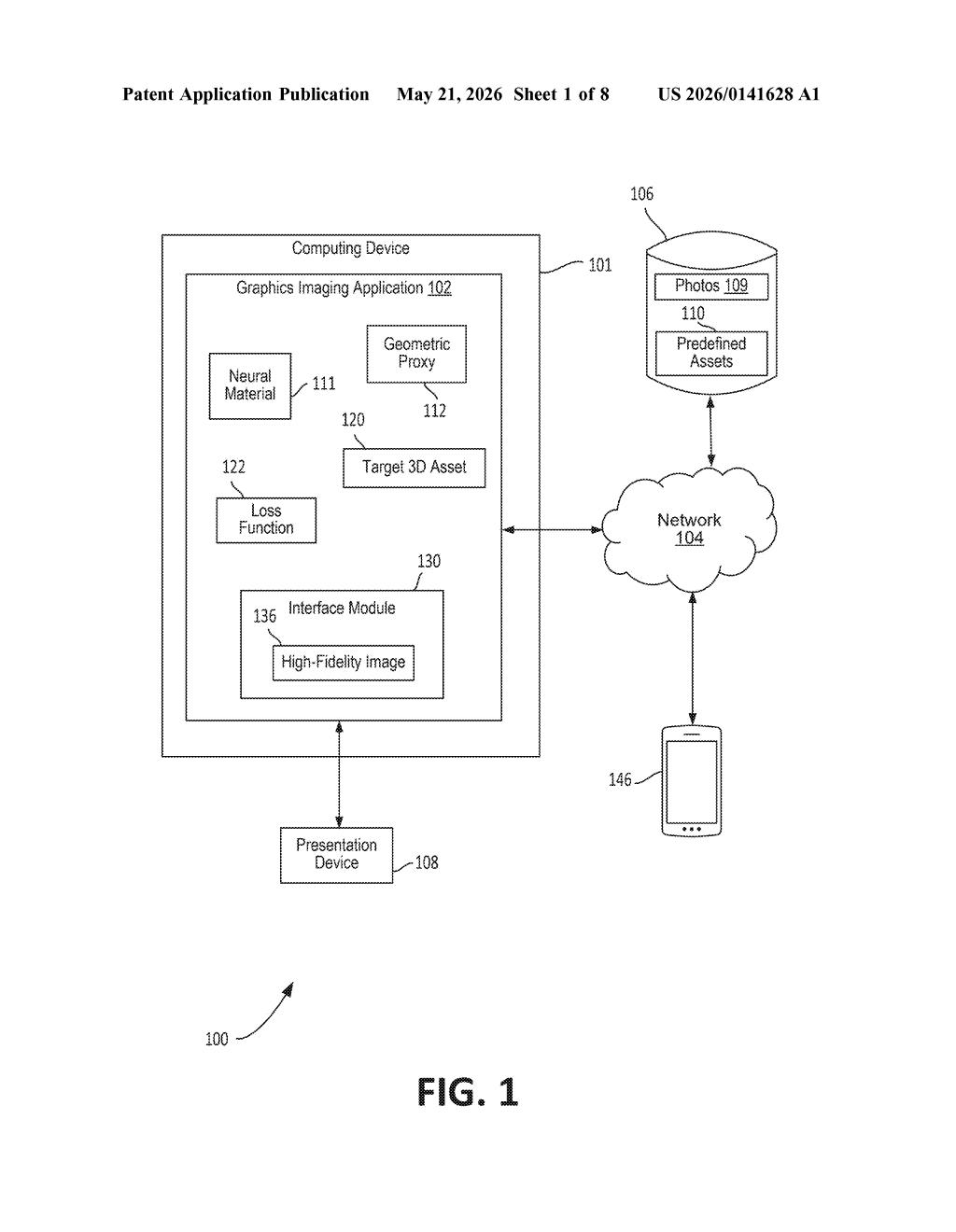
What Adobe's neural material baking actually does
Imagine you've built a stunning 3D model of a ceramic vase in a professional design tool — every tiny glaze reflection, every subtle curve captured in detail. The problem is that showing that vase on a website or a mobile app usually means stripping most of that detail away, because phones and browsers just don't have the computing power to handle it.
Adobe's patent describes a system that sidesteps this tradeoff. Instead of sending the full, heavy 3D geometry to the device, it trains a small AI network — called a neural material — to memorize how that specific object looks under different lighting and camera angles. That trained network then gets attached to a simplified stand-in shape (a "coarse geometric proxy") that's cheap to render.
The result is a 3D asset that looks nearly as good as the original but is far cheaper to display. Because the neural material is locked to a specific shape, the output is predictable and reproducible — which matters a lot when you're shipping assets to thousands of different devices.
How the neural material trains against a loss function
The system starts by sampling a wide range of lighting and camera directions around a target 3D asset. These samples become training data for a compact neural network — the neural material — which learns to predict how the asset's surface should look from any given viewpoint under any given light.
Training uses a loss function (a mathematical score that measures how far off the neural material's output is from the real rendered asset). The network's weights are iteratively adjusted to minimize this score, which is a standard supervised-learning loop applied to a rendering problem.
The clever part is what happens after training. Instead of deploying the full complex mesh, the trained neural material is applied to a coarse geometric proxy — a low-polygon stand-in for the original shape. Position features from the original high-detail asset are baked in, so the neural material knows where on the surface it is and can reproduce fine local detail even on the simplified mesh.
The method also handles irregular or curved surfaces explicitly during training data generation, which matters because flat-surface assumptions break down on organic shapes. The final encoded asset is compact, transferable, and deterministic — meaning it renders the same way every time, which is a practical requirement for production pipelines.
What this means for 3D on the web and mobile apps
The web and mobile 3D space has long been stuck in a quality-versus-performance tradeoff. Tools like WebGL and WebGPU have improved a lot, but complex material rendering on budget hardware still forces designers to make painful compromises. Adobe's approach — baking visual fidelity into a neural network rather than the geometry itself — could let platforms like Adobe Substance or Creative Cloud serve photorealistic 3D previews in contexts where that was previously impractical.
For e-commerce, AR try-ons, and interactive product configurators, this is a real pain point. If this technique makes it into Adobe's creative tools, designers could export high-quality 3D assets for web or mobile without manually creating separate low-poly versions. That's time saved and quality preserved — a combination that tends to actually ship.
This is a genuinely interesting piece of applied ML research with a clear commercial target. Adobe isn't filing this for fun — the company has a direct stake in making 3D content easier to deploy through its Substance and Creative Cloud ecosystem. The neural material approach isn't brand new as a research concept, but packaging it as a reproducible, transferable asset encoding pipeline is a practical step toward productization.
Get our take in your Top Stories
Liked this breakdown? Add Patentlyze as a preferred source on Google, and our plain-English take shows up more often in your Top Stories the next time Adobe patent news breaks.
There are more where this came from
We read every patent application Big Tech publishes and send you the ones worth knowing. Plain English, free, every week.
Want this weekly breakdown for a company we don't cover? Patentlyze Pro →