
Adobe Patents a Distillation Trick to Speed Up AI Image Generation
Diffusion models make beautiful images, but they're slow — they have to reverse a noisy process dozens of times per generation. Adobe's new patent tries to shortcut that bottleneck by teaching a separate encoder to predict where the diffusion process is headed, without actually running all the steps.
What Adobe's latent-code shortcut actually does
Imagine trying to find a hidden object in a room by searching every corner methodically. Now imagine someone handed you a cheat sheet that said, "It's probably near the window." You'd still look around, but you'd start in the right place and finish much faster. That's roughly what Adobe is doing here.
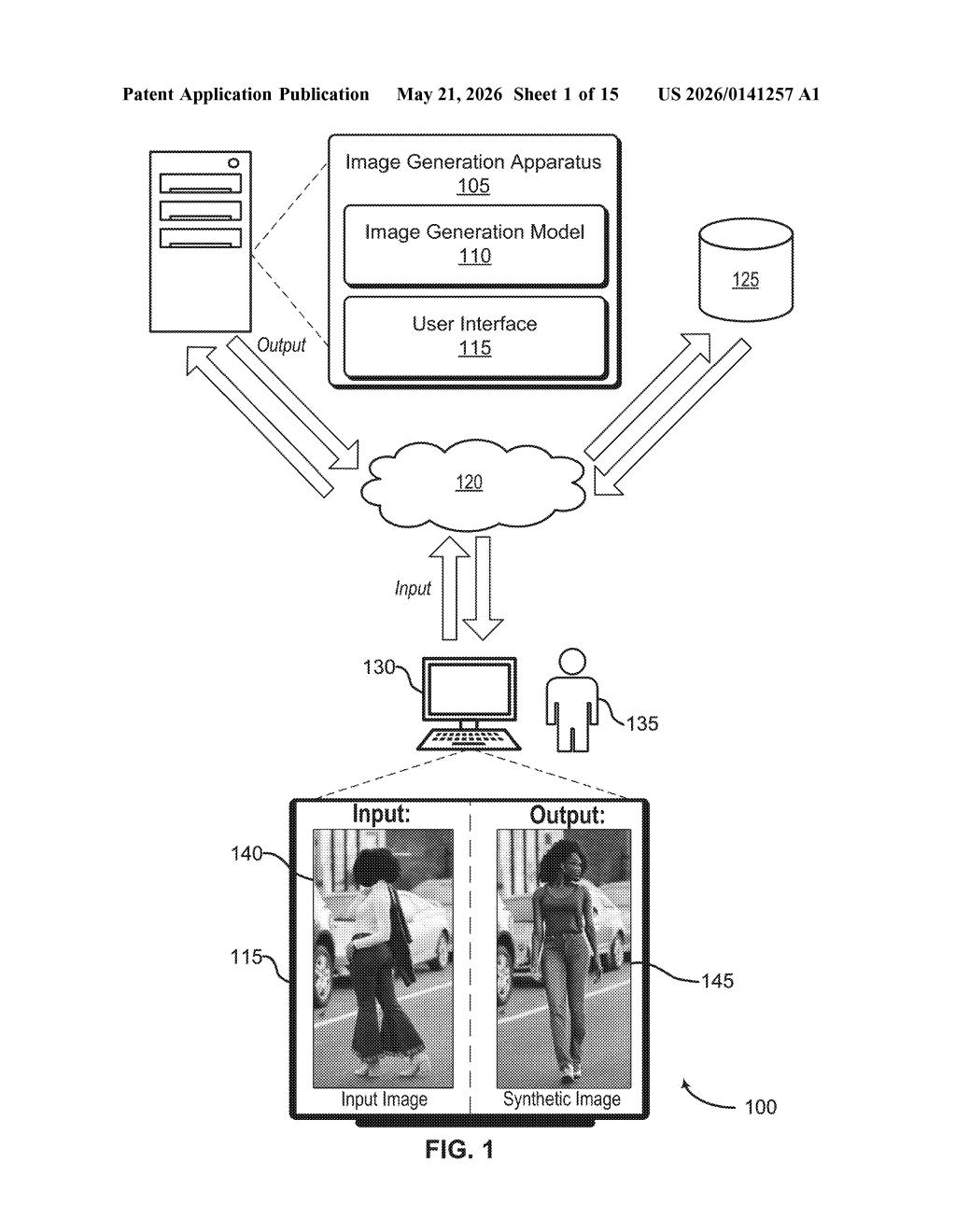
AI image generators like Stable Diffusion work by starting with random noise and slowly cleaning it up, step by step, to produce a picture. The problem is that each of those steps takes real computing time. Adobe's patent describes training a separate neural network — called an image encoder — that looks at an input image and immediately estimates the best starting point for that noisy reverse process.
The encoder is trained using a technique called distillation, where it learns to mimic the output of the full, expensive diffusion process without having to run it. The result is a model that can generate or reconstruct images more quickly, which matters a lot if you're editing images in real time inside a product like Photoshop.
How the encoder learns to predict the mean latent code
Diffusion models operate in a latent space — a compressed mathematical representation of images. When generating an image, the model samples a random point from a probability distribution in that latent space, then iteratively denoises it. The distribution isn't a single point; it's a bell curve, characterized by a mean code (the center) and variance (the spread).
Adobe's method trains an image encoder to directly predict that mean code given an input image. Instead of running the full forward and reverse diffusion passes to figure out where in latent space an image lives, the encoder learns to jump straight to the center of that distribution in one pass.
The training process uses a distillation loss — a measure of how far the encoder's predicted mean code is from the "true" mean code computed by the full diffusion model. By minimizing this loss during training, the encoder gets better and better at approximating the expensive computation cheaply.
Practically, this means:
- The encoder acts as a fast initialization step, placing the sampling process in a good neighborhood of latent space before any denoising begins.
- Fewer reverse diffusion steps may be needed because you're starting closer to the target.
- The approach applies to image-conditioned tasks like style transfer, inpainting, or image editing — not just text-to-image generation.
What this means for real-time AI image editing tools
Diffusion model speed has been a persistent bottleneck for Adobe's AI tools. Products like Firefly and the generative fill features in Photoshop and Express need to return results in seconds, not minutes. Any architectural trick that reduces the number of denoising steps — or makes each step more informed — translates directly to a snappier user experience for you as a designer or editor.
This patent is also notable because it frames the encoder as a learned prior — essentially compressing domain knowledge about real images into a fast lookup. That's a meaningful shift away from purely random sampling, and it aligns with a broader industry trend of making diffusion models more deterministic and controllable for professional creative workflows.
This is solid, focused engineering work rather than a conceptual leap — Adobe is solving a real latency problem that affects every diffusion-based product it ships. The distillation approach is well-established in ML, but applying it specifically to latent-space mean prediction in diffusion pipelines is a practical and publishable contribution. If this lands in Firefly's inference stack, users will feel it even if they never know why.
Get our take in your Top Stories
Liked this breakdown? Add Patentlyze as a preferred source on Google, and our plain-English take shows up more often in your Top Stories the next time Adobe patent news breaks.
There are more where this came from
We read every patent application Big Tech publishes and send you the ones worth knowing. Plain English, free, every week.
Want this weekly breakdown for a company we don't cover? Patentlyze Pro →