
Sony Files Patent for Needle-Free Glucose Readings That Account for Body Water
Sony has filed for a blood sugar reader that sends faint microwaves into your skin, then corrects the result for how much water is in the tissue. Water is a known weak spot for today's needle-free sensors, and this filing targets it head on.
What Sony's glucose-sensing patent actually does
Ever notice how your wrist feels different after a workout, damp and warm? That extra water is a real headache for any device trying to read blood sugar without a needle. Sony's filing starts from that problem: it says today's needle-free sensors lose accuracy depending on how much water is in or on the body, sweat included.
Sony's fix is to measure two things at once. A sensor sends faint microwaves into your skin and listens to what comes back. One part of the reading points to your glucose level. Another part tells the device how much water is in the tissue. The device then nudges the sugar estimate up or down to account for that water, using a lookup table prepared ahead of time.
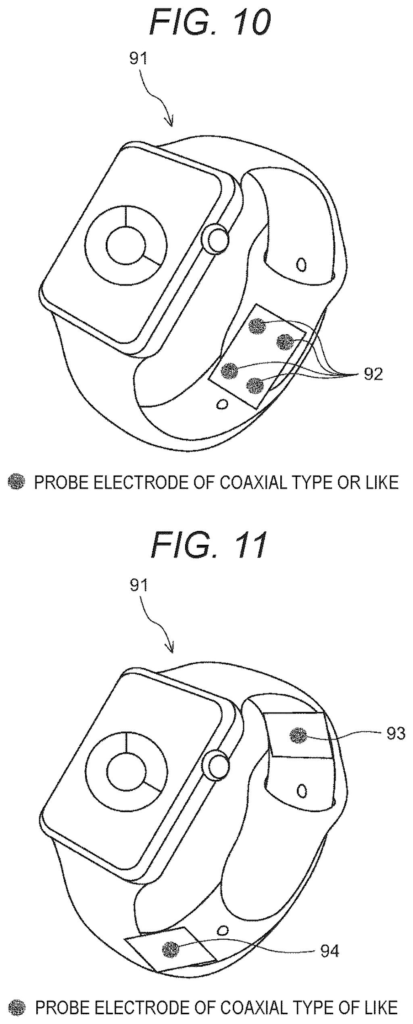
The filing pictures the sensor contacts on the inside of a smartwatch band, with the electronics packed into a single chip.
… calculates a glucose concentration in a measurement target, on a basis of a complex dielectric constant of the measurement target and a moisture content of the measurement target.
Translation: It figures out your blood sugar using electrical properties and body water levels.
How the sensor reads sugar through body water
The core claim covers a processor that works out glucose concentration from two inputs: the complex dielectric constant of the tissue and its moisture content. The dielectric constant describes how a material responds to an electromagnetic wave. It has two parts, and the "imaginary" part (the one tied to energy the tissue absorbs) shifts with glucose, so the dependent claims lean on it.
The description walks through the steps:
- A probe sends an electromagnetic wave into the skin (the filing gives 1 to 9 GHz as an example) and picks up the wave that bounces back, and in some versions the wave that passes through.
- Circuits convert the signals to digital, run a Fourier transform (math that splits a signal into its frequency ingredients), and calculate S parameters (numbers describing how much the wave changed in strength and timing).
- From those numbers, one path extracts the imaginary part for glucose. Another computes the overall size of the dielectric constant and converts it to a moisture level with a calibration curve.
- A correction table then adjusts the glucose estimate for the actual moisture level.
A second independent claim covers just the front end: a radio circuit, an analog-to-digital converter, the Fourier transform and the S-parameter calculation, which can all sit on one chip. The description adds a timing circuit design that cancels its own noise while drawing little power. It also describes electrodes laid flat or placed facing each other, and says the approach could measure substances other than glucose.
The moisture content can be calculated on the basis of an incident signal as an electromagnetic wave that has entered the measurement target, and a reflected signal reflected from the measurement target with respect to the incident signal.
Translation: It measures how much water is in your body by bouncing radio waves off your skin.
What this means for glucose tracking on your wrist
Anyone who manages diabetes knows the routine of pricking a finger. Reading blood sugar through the skin has long been an attractive idea, and Sony's filing goes after a known weak spot: sensors lose accuracy depending on how much water is in or on the body, sweat included. Correcting for water directly is a sensible target.
The filing shows a smartwatch band with sensor contacts on the inner surface, but it gives no accuracy numbers or test results, so it reads as an engineering plan, and no product is named. The single-chip design and low-power timing circuit would matter for anything running on a watch battery.
Sony's 12th filing we've tracked in our body-reading wearables watchlist since July builds on ideas like brain-wave headphones and flagging bad heart readings.
Every fix has a price, and here it is extra hardware. To correct for body water, the device has to take a second reading and run more math on top of the sugar reading, all on a watch with a tiny battery. The filing does offer one way to cut that cost: put the radio, converter and math circuits on a single chip with a low-power timing circuit.
The bigger risk is the correction table. It is prepared in advance, so it assumes your body responds the way the table expects. Skin differs between people and changes through the day, and the filing shows no test results or accuracy figures to say how well the table holds up.
Still, the trade looks worth making. Water is the problem the filing itself names, and tackling it directly beats hoping it averages out.
Get our take in your Top Stories
Liked this breakdown? Add Patentlyze as a preferred source on Google, and our plain-English take shows up more often in your Top Stories the next time Sony patent news breaks.
There are more where this came from
We read every patent application Big Tech publishes and send you the ones worth knowing. Plain English, free, every week.
The drawings
11 drawing sheets from US 2026/0334821 A1 · click any drawing to enlarge


Show the other 3 sheets


Want this weekly breakdown for a company we don't cover? Patentlyze Pro →
Be the first to weigh in