
Samsung Files Patent for a Health Sensor That Focuses Light Without Curved Glass
Samsung's filing describes a health sensor whose lenses and filters are flat surfaces covered in microscopic pillars, built to ignore the glare off your skin.
What Samsung's infrared health sensor does
Ever pressed a fingertip on a sensor and had it tell you to try again? One reason a light-based reading goes bad is glare: a lot of the light bounces straight off the surface of your skin and never goes inside you.
Samsung's patent application describes a health sensor that shines infrared light (the invisible, heat-type light) at your skin and catches what comes back. The twist is two ultra-thin, flat lens-like layers, one in front of the light and one in front of the detector. They shape the light going out and filter the light coming in, so the surface reflection gets thrown away and the light that actually traveled through your tissue gets counted.
The filing says the sensor could sit in a watch, an earbud, smart glasses, or even a phone you press a thumb against.
… the infrared transmitter comprising a light source and a first metasurface, the infrared transmitter being configured to transmit light, from the light source, through the first metasurface …
Translation: The transmitter uses a flat optical surface instead of a curved lens to send out infrared light.
How the tiny lenses cut glare off your skin
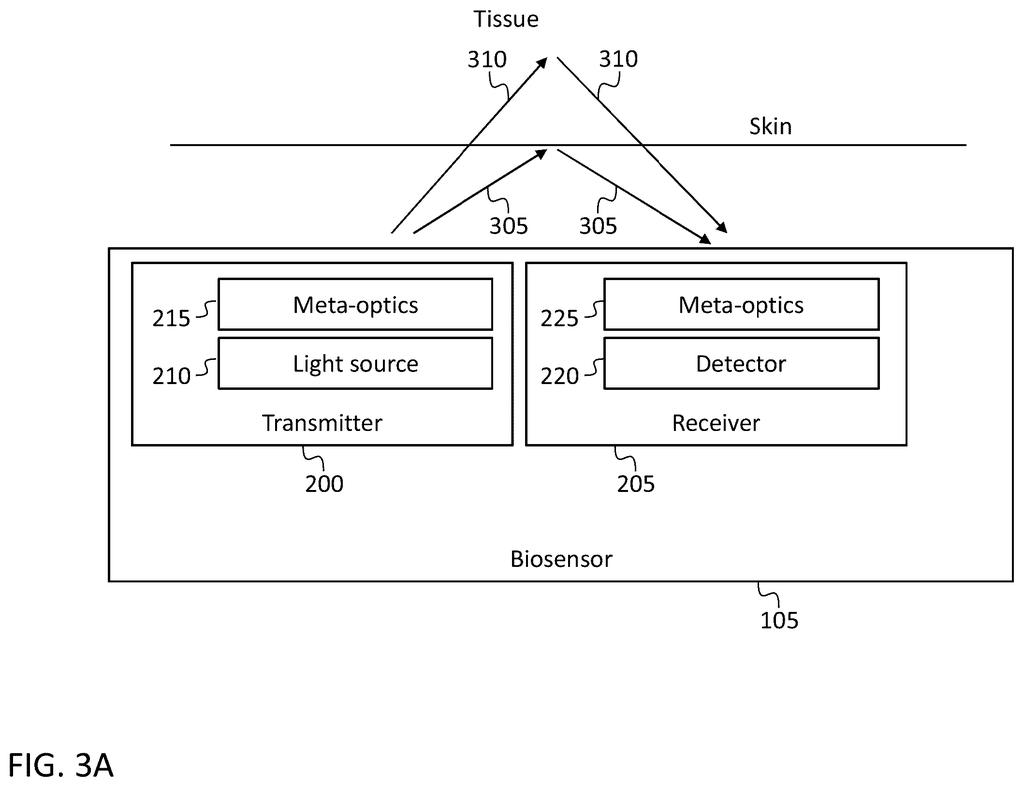
The claims cover a biosensor with two halves: an infrared transmitter (a light source) and an infrared receiver (a detector). Each half has a metasurface in front of it. That is a flat surface covered in microscopic pillars that bend, filter or split light, so one thin layer can do the job of a conventional lens or filter.
The filing focuses on thermal infrared light, roughly 1 to 12 micrometers in wavelength, because molecules of interest absorb light there and the body itself gives off light at those wavelengths. A key trick is polarization (the orientation of the light waves). Skin reflects horizontally polarized light more than vertically polarized light. So the transmitter's metasurface can send out vertical light, while the receiver's metasurface blocks light that bounced once off the skin's surface. Light that went into the tissue scatters and comes back mixed, so it gets through more easily.
The receiver's metasurface can also act as a lens that funnels light onto a small detector, or as a disperser (it splits colors apart, like a prism) so the sensor can read a spectrum. The filing also describes:
- Pixelated light sources paired with matching metasurface pixels, so each pixel emits a different color
- A temperature sensor that measures ambient temperature so it can be calibrated out
- Detector types such as thermopiles and bolometers
- Silicon, germanium or calcium fluoride bases, since fused silica is opaque at these wavelengths
… the infrared receiver including a detector and a second metasurface, the detector being configured to receive light which enters the infrared receiver through the second metasurface …
Translation: The receiver uses another flat optical surface to catch incoming light for the sensor.
What this means for body sensing in watches
The practical point is signal quality. Wearables that shine light into you waste most of it, and glare off the skin adds noise. A sensor that filters out that glare and focuses light where it's needed could give a watch, earbud or phone a more reliable read on things like body temperature. The filing lists a smart watch, smart glasses, a smartphone, a tablet and a laptop as possible homes, plus a card you press a thumb on.
The document also lists possible health uses: estimating core body temperature, spotting inflammation or blood-flow problems, and detecting cancer cells through heat maps. Those are examples, and the filing gives no test results. It also describes making the flat layers with lithography and stamp imprinting, which hints at how they might be mass-produced.
This is the 31st Samsung filing we've tracked since June in our wearables that read your body watchlist, following applications like angled glass reading fingertips and ring spin recalibration.
The benefit you would feel, if this ever ships, is a cleaner reading from a sensor that needs fewer do-overs. Light that bounces off the top of your skin tells the device nothing about what's inside you, and the filing's answer is to filter it out before it reaches the detector. Fewer wasted readings means fewer moments of "hold still and try again."
The filing gives no accuracy figures and no test results. The health uses it lists, such as core temperature, inflammation and cancer cell detection, sit a long way from a thumb on a phone.
So you should not expect a new health feature from this document alone. It does describe a sensible fix for a real nuisance in light-based sensing, and the fix is easy to explain: send out light that skin reflects poorly, and block the light that skin reflects well.
Get our take in your Top Stories
Liked this breakdown? Add Patentlyze as a preferred source on Google, and our plain-English take shows up more often in your Top Stories the next time Samsung patent news breaks.
There are more where this came from
We read every patent application Big Tech publishes and send you the ones worth knowing. Plain English, free, every week.
The drawings
6 drawing sheets from US 2026/0334794 A1 · click any drawing to enlarge


Want this weekly breakdown for a company we don't cover? Patentlyze Pro →
Be the first to weigh in