
Sony Patents a Dual-Sensor Setup for Reading Electrical Signals From the Body
Picking up faint electrical signals from skin is notoriously messy work. Sony's new patent describes a two-sensor architecture that uses a shared reference line to help separate clean readings from electrical noise.
What Sony's paired-electrode body sensor actually does
Imagine wearing a fitness band that's supposed to track your heart rhythm, but every time you move your arm or touch something metallic, the reading goes haywire. That's a real and persistent problem with devices that measure the tiny electrical signals your body produces.
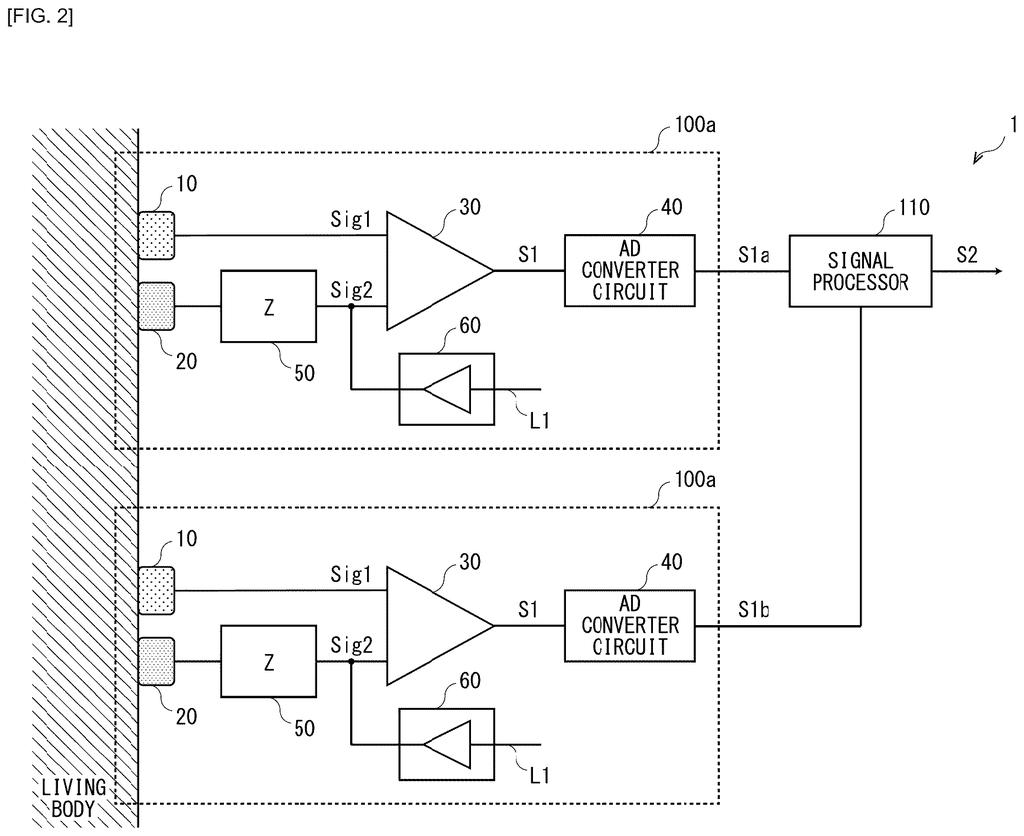
Sony's patent describes a device with two separate measurement units, each carrying a pair of electrodes that touch your skin. One electrode in each pair does the actual sensing; the other connects through a passive component (think a resistor or capacitor, a basic circuit part that doesn't amplify but does shape how electricity flows) to a shared ground line. The idea is that tying both units to the same reference point helps the device sort out genuine body signals from interference.
The output from each sensor unit is a voltage reading based on what the first electrode picks up. Having two of these units means the device can compare or combine their readings, which is a standard technique for filtering out noise that hits both sensors equally.
a first measurer; and a second measurer, the first measurer and the second measurer each including a first electrode and a second electrode that are configured to be in contact with a living body …
Translation: The device uses two separate measuring units, each with a pair of electrodes touching your skin.
How the two measurers share a ground to clean up signals
The device contains two parallel measurement blocks, called the first measurer and the second measurer. Each block holds two electrodes meant to sit against the skin, and a passive element (a component that stores or dissipates energy rather than amplifying it, so typically a resistor, capacitor, or inductor) wired between the second electrode and a shared reference potential line, which is essentially a common ground.
The key output from each block is a voltage signal derived from the first electrode's potential. Because both blocks tie their second electrodes to the same reference line through passive components, they share a common electrical baseline. This matters because biological signals like ECG (heart electricity) or EEG (brain electricity) are tiny, often just microvolts to millivolts, and any asymmetry in grounding can introduce false readings.
Why two units? Differential measurement, comparing the output of two sensors rather than relying on a single reading, is one of the oldest tricks in biomedical electronics for rejecting common-mode noise (interference that affects both electrodes identically, such as 60 Hz hum from nearby power lines). The passive element on the reference side controls how the second electrode interacts with the ground, which affects both noise rejection and the safe level of current that flows through the body.
The patent's claim is broad at this stage, covering the core architecture without specifying whether the passive element is a resistor, capacitor, or something else, or what the exact application (cardiac, neural, muscular) is.
… a first passive element that is electrically coupled between the second electrode and a reference potential line …
Translation: A basic circuit component connects the second electrode to a steady ground reference.
What this means for wearable health monitoring
Accurate body-signal sensing is the foundation of any serious health wearable, and noise rejection is where most consumer devices fall short. ECG readings from a wrist sensor are already harder to get right than those from clinical chest electrodes; adding movement, sweat, and everyday electrical interference makes clean signals even harder to capture. A two-channel architecture with a shared reference is a well-understood engineering approach to that exact problem.
For you as a consumer, this kind of filing signals that Sony is thinking carefully about the signal-quality layer of wearable health tech, not just the feature list. Sony's interest in wearable biosensing shows up in several recent filings, and cleaner signal capture is a prerequisite for any of the more headline-grabbing health features, like arrhythmia detection or continuous blood-pressure monitoring, to actually work reliably.
Sony's eighth filing since July in our wearables that read your body watchlist follows a wrist-rotating display and a sleepwalking predictor with another body-sensing application.
Consumer health wearables have a credibility gap: they look like medical devices, but electrical noise in the signal chain undermines the health readings people trust. That gap has real costs, from missed irregular heartbeats to sleep data too corrupted to act on.
Sony's approach here uses two pairs of skin-contact electrodes, each anchored to a shared electrical ground through passive components, to filter out that noise. The underlying logic is established in medical-grade equipment, but applying it consistently in a small wearable is harder than it sounds.
The architecture described is broad enough to cover many body sites and signal types, which reads more as foundational IP positioning than a narrow product announcement. Whether the approach matches the size of the problem depends on what sits beneath it, and this filing only shows one layer.
There are more where this came from
We read every patent application Big Tech publishes and send you the ones worth knowing. Plain English, free, every week.
The drawings
23 drawing sheets from US 2026/0283527 A1 · click any drawing to enlarge


Want this weekly breakdown for a company we don't cover? Patentlyze Pro →
Be the first to weigh in