
Samsung Files Patent to Keep Wheeled Robots on Course When a Wheel Lifts Off the Floor
Samsung's robot rides on several swiveling wheel units, and this patent covers what happens when one of them briefly leaves the floor. The robot notices, spins the lifted wheels at different speeds to snap the unit back into line, and ignores that unit's bad data in the meantime.
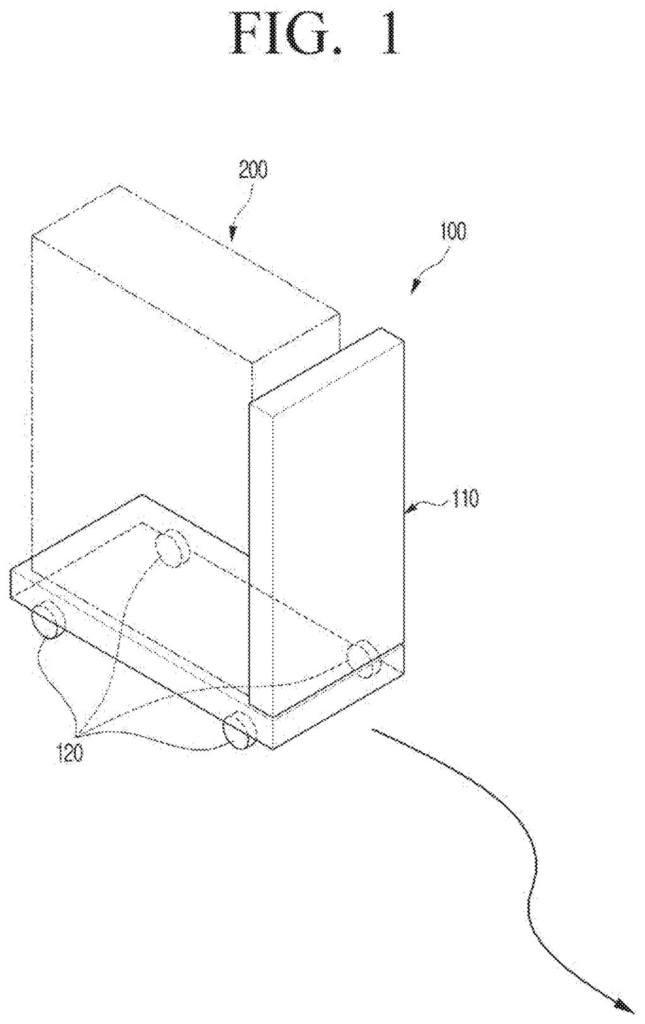
What Samsung's lifted-wheel robot fix actually does
Every time a wheeled robot rolls over a bump, a seam in the floor, or a dip in the pavement, one of its wheels can briefly hang in the air. For a few moments, that wheel is spinning but not steering anything.
Samsung's patent describes a robot with several swiveling driving modules under its body, each holding a pair of wheels. If one module loses contact with the ground, the robot spins its two wheels at different speeds. That way, the moment the module touches down again, it swings quickly back to the direction it is supposed to face.
The robot also stops trusting the lifted module when it works out where it is. Wheels that spin in the air report distance they never traveled, so the robot leaves that data out and relies on the modules still on the ground.
… identify at least one driving module, among the plurality of driving modules, that is not in contact with a bottom surface based on a sensing value of the sensor of the at least one driving module …
Translation: Detects when a wheel loses contact with the ground using internal sensors.
How the robot spots a wheel pair off the ground
The robot has a main body and several driving modules attached underneath on swivels. Each module has its own sensor, two wheels, and a motor. The robot points each module in the direction needed for the route: all the same way for a straight line, or at different angles for a curve, based on where the center of the curve is.
To steer a module, the robot spins its two wheels at different speeds. This only works when both wheels are on the ground, which gives the robot a way to detect a problem. The filing describes several tests:
- An absolute encoder (a sensor that reads exactly which way a module is pointing) shows a module did not turn as commanded.
- A module's motor load current (how much electricity it draws) drops well below the other modules'. A wheel spinning in the air meets almost no resistance.
- The filing also mentions contact, ultrasonic, or infrared sensors as alternatives.
Once a lifted module is found, the robot spins the wheel on the far side of the intended turn faster than the other modules' wheels. It spins the wheel on the turning side slower. When the module lands, that speed gap swings it quickly into position. Once it is aligned, both wheels go back to the same speed.
For location tracking, the robot calculates its position (called odometry, which means adding up each move from a known starting point) without the lifted module's readings.
… control the motor of the at least one driving module to drive the plurality of wheels of the at least one driving module at different rotation speeds …
Translation: Adjusts the wheel speeds on the lifted module to keep the robot moving straight.
Why bumpy floors matter for Samsung's robots
If you have ever watched a delivery or warehouse robot wobble after a bump, this is the problem Samsung is going after. A robot that drifts off its path or misjudges where it is can bump into shelves, people, or walls. The filing names factory carts, cleaning robots, serving robots, delivery robots, and movable projectors as places this could apply.
The approach needs no extra hardware beyond sensors the modules already carry. The filing says the method could arrive as a software update on existing robots. It also notes that a module with a single wheel and a direct swivel joint could work too.
This is the 57th Samsung filing we've tracked since May on our home robots watchlist, adding to earlier work like a single-motor bending finger and vacuum maps turned 3D.
Claim 1 is broad in an interesting way. It covers any robot with several swiveling wheel modules that finds a module off the ground by reading that module's sensor and then spins its wheels at different speeds. It does not say how the lifted module is found, how big the speed gap is, or what kind of robot it is. Those details only show up in the narrower claims, such as the motor current test or the faster and slower wheel on each side.
If granted, that wording could reach many robots that use this swivel-module design and react to a lifted wheel by changing wheel speeds. The claim ties the idea to a specific layout, so it would not cover robots with ordinary fixed wheels.
The idea is sensible and fairly narrow. It fixes a real problem for factory robots without needing any fancy new hardware. Most people will never notice it working, which is probably what Samsung is aiming for.
Get our take in your Top Stories
Liked this breakdown? Add Patentlyze as a preferred source on Google, and our plain-English take shows up more often in your Top Stories the next time Samsung patent news breaks.
There are more where this came from
We read every patent application Big Tech publishes and send you the ones worth knowing. Plain English, free, every week.
The drawings
10 drawing sheets from US 2026/0336427 A1 · click any drawing to enlarge


Show the other 2 sheets


Want this weekly breakdown for a company we don't cover? Patentlyze Pro →
Be the first to weigh in