
Sony Files Patent for a Drone Microphone That Hides From the Camera
Sony describes a drone that holds the microphone over a film set and keeps recalculating the closest spot to the actor that the camera can't see. It also works around lights, noisy air conditioners and even the microphone cable.
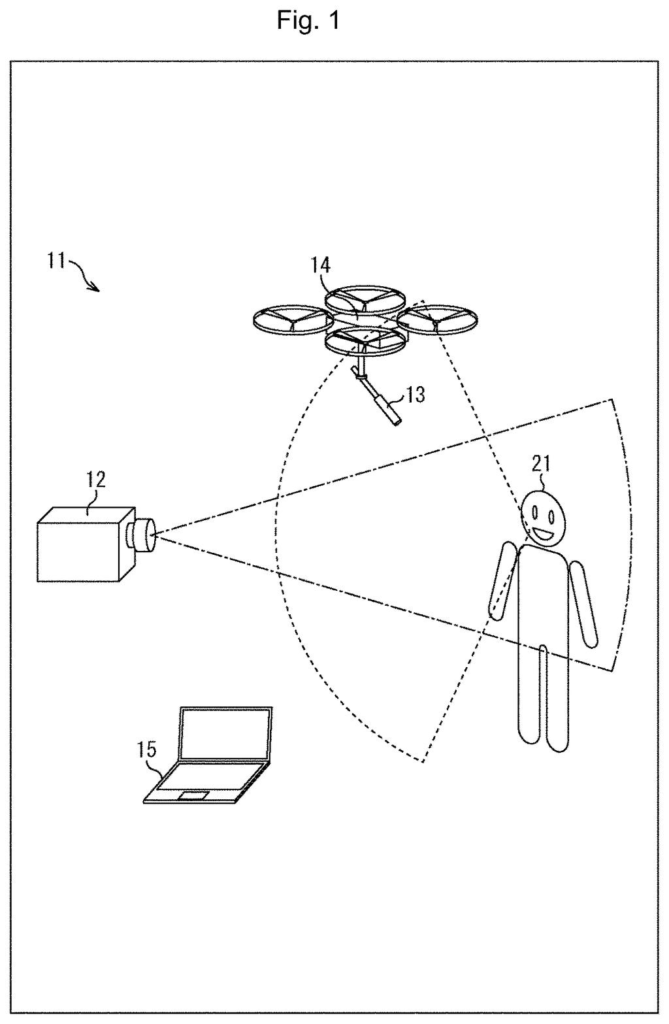
What Sony's drone boom mic actually does
Ever seen behind-the-scenes footage of a crew member holding a long pole over an actor's head? That's a boom microphone, and the person holding it has one tricky job: get as close to the actor as possible without sneaking into the shot.
Sony's patent application hands that job to a drone or a similar moving machine. A computer works out where the camera is looking, where the actor is standing, and where a microphone could sit close enough to hear clearly while staying just outside the picture. Then it moves the microphone there and keeps adjusting as the actor moves.
It also thinks about the clutter of a real set: a humming air conditioner to avoid pointing at, a light whose beam or shadow the microphone shouldn't cross, and people it shouldn't bump into. A cable running to the recording gear gets the same treatment.
an information acquisition unit that acquires information necessary for calculating an optimal arrangement of a sound collection device that collects a sound of a collection target, the information including at least information indicating a position or orientation of the sound collection device; …
Translation: The system figures out the best place to put the microphone based on its current location.
How the system finds a spot the camera can't see
The filing lays out a system with three parts. An information acquisition unit tracks where the camera, the actor (called the collection target) and the microphone are, and which way each one faces. A calculation unit works out the best placement. An operation control unit moves the machine carrying the microphone, such as a drone.
The calculation follows a clear rule. The system estimates the capture range (the space the camera lens can see) and the recordable range (where the microphone could still pick up the actor's direct voice). It picks the spot inside the second and outside the first that sits closest to the actor, then aims the microphone's sound axis (the narrow line a directional microphone listens along) at the actor.
Extra inputs refine the answer:
- Noise sources like air conditioners or generators, so the microphone doesn't point at them.
- Lighting, so the drone doesn't block a light or cast a shadow.
- Several speakers: aim at the midpoint, swing between speakers on a script timing, or use an all-around microphone or two directional ones.
- Cables: a second drone can hold up the microphone cable so it stays out of frame.
Crew can also place the microphone by hand before filming and check the sound. The system stores that relationship and recreates it for rehearsals and retakes. A top-down screen marks allowed and off-limits zones.
Why film sets might care about drone mics
On a film set, a microphone that creeps into the frame wastes a take, and a microphone held too far away makes muddy dialogue. A machine that works out the closest safe spot, and can return to that same spot for every retake of a scene, takes some of that guesswork off the crew.
The filing also deals with the machine's own flaws. A drone's propellers are loud, so the system can store their rotation speed and later filter that hum out of the recording. It also puts avoiding collisions with people ahead of staying out of the shot, and flags the change on screen. For you as a viewer, the payoff would be cleaner dialogue.
Sony's 85th filing in our camera patent coverage since May adds to a run that includes one on surgical dye imaging and one on stabilization artifacts.
Claim 1 is written very wide. It asks for three things: something that collects the microphone's position or direction, something that works out the best placement, and something that moves the microphone there. Nothing in it mentions drones, cameras or movie sets.
The film-set details show up in the later claims. Claim 2 adds the camera and the rule about staying within hearing range yet outside the shot. Other claims cover noise, lights, several speakers and cables. On paper, the broad first claim would reach any machine that calculates a microphone's best spot and moves it there, which is a lot of territory for an idea this simple.
Broad opening claims often get trimmed during review, so the narrower claims carry the real substance. The out-of-frame rule is a practical idea any sound crew would recognize.
Get our take in your Top Stories
Liked this breakdown? Add Patentlyze as a preferred source on Google, and our plain-English take shows up more often in your Top Stories the next time Sony patent news breaks.
There are more where this came from
We read every patent application Big Tech publishes and send you the ones worth knowing. Plain English, free, every week.
The drawings
15 drawing sheets from US 2026/0352998 A1 · click any drawing to enlarge


Show the other 7 sheets


Want this weekly breakdown for a company we don't cover? Patentlyze Pro →
Be the first to weigh in