
Microsoft Files Patent for Hiding Your Name From the AI in Group Chats
When someone @-mentions you in a group chat, an AI helper should be able to reply to you by name. Microsoft's patent application describes a way to do that without the AI ever seeing your name: a fake tag goes in, and the real name comes back out.
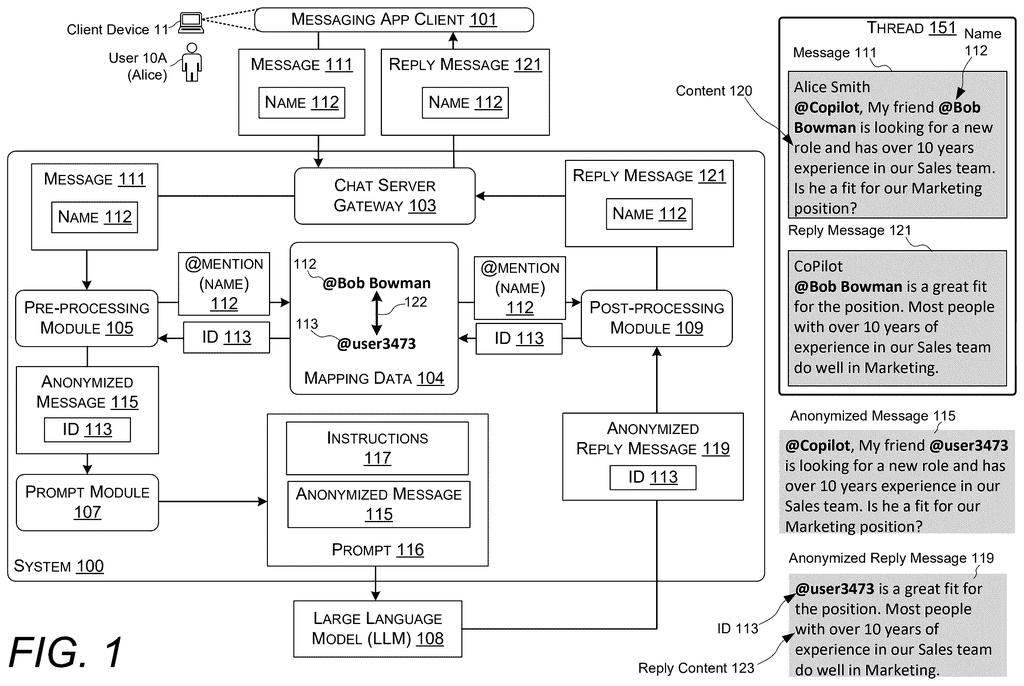
What Microsoft's name-swap for group chat AI does
Ever @-mentioned a coworker in a group chat and then watched an AI helper chime in about them? That helper normally sees the person's real name, and a name can nudge an AI to guess at, or repeat, things it picked up during training.
Microsoft's patent application describes a go-between that fixes this. Before your message reaches the AI, the system swaps a name like @Bob Bowman for a made-up tag such as user3473. The AI writes its reply using the tag. On the way back, the system looks the tag up, puts Bob's real name in, and posts the reply in the thread.
To you, the chat looks normal, with replies that address people by name. The AI only ever worked with stand-in labels. The filing points to healthcare, legal and school settings as places where that matters most.
removing a name of a user from a message having content prior to sending the message to a large language model; replacing the name of the user in the message with a unique identifier for the user to generate an anonymized message that includes the unique identifier and the content of the message without the name of the user …
Translation: The system strips user names from chat messages and substitutes temporary ID codes before the text reaches the AI.
How the stand-in tags get made, tracked and retired
The system sits between the chat app and the AI model (the large language model, or LLM, that writes the replies). A pre-processing step finds the name in each message, removes it, and inserts a unique identifier in its place. It records the pairing in a mapping table (a lookup list linking each name to its tag) so it can recall the name later.
Next, a prompt module wraps the anonymized message in instructions. Those instructions tell the AI that the tag stands for a person, to copy the tag's exact format into its reply, and not to invent tags of its own. The filing says the prompt can include sample valid and invalid replies. Tags copy the look of what they replace: an @-mention gets an @-style tag, and a phone number gets a fake number, such as one starting with 555.
A post-processing step then takes the AI's reply, looks up each tag, restores the real name, and a gateway posts the result to the thread. The filing also describes tags that don't last:
- A new tag is created after a set time passes, so one tag isn't used so often that Bob's identity could be guessed.
- The timer can start only after an event, such as midnight, a spike in message traffic, or someone joining or leaving the group.
- Bob gets a different tag in each separate thread with different people, and tags are deleted when the thread is deleted or deactivated.
… anonymizes the user identities in messages that are shared with an AI engine to generate response messages, and then re-introducing user names back into the response messages …
Translation: Real names are hidden from the AI during processing and swapped back in before the final reply appears in the chat.
Why Copilot-style chat helpers need name cover
If you use an AI helper in a team chat, this approach would let it talk to people by name without being told who they are. That could make organizations with strict privacy rules, such as hospitals, law firms and schools (the settings the filing itself names), more comfortable turning an AI helper on in group conversations. The examiner's first review rejected the claims as filed, which is routine at this stage and usually followed by amendments.
The filing's example thread includes an AI agent named Copilot alongside human members, and the text mentions Teams channels. The same idea covers other personal details too, such as email addresses, phone numbers and home addresses. Fewer personal details leaving the chat app also means fewer awkward questions about where they went.
Microsoft's 19th filing we've tracked since August in our on-device AI privacy push builds on earlier applications for locking down sensitive data and a voice-deleting recorder.
Ship-path check: this needs no new hardware. It is a software layer made of a name lookup table, a text swap before the AI sees a message, a text swap after, and a carefully written set of instructions. Any chat service that already routes messages through a server could build it, and the filing's own example thread already includes an AI agent named Copilot.
The hard part is getting the AI to follow the rules. The whole scheme relies on the model repeating the tag exactly, which is why the filing leans on sample good and bad replies and a ban on inventing tags. If the model garbles a tag, the name can't be restored, so a backup plan would have to exist before this ships.
Verdict: of the privacy ideas that could turn into a feature, this one sits near the easy end, since the main work is testing against messy real chats and keeping the rotating tags in order.
Get our take in your Top Stories
Liked this breakdown? Add Patentlyze as a preferred source on Google, and our plain-English take shows up more often in your Top Stories the next time Microsoft patent news breaks.
There are more where this came from
We read every patent application Big Tech publishes and send you the ones worth knowing. Plain English, free, every week.
The drawings
23 drawing sheets from US 2026/0352614 A1 · click any drawing to enlarge


Show the other 15 sheets


Want this weekly breakdown for a company we don't cover? Patentlyze Pro →
Be the first to weigh in