
Microsoft Files Patent for Digital ID Badges for Robots and AI Agents
Your work login proves you are you. Microsoft has filed a patent application for a version that does the same for robots and AI agents, so a human team can bring them into a shared mission and control what each one is allowed to do.
What Microsoft's robot-and-AI ID directory does
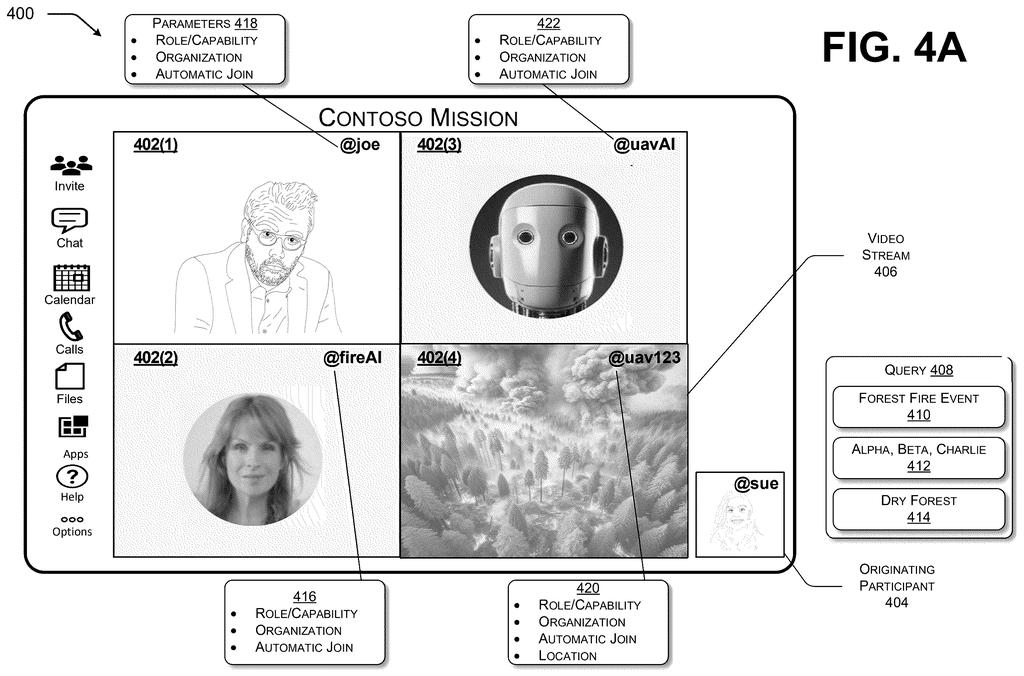
Imagine a forest fire is spreading and you are the coordinator. You open a shared screen and type in what is happening. Within moments, the right people, drones, bulldozers and AI helpers from several agencies get an invitation to join you.
The hard part is trust. Microsoft's filing describes a digital ID directory that lists not just people but also robots and AI agents (software helpers that analyze data and can act on it). Each entry says who owns it, what it can do and, for robots, where it is right now.
That directory decides who gets in. A drone from a partner agency can walk right in. A bulldozer from an agency with no agreement has to wait until you click accept. It also decides what each member may do once inside, such as steering a drone or watching its live video.
… wherein the plurality of participants include a human participant, a robotic device participant, and an artificial intelligence agent participant; …
Translation: The system brings people, robots, and AI together into the same shared workspace.
How the directory decides who joins and who steers
The process starts when an originating participant (a person, a robot or an AI agent) asks to create a collaboration session tied to a mission in a real-world area. The request carries a query, which is a search phrase such as the type of event (a forest fire), helpful organizations, or a location.
The system then looks that query up in a datastore (a searchable database) connected to an identity platform. Ordinary identity systems only hold human users and the organizations they belong to. This one also holds robots and AI agents, and each entry carries extra details:
- Type: human, robot or AI agent.
- Link: whether two organizations have an agreement that lets members join automatically.
- Data access: whether a linked organization's robots and AI can reach its files stored in an outside cloud service.
- Location: where a robot currently is, as reported by GPS.
- Role, capability and view: what a participant is, what it can do, and whether a person may watch robot video.
Matching can work on exact words or on meaning. The filing mentions embeddings (lists of numbers that capture what a phrase means). Matching entries get invitations. For a robot, the invitation can wake it from sleep and switch on a downloadable "robot agent," a piece of software that connects it to the cloud session.
Finally, the system builds a shared screen with a tile for each participant, including live robot video for people who have viewing rights, and sends it to the human's device. The claims cover this invite-and-join flow, along with dependent claims on automatic joining, remote driving of a robot, and video access.
… via the use of participant identifiers and the identity platform, the system determines which functions participants are authorized to implement within a context of the collaboration session.
Translation: Digital badges verify who everyone is and what tasks they are allowed to perform.
Why robots and AI agents need their own logins
If robots and AI agents are going to work next to people, someone has to answer a basic question: who is allowed to do what? This filing gives that answer in one place. A drone from another agency can join without a manual approval step, while a bulldozer from a stranger waits for a human to say yes. Only a certified operator can steer a given machine, and only approved people see its camera feed.
The filing frames this around disaster response, but it also describes warehouses, construction sites, and an office robot hunting for a coworker. Its first review ended in a rejection of the claims as filed, a routine step that usually leads to amendments, so nothing here is approved or granted.
Microsoft's 27th filing we've tracked since July in our AI agents that act for you watchlist builds on its website map for AI clicks and button labels for AI assistants applications.
This is a software idea, and that is its biggest strength. No new hardware is needed. A company would build the directory, write the rules for who can join and who can steer, and hand robot makers a downloadable program that connects their machines to the session.
The hard part is everything around the software. Robots from different makers have to install that program, and organizations have to fill in the directory and sign agreements with one another. A disaster response with a dozen agencies is the toughest place to start.
The shortest route to a real product is a single company's own warehouse or factory, where one owner controls the robots, the AI helpers and the staff. The filing itself mentions reassigning warehouse robots when a task becomes urgent. Treat the multi-agency rescue scenario as the long-range version and the single-company setup as the near-term one.
Get our take in your Top Stories
Liked this breakdown? Add Patentlyze as a preferred source on Google, and our plain-English take shows up more often in your Top Stories the next time Microsoft patent news breaks.
There are more where this came from
We read every patent application Big Tech publishes and send you the ones worth knowing. Plain English, free, every week.
The drawings
11 drawing sheets from US 2026/0352505 A1 · click any drawing to enlarge


Show the other 3 sheets


Want this weekly breakdown for a company we don't cover? Patentlyze Pro →
Be the first to weigh in