
Nvidia · Filed Nov 13, 2025 · Published Nov 5, 2026

Nvidia Files Patent for Judging an Object's Shape and Lighting From Two Photos

A photo of your sneaker dropped into a video game rarely looks right, because a picture says nothing about how glossy the shoe is. Nvidia's patent application tries to read that from two photos of the object, taken under different lighting.
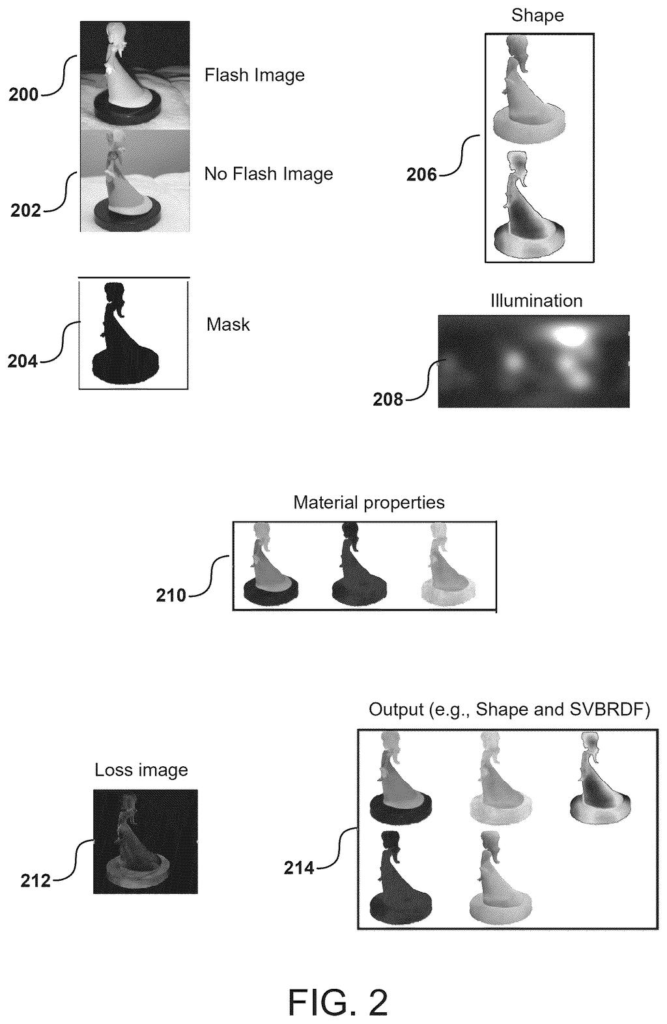
Two photos of a figurine taken with and without flash help software work out its exact outline, materials, and surrounding light. Drawing from patent filing US 2026/0350770 A1.
Two photos of a figurine taken with and without flash help software work out its exact outline, materials, and surrounding light.
See all 49 drawings from this filing ↓
Publication number US 2026/0350770 A1 US20260350770A1
Applicant NVIDIA Corporation
Filing date Nov 13, 2025
Publication date Nov 5, 2026
Inventors Varun Jampani, Mark Boss, Kihwan Kim, Jan Kautz
US classification 382/155
Status when we published Waiting for an examiner (Jul 29, 2026)
Parent application is a Continuation of 16786092 (filed 2020-02-10)
Document 1 claims

What Nvidia's two-photo object scan does

Today, if you photograph a sneaker and drop it into a video game, it usually looks pasted on. A photo records color, but it says nothing about how glossy or rough the surface is, so the sneaker never catches the game's light the way everything around it does.

Nvidia's filing describes a fix that needs only a phone camera. You take two shots of the same object, one with the flash and one without. Software trained on many examples (a neural network) studies the pair and works out the object's shape and the lighting in the room.

Then it checks its own work. It redraws the object from those guesses, compares the result with a real photo, and corrects what it got wrong. The goal is a digital copy that reacts to light like the real thing.

From the filing · CLAIM 31
receive a first image of an object captured under first illumination conditions, and a second image of the object captured under second illumination conditions different than the first illumination conditions …

Translation: The system takes in two photos of the same item taken under different lighting.

How the networks guess, redraw and correct

The main claim covers processors with circuitry that takes two images of one object, shot under different lighting, such as with and without a flash. Neural networks (software that learns patterns from examples) make a first estimate of the object's shape and of the lighting. They then produce a rendered image, meaning a picture drawn by computer from those estimates, and compare it against the second photo to make a better estimate.

The description lays out a four-network chain, where each step is guided by the one before it:

  • Shape: estimates depth (how far away each point is) and surface direction (which way each patch faces).
  • Lighting: guesses the light in the scene, using the shape as a guide.
  • Material: estimates color, shininess and roughness at every pixel.
  • Refinement: redraws the flash photo, compares it with the real one, and fixes all the estimates together.

The filing says each network is small enough for phone hardware. The full chain takes about 700 milliseconds on a 256 by 256 image using an Nvidia 1080 Ti graphics card. Training used made-up scenes built from spheres, cones, cylinders and rings covered in 11,250 material maps, with the no-flash view shifted slightly to mimic a shaky hand.

From the filing · THE ABSTRACT
… shape and visual properties of an object can be determined using differently illuminated images fed to a pipeline of neural networks …

Translation: A series of AI models figures out the physical form and lighting details from the photo pair.

What this means for scanning real objects

If this works as described, scanning a real object for a game or an AR scene could take two quick phone shots instead of a studio setup. The result would be a digital copy that reacts to virtual lighting, so it matches the objects around it. The filing names AR, VR and gaming as the motivation, along with growing demand to put physical objects into virtual worlds.

The filing is a continuation of an application first filed in February 2020, so the underlying research is not new. It also describes a handheld, burst-capture setup with slight misalignment between shots, which suits phones. Nothing in the text names a product.

Nvidia's 87th filing in the AI vision filings we've tracked since May adds to a run that includes one on mood-shifting characters and one on sports camera direction.

Editorial take

Read the main claim closely and it is wider than the description suggests. It asks for two images under different lighting, a first guess at shape and lighting, a rendered third image, and a second guess based on comparing that render to the second image. Flash is never mentioned, and neither are phones, gloss or the four-network chain.

As written, the claim covers any processor running that guess, redraw, compare and correct loop on a differently lit photo pair, whatever the hardware or the lighting trick. The flash pair and the small phone-sized networks sit in the description, and would only shape the claim if narrower claims were added.

Whether a claim this open survives review is an open question. It does show Nvidia is aiming at the whole idea of the loop.

Get our take in your Top Stories

Liked this breakdown? Add Patentlyze as a preferred source on Google, and our plain-English take shows up more often in your Top Stories the next time Nvidia patent news breaks.

There are more where this came from

We read every patent application Big Tech publishes and send you the ones worth knowing. Plain English, free, every week.

The drawings

49 drawing sheets from US 2026/0350770 A1 · click any drawing to enlarge

How AI turns flash photos into 3D models, drawing sheet 1 from US 2026/0350770 A1
Sheet 1 How AI turns flash photos into 3D models
Steps that extract 3D shape and lighting, drawing sheet 2 from US 2026/0350770 A1
Sheet 2 Steps that extract 3D shape and lighting
Combining two photo views inside a neural network, drawing sheet 3 from US 2026/0350770 A1
Sheet 3 Combining two photo views inside a neural network
Turning two photos into a realistic 3D replica, drawing sheet 4 from US 2026/0350770 A1
Sheet 4 Turning two photos into a realistic 3D replica
Basic steps for scanning an item using photos, drawing sheet 5 from US 2026/0350770 A1
Sheet 5 Basic steps for scanning an item using photos
Computer chip parts that run the AI models, drawing sheet 6 from US 2026/0350770 A1
Sheet 6 Computer chip parts that run the AI models
A chip design pairing storage directly with processors, drawing sheet 7 from US 2026/0350770 A1
Sheet 7 A chip design pairing storage directly with processors
Cloud servers that teach and run the AI models, drawing sheet 8 from US 2026/0350770 A1
Sheet 8 Cloud servers that teach and run the AI models
Show the other 41 sheets
Internal parts of a desktop computer running AI tasks, drawing sheet 9 from US 2026/0350770 A1
Sheet 9 Internal parts of a desktop computer running AI tasks
Hardware inside a laptop or phone handling image capture, drawing sheet 10 from US 2026/0350770 A1
Sheet 10 Hardware inside a laptop or phone handling image capture
Connecting multiple graphics chips to share heavy AI workloads, drawing sheet 11 from US 2026/0350770 A1
Sheet 11 Connecting multiple graphics chips to share heavy AI workloads
USB drive that runs AI tasks on your computer, drawing sheet 12 from US 2026/0350770 A1
Sheet 12 USB drive that runs AI tasks on your computer
Fast data links connecting computer processors directly to graphics chips, drawing sheet 13 from US 2026/0350770 A1
Sheet 13 Fast data links connecting computer processors directly to graphics chips
Core circuitry linking a main processor to a graphics accelerator, drawing sheet 14 from US 2026/0350770 A1
Sheet 14 Core circuitry linking a main processor to a graphics accelerator
Alternative wiring layout for sharing memory with an accelerator, drawing sheet 15 from US 2026/0350770 A1
Sheet 15 Alternative wiring layout for sharing memory with an accelerator
How an app sends graphics tasks directly to visual hardware, drawing sheet 16 from US 2026/0350770 A1
Sheet 16 How an app sends graphics tasks directly to visual hardware
How apps offload tasks directly to graphics hardware, drawing sheet 17 from US 2026/0350770 A1
Sheet 17 How apps offload tasks directly to graphics hardware
Multiple graphics chips sharing one pool of memory, drawing sheet 18 from US 2026/0350770 A1
Sheet 18 Multiple graphics chips sharing one pool of memory
Mobile system chip with built in AI acceleration, drawing sheet 19 from US 2026/0350770 A1
Sheet 19 Mobile system chip with built in AI acceleration
Graphics processor split into dedicated visual units, drawing sheet 20 from US 2026/0350770 A1
Sheet 20 Graphics processor split into dedicated visual units
Alternative graphics chip using flexible shader cores, drawing sheet 21 from US 2026/0350770 A1
Sheet 21 Alternative graphics chip using flexible shader cores
Internal layout of an advanced graphics processing core, drawing sheet 22 from US 2026/0350770 A1
Sheet 22 Internal layout of an advanced graphics processing core
Clustered chip design built for heavy AI workloads, drawing sheet 23 from US 2026/0350770 A1
Sheet 23 Clustered chip design built for heavy AI workloads
Computer setup pairing central processors with graphics chips, drawing sheet 24 from US 2026/0350770 A1
Sheet 24 Computer setup pairing central processors with graphics chips
Internal layout of a graphics processor that handles AI calculations, drawing sheet 25 from US 2026/0350770 A1
Sheet 25 Internal layout of a graphics processor that handles AI calculations
Memory management circuits that feed graphics rendering tasks, drawing sheet 26 from US 2026/0350770 A1
Sheet 26 Memory management circuits that feed graphics rendering tasks
A graphics chip cluster that manages AI tasks, drawing sheet 27 from US 2026/0350770 A1
Sheet 27 A graphics chip cluster that manages AI tasks
Core calculation engines and local storage within a graphics processor, drawing sheet 28 from US 2026/0350770 A1
Sheet 28 Core calculation engines and local storage within a graphics processor
Linking multiple graphics chips directly together to share heavy workloads, drawing sheet 29 from US 2026/0350770 A1
Sheet 29 Linking multiple graphics chips directly together to share heavy workloads
Hardware blocks organized to process geometry and visual media, drawing sheet 30 from US 2026/0350770 A1
Sheet 30 Hardware blocks organized to process geometry and visual media
Microscopic circuits that sort and run incoming computer instructions, drawing sheet 31 from US 2026/0350770 A1
Sheet 31 Microscopic circuits that sort and run incoming computer instructions
Custom chip built to train visual AI models, drawing sheet 32 from US 2026/0350770 A1
Sheet 32 Custom chip built to train visual AI models
Brain inspired chips that link artificial neurons to run AI, drawing sheet 33 from US 2026/0350770 A1
Sheet 33 Brain inspired chips that link artificial neurons to run AI
Main circuit board parts that connect cameras, displays, and chips, drawing sheet 34 from US 2026/0350770 A1
Sheet 34 Main circuit board parts that connect cameras, displays, and chips
Multiple chip cores sharing memory to speed up visual tasks, drawing sheet 35 from US 2026/0350770 A1
Sheet 35 Multiple chip cores sharing memory to speed up visual tasks
Graphics chip layout showing dedicated hardware for rendering 3D images, drawing sheet 36 from US 2026/0350770 A1
Sheet 36 Graphics chip layout showing dedicated hardware for rendering 3D images
Internal execution units that handle multiple computing threads at once, drawing sheet 37 from US 2026/0350770 A1
Sheet 37 Internal execution units that handle multiple computing threads at once
Inside an execution unit that crunches numbers for 3D visuals, drawing sheet 38 from US 2026/0350770 A1
Sheet 38 Inside an execution unit that crunches numbers for 3D visuals
How the chip routes work between memory and AI, drawing sheet 39 from US 2026/0350770 A1
Sheet 39 How the chip routes work between memory and AI
Clustered processing units that transform raw 3D shapes into pixels, drawing sheet 40 from US 2026/0350770 A1
Sheet 40 Clustered processing units that transform raw 3D shapes into pixels
Memory management circuits that store and route image pixels, drawing sheet 41 from US 2026/0350770 A1
Sheet 41 Memory management circuits that store and route image pixels
Internal computing cores that execute vision commands, drawing sheet 42 from US 2026/0350770 A1
Sheet 42 Internal computing cores that execute vision commands
Training medical AI software using hospital scan records, drawing sheet 43 from US 2026/0350770 A1
Sheet 43 Training medical AI software using hospital scan records
Hardware and cloud services that run medical vision tools, drawing sheet 44 from US 2026/0350770 A1
Sheet 44 Hardware and cloud services that run medical vision tools
Converting raw body scans into detailed organ views, drawing sheet 45 from US 2026/0350770 A1
Sheet 45 Converting raw body scans into detailed organ views
How ultrasound signals turn into live screen video, drawing sheet 46 from US 2026/0350770 A1
Sheet 46 How ultrasound signals turn into live screen video
Checking scan quality and patient movement during CT scans, drawing sheet 47 from US 2026/0350770 A1
Sheet 47 Checking scan quality and patient movement during CT scans
Refining prebuilt AI models with custom clinic datasets, drawing sheet 48 from US 2026/0350770 A1
Sheet 48 Refining prebuilt AI models with custom clinic datasets
Labeling raw photos to train the image AI, drawing sheet 49 from US 2026/0350770 A1
Sheet 49 Labeling raw photos to train the image AI
Browse all the drawings 49 drawing sheets
Patent filing page

Source. Full patent text and figures from the official USPTO publication PDF.
Reader comments

Be the first to weigh in

Start the discussion

Real name or a handle, either is fine. Comments are read by a person before they appear, so allow a little time. Keep it about the filing.