
Samsung Files Patent to Undo the Stretched Faces in Close-Up Selfies
Your nose looks big in close-up selfies because of where the camera sits, and Samsung has filed a patent application for software that undoes the effect in one pass. It fixes the face without losing details like earrings.
What Samsung's selfie distortion fix does
You hold your phone close for a selfie, and your nose and ears look oddly oversized. That's not your face. It's what a camera does to perspective when it is only a short distance away, and anyone who has taken a close-up knows the result.
Samsung's patent application describes a fix that runs on the device itself. The software first lines your face up to a standard position and size. Then it takes two numbers: how much distortion the photo has, and how much the finished picture should have. One trained AI model uses those to produce a version that looks like it was shot from farther away.
The filing says earlier methods needed slow, per-photo tuning. This one goes straight from input to result, and it is built to keep small details like earrings and moles.
… providing the input angle, the output angle and the canonical image as inputs to a pre-trained multi-task neural network model for correcting perspective distortion …
Translation: An AI model takes the image and camera angles to fix the distortion.
How the two angles steer the correction
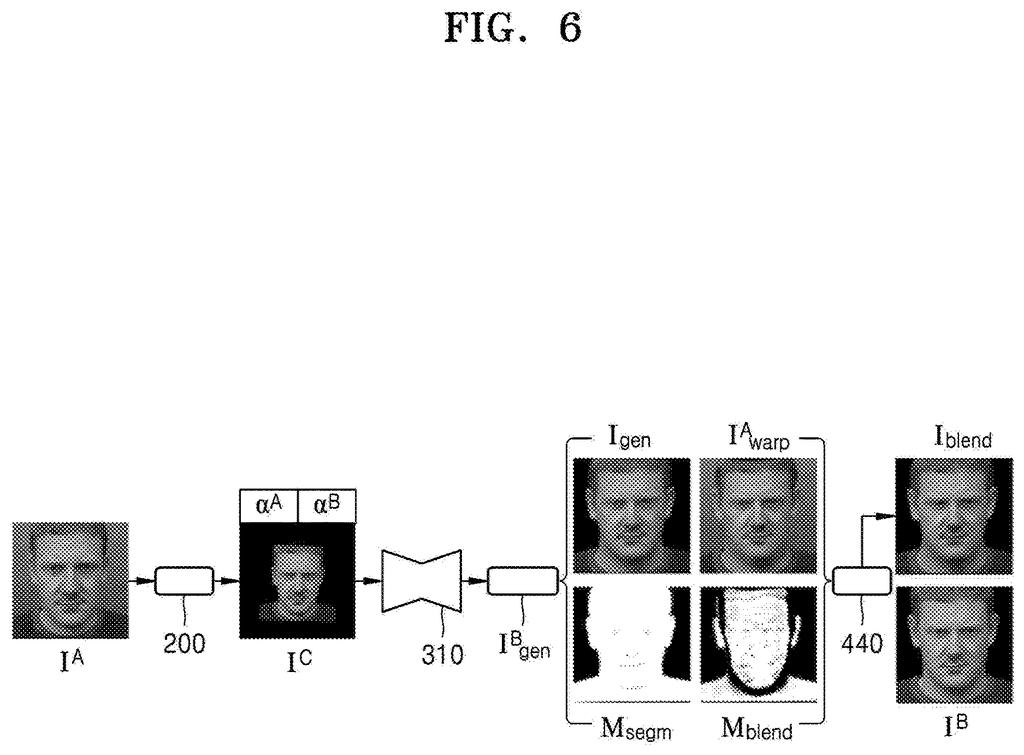
The method starts with a photo and straightens it into a canonical image: the face is moved to a set spot, its tilt is removed and it is scaled to a standard size. Two numbers come along with it, an input angle (how distorted the photo is) and an output angle (how distorted the result should be). Each angle is measured between two lines running from the lens to the left and right edges of the face.
All three go into one pre-trained multi-task neural network (one AI model that produces several outputs at once). Its output channels, called heads, include:
- Warping: a map telling each pixel where to move.
- Restoration: a corrected picture that fills in hidden parts like ears or chin.
- Segmentation: a mask that removes the background.
- Blend mask: a per-pixel recipe for mixing the first two.
- Depth: a per-pixel distance estimate, used mainly in training.
The warped photo keeps fine detail but cannot fill gaps, and the restored one fills gaps but loses detail. The blend takes the best of each with a weighted average (linear interpolation) of their pixels.
The input angle can come from lens data, and the output angle from a preset or a slider. Training used computer-generated face pairs shot from near and far, covering 13,000 identities.
Why selfies and video calls could look better
If you take selfies or sit through video calls, this targets the look where your nose and ears seem oversized because the camera is too close. The filing names smartphones, laptops and video conferencing as places it could run, and says the model can work on the device itself because it needs no per-photo tuning. It also mentions face identification apps, which work better with undistorted faces.
The filing's own tests say it beat seven earlier methods on most measures, including how well the person still looks like themselves. Those are the company's numbers, though. It admits the model can misjudge extreme cases and rare accessories like heart-shaped glasses, and that the input angle may be hard to get for real-world photos.
That makes this Samsung's 33rd filing we've tracked since July in the AI photo editing race, a list that already includes patents for fixing closed eyes and completing cropped people.
Claim 1 is short and wide. It asks for an input image, a straightened-up version of it, two angle numbers and a pre-trained model that returns a corrected picture. Nothing in that claim mentions faces, a camera, or the model's separate output channels. Those show up only in later claims.
As worded, the claim covers any device that feeds a photo, a "how distorted now" number and a "how distorted after" number into one trained network. A rival with a different internal design could still land inside that wording, so the first claim is where the real reach sits.
Whether the Patent Office keeps it that wide is another question, since the filing itself lists earlier methods that also fix distorted portraits. For you, the most concrete detail is the slider idea: the filing says the output angle could be set by a preset or by you, which would let you choose how much of the close-up look gets undone.
Get our take in your Top Stories
Liked this breakdown? Add Patentlyze as a preferred source on Google, and our plain-English take shows up more often in your Top Stories the next time Samsung patent news breaks.
There are more where this came from
We read every patent application Big Tech publishes and send you the ones worth knowing. Plain English, free, every week.
The drawings
13 drawing sheets from US 2026/0340794 A1 · click any drawing to enlarge


Show the other 5 sheets


Want this weekly breakdown for a company we don't cover? Patentlyze Pro →
Be the first to weigh in