
Adobe Files Patent for Wrapping Images Around Smooth 3D Shapes in Real Time
Giving a smooth, formula-based 3D shape a texture normally means converting it into triangles first. Adobe's patent filing describes a way to apply the texture directly and keep the shape fully editable.
What Adobe's 3D texture-wrapping patent does
Imagine you're sculpting a digital clay dragon on your computer, and you want to give it scales. The usual trick is to turn the dragon into a mesh of tiny triangles first, then wrap a scale image around it like gift paper. But that conversion is slow, and it throws away what made your smooth, stretchy clay easy to reshape in the first place.
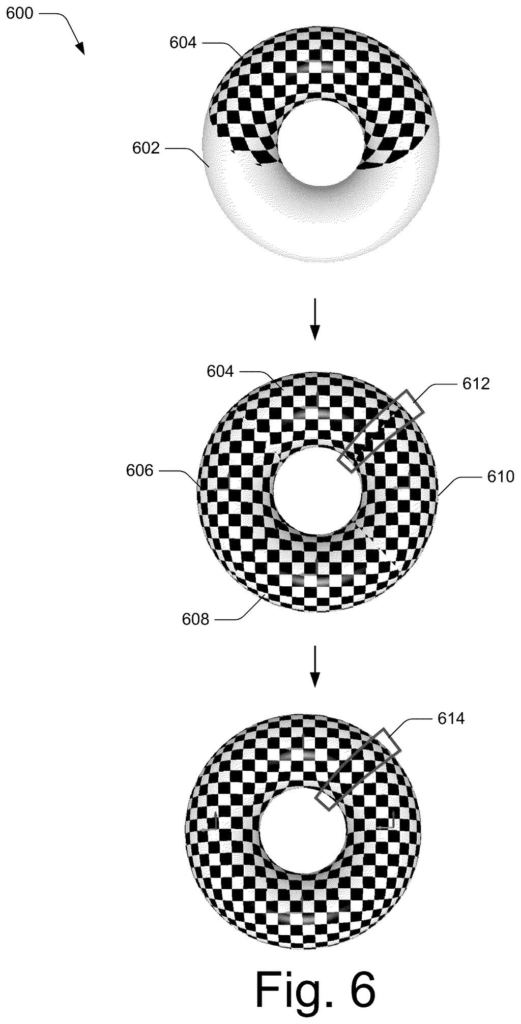
Adobe's patent filing describes a way to skip that step. The software picks a few anchor spots on the shape and, for every other spot nearby, figures out the shortest walk along the surface back to an anchor. That walk gives each spot its own address on a flat image, so the picture lines up.
Where several anchors overlap, the patent blends their addresses so there are no visible seams. It's designed to run fast enough on a graphics chip that you can keep reshaping the model while you watch.
… approximating, by the processing device, a geodesic path between a query point and a reference point on the implicit surface …
Translation: The software calculates the shortest route across a smooth curved shape to map where the texture should go.
How Adobe traces paths across a 3D surface
The patent starts with an implicit surface: a 3D shape described by a formula that gives every point in space a number, with the surface sitting wherever that number is zero. To lay a picture over it, the software needs a flat (u, v) address for each surface point, like grid coordinates on a map. That set of addresses is called a parameterization.
To get a point's address, the system estimates a geodesic path (the shortest route along the surface) from that point back to a nearby anchor, called the reference point. It runs a fixed number of steps, and each step does two things:
- Projects the straight-line direction toward the anchor onto the surface's tangent plane (the flat plane that just touches the surface at that spot).
- Moves along the surface using a second-order approximation, meaning it accounts for curvature so it can take bigger steps.
The path's length and its angle against a reference direction become the u and v coordinates. A sharp-edge test compares neighboring surface directions, and if the angle between them passes a threshold, the patch stops there, so it never tries to wrap across a box's corner.
One anchor gets distorted far away, so the filing places several. Each gets a UV offset, and overlapping coordinates are blended with a weighting function based on geodesic distance. Results can be cached, and the work is meant to run in GPU shaders (small programs on the graphics chip) so it updates as the shape deforms.
The parameterization patch provides a localized two-dimensional (2D) coordinate system on a portion of the 3D object's surface.
Translation: It creates a local flat grid over part of the 3D object so a 2D image can wrap around it without distortion.
Why Adobe's patent matters to 3D sculptors
If you've ever watched a pattern stretch or smear across a 3D model, you've seen what this filing targets. Formula-based shapes are popular because they blend, merge and change form easily. Adding detail like fabric weave, scratches or scales has meant converting them into triangle meshes and losing that flexibility.
The filing describes a 3D modeling service where artists adjust how a texture sits on a shape and see the result instantly, then keep reshaping, cutting or warping the model afterward. It also covers bump and displacement detail (surface features that change how light hits or even the real shape), and a texture that follows the model when it deforms. Nothing here names a shipping product, but it fits creative software where editing stays live instead of being locked in by a conversion step.
Adobe's fourth filing we've tracked in the GPU rendering race since August follows earlier applications like one on transparent 3D objects and one on streaming 3D models early.
The problem is narrow but real. Artists who sculpt with formulas get smooth shapes that morph easily, and then hit a wall the moment they want to put a pattern on them. Converting to triangles fixes the pattern and breaks the sculpting, so they have to pick one.
The approach fits the size of that problem. It does one job, giving every point on the surface a flat address, and it spends its effort on the awkward cases like sharp corners, seams between patches and shapes that keep changing. Anyone who has watched a texture stretch or tear on a 3D model knows how irritating that is, and the patent goes straight at it.
Most people will never see this directly. Whether it holds up in practice depends on testing outside the document, since the filing gives no speed or quality numbers.
Get our take in your Top Stories
Liked this breakdown? Add Patentlyze as a preferred source on Google, and our plain-English take shows up more often in your Top Stories the next time Adobe patent news breaks.
There are more where this came from
We read every patent application Big Tech publishes and send you the ones worth knowing. Plain English, free, every week.
The drawings
10 drawing sheets from US 2026/0350905 A1 · click any drawing to enlarge


Show the other 2 sheets


Want this weekly breakdown for a company we don't cover? Patentlyze Pro →
Be the first to weigh in