
Samsung Files Patent for a TV That Turns Off When You Fall Asleep
Samsung's patent application describes a TV that listens for your breathing and reads how your home Wi-Fi bounces around your body, then shuts itself off once everyone in the room is asleep.
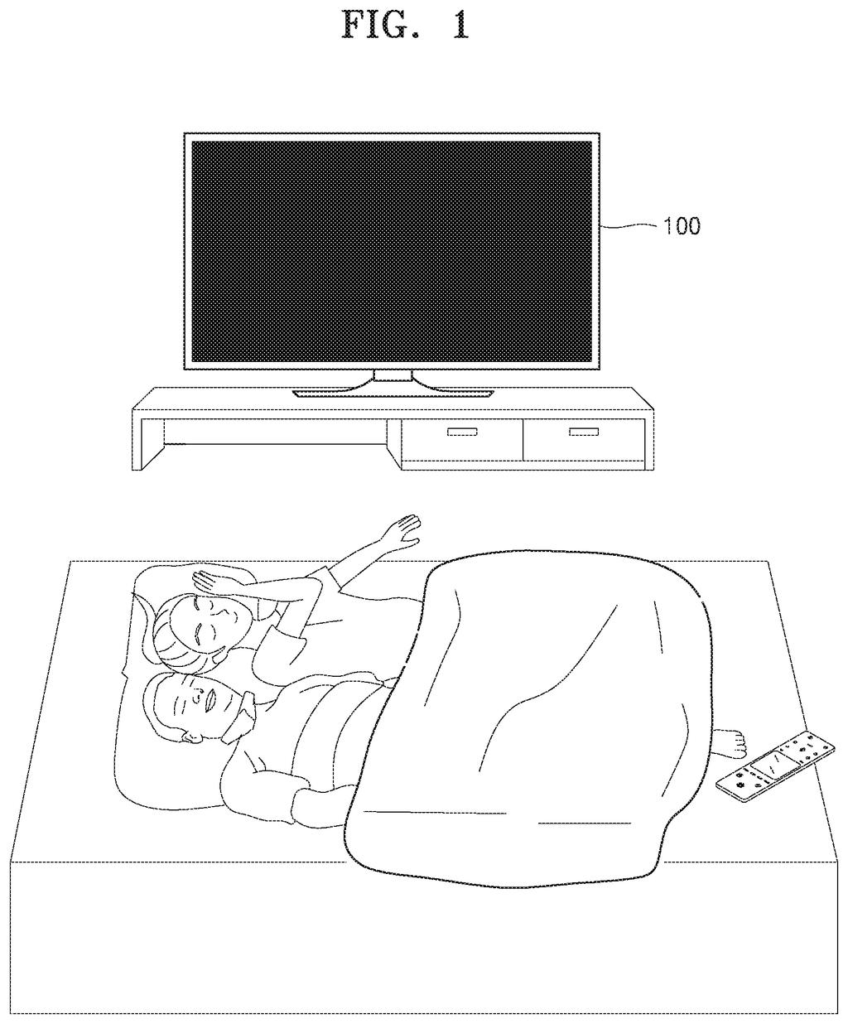
What Samsung's sleep-sensing TV patent describes
Right now, if you nod off during a show, your TV keeps right on playing. Samsung's own filing points out that the sound and light can get in the way of deep sleep. Most fixes rely on a timer you have to set before you doze off.
Samsung's idea is to let the TV work out whether you're asleep. It listens through its microphones for breathing and movement sounds. It also watches your Wi-Fi signal, which wobbles slightly when a person moves or breathes nearby. Put the two clues together over a stretch of time, and the TV decides whether you are awake, asleep, or gone.
If everyone it can detect is asleep, the TV switches to a low-power mode and stops playing sound and video.
identify a final state of at least one user based on first state information and second state information, the first state information being obtained based on an acoustic signal pattern obtained from an acoustic signal, and the second state information being obtained based on a Wi-Fi signal pattern obtained from a Wi-Fi signal …
Translation: The device figures out if you are asleep by listening to sounds and tracking Wi-Fi signals.
How sound and Wi-Fi get combined to spot sleep
The claims cover a device that takes two inputs and combines them into one verdict. The first input is sound. The device filters out background noise and whatever its own speaker is playing, then turns the remaining audio into a Mel-spectrogram (a picture of which pitches are present over time). From that picture it reads pitch, timbre (tone quality) and intensity, which hint at breathing, footsteps or talking.
The second input is the Wi-Fi signal. Wi-Fi radio waves bounce off people, so the signal pattern shifts when someone breathes, sits down or walks around. The device tracks how that pattern trends over a set period. The description gives one example of 25 seconds.
Each clue gets a state weight (a score for awake, asleep or absent). A table in the description shows how: if both signals show someone present but still, or breathing, the score leans toward sleep. A time-based neural network then reads those scores over time to make the final call.
Two extra safeguards appear in the claims. The device measures how far away a sound came from, so a neighbor's Wi-Fi-disturbing movements don't count. And when several people are present, a neural network matches each person's voice to the Wi-Fi channels affected by them. The device sleeps only when every user is asleep.
… control the electronic device to operate in a state corresponding to the final state of the at least one user.
Translation: It changes what the TV is doing to match whether you are awake or asleep.
Why a sleepy TV could be an easy feature to ship
The practical payoff is a TV that stops on its own, with no sleep timer to remember. It also saves power, and the sleep mode keeps only the microphone and Wi-Fi parts running so the TV can notice when you wake up. The description even mentions switching to a quiet music or meditation mode at that point.
The design also tries to fix real weaknesses. Wi-Fi can pick up people through walls, so the distance check keeps a neighbor's activity from fooling your TV. Handling several people matters because couples often fall asleep at different times, and the TV waits for everyone. Samsung lists TVs first, but the filing also names phones, tablets and speakers as possible devices.
Samsung's 29th sensor filing we've tracked since May adds to a run that includes one on keeping robots upright and one on focusing light without lenses in our sensor patent coverage.
This one sits close to a shippable feature. The hardware it needs is a microphone, a Wi-Fi receiver and a processor, and most modern TVs already have those. The filing talks about tuning the neural networks in the factory, which suggests the work is mostly software.
The harder part is reliability. Wi-Fi sensing needs access to detailed signal data that many consumer chips don't expose, and the two-signal design shows the company knows each clue alone gets fooled. A TV that cuts out while you're reading would annoy people fast, so tuning will decide whether this ships.
There's also a privacy question the filing barely touches: a living room TV that listens to you breathe all night. Samsung would need to explain clearly what stays on the device. As a feature, though, a TV that notices you've fallen asleep is easy to understand and easy to want.
Get our take in your Top Stories
Liked this breakdown? Add Patentlyze as a preferred source on Google, and our plain-English take shows up more often in your Top Stories the next time Samsung patent news breaks.
There are more where this came from
We read every patent application Big Tech publishes and send you the ones worth knowing. Plain English, free, every week.
The drawings
15 drawing sheets from US 2026/0351279 A1 · click any drawing to enlarge


Show the other 7 sheets


Want this weekly breakdown for a company we don't cover? Patentlyze Pro →
Be the first to weigh in