
Sony Files Patent for Camera Images That Show Which Way Things Moved
Sony's camera sensor only reports what changes, and this patent application gives each pixel a short memory so a single still image can show which way something moved.
What Sony's event-camera shading actually does
Every time a ball flies across a camera's view, an ordinary camera snaps full photo after full photo, even though almost all of each one is unchanged background. Some Sony sensors work differently: each pixel stays quiet until the light it sees changes, then it reports an event.
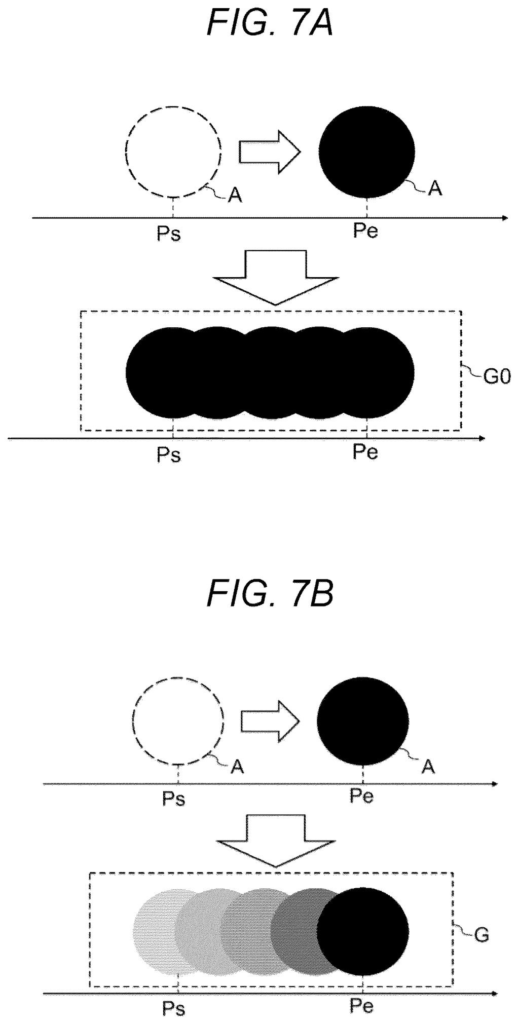
The catch is making that data readable to a person. Squash a short stretch of events into one picture and you get a smear. You can see where something moved, but not which way it went, or whether one spot flickered once or ten times.
Sony's patent application fixes the smear with shading. Newer changes show up brighter and older ones fade, a bit like the afterimage your eyes leave behind. A bright head and a dim tail tell you the direction at a glance.
An information processing device comprising: a pixel including a light detection element that detects an event based on an amount of change in a light amount of incident light …
Translation: The camera uses a special sensor that reacts specifically to changes in brightness.
How each pixel keeps an eight-step motion history
The patent application covers a sensor and the processing behind it. Each pixel in an event-based vision sensor (a camera chip that reports only when the light on a pixel changes, instead of recording full frames) detects an event. A pixel data generation unit then builds, for every pixel, a record of what happened in each of several short time periods.
In the main example, a time window is cut into eight equal slices, and each pixel gets an eight-bit number (a row of eight 1s and 0s). As each slice is processed, the row shifts over one place, the oldest entry drops off, and a new entry goes in on the newest end: 1 if the pixel saw a change, 0 if not. Newer changes land in the places that count most, so the final number is larger when the change was recent and when it happened often. That number is drawn as a shade of gray.
The filing also describes several variations:
- Slices of unequal length, with shorter ones for recent moments so the latest motion is captured in finer detail.
- Recording whether a pixel got brighter or darker (the event's polarity).
- Overlapping frames, so work from earlier frames can be reused and images come out faster.
- Feeding the images to a neural network (software that learns from examples) for tracking, recognizing or predicting the motion of objects.
Visualization of the occurrence time and frequency of an event in a human-understandable form is disclosed.
Translation: The system makes it easy for people to see when and how often motion happens in a scene.
Why readable motion helps robot and car cameras
Event cameras react to motion very quickly and skip the parts of a scene that don't change. Their weak spot is that the raw output is hard for people to read. Sony's approach gives engineers an image where direction and repeated activity show up as shading, and it hands AI models richer input for following and predicting movement. The description names industrial robots and smartphones as places the device could go, along with vehicles in its application examples.
This is an early-stage application. The examiner's first review rejected the claims as filed, which is routine and usually followed by amendments, so the final scope may end up narrower. Nothing in the filing points to a specific product.
Sony's 100th filing we've tracked in our Display coverage since May follows work like pixel isolation walls and motion-free sensor capture.
The problem here is narrow but real. Event cameras are a specialty sensor, and their raw output looks like a smear when a person tries to read it. For an engineer debugging a robot or a car camera, being unable to tell which way something moved is a daily annoyance.
The fix matches that size. Each pixel keeps a short row of 1s and 0s, and a brightness rule turns it into a picture. It is simple to explain, and the description says reusing overlapping data speeds up how fast images come out.
You will not notice this on your phone. Its value is as plumbing that makes motion data readable for both people and AI models, and that is a modest job done sensibly.
Get our take in your Top Stories
Liked this breakdown? Add Patentlyze as a preferred source on Google, and our plain-English take shows up more often in your Top Stories the next time Sony patent news breaks.
There are more where this came from
We read every patent application Big Tech publishes and send you the ones worth knowing. Plain English, free, every week.
The drawings
23 drawing sheets from US 2026/0352967 A1 · click any drawing to enlarge


Show the other 15 sheets


Want this weekly breakdown for a company we don't cover? Patentlyze Pro →
Be the first to weigh in