
Samsung
Samsung · Display · Filed Jan 29, 2026 · USPTO published Oct 8, 2026 · Oct 8 release
Samsung Patents a Fix for Jagged Lines on Screens That Show 3D Without Glasses
Glasses-free 3D screens have a quirk: straight lines can look broken, and thin white lines can split into red, green and blue stripes. Samsung's patent application describes a software fix that blends pixel values in just the trouble spots.
- Publication number
- US 2026/0313085 A1(US20260313085A1)
- Applicant
- Samsung Electronics Co., Ltd.
- Filed · Published
- Jan 29, 2026 · Oct 8, 2026
- Inventors
- Kyungmin LIM, Jonghoon LEE, Daeyeong KIM
- Status when we published
- Waiting for an examiner
- Document
- 20 claims
- US classification
- 348/51
- Parent application
- Continuation of 18/812,391 (filed Aug 22, 2024)(18812391)
What Samsung's 3D-screen line fix actually does
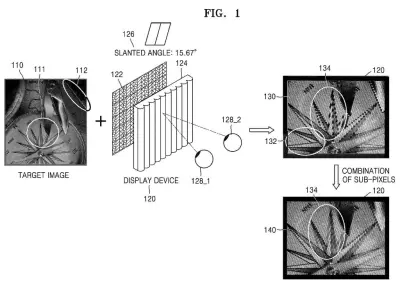
Ever watched a perfectly straight line on a screen turn into a little staircase? On some glasses-free 3D displays, that really happens. These screens put a sheet of tiny ridged lenses over the pixels so each of your eyes sees a different image. The side effect is that some lines look chopped up, and thin white lines can split into separate red, green and blue stripes.
Samsung's patent application describes a software fix. The screen scans the picture for the spots most likely to go wrong, then blends the brightness of neighboring dots there. Instead of a harsh jump from black to white, you get a gentle fade, and your eye reads that as one clean line.
The screen only touches the problem areas. Everything else in the picture is left exactly as it was.
… identifying, by the display device, at least one area in the target image, which comprises at least one edge within the target image, which is slanted with respect to the display axis at a second slanted angle that is within a preset range from the first slanted angle …
Translation: The screen searches for image lines running at nearly the same tilt as its internal lens layer.
How the screen finds and blends problem pixels
The display sits behind a lenticular lens (a sheet of tiny side-by-side ridges that sends different pixels to each eye). The sheet is tilted slightly against the pixel grid. That tilt, called the slanted angle, is stored in the device's memory, and the filing's example is 15.67 degrees. Each ridge covers a strip of pixels called a pitch section.
The main claim covers fixing broken edges, in four steps:
- Turn the frame to grayscale and run edge detection (finding where brightness changes sharply).
- Build a mask image (a black-and-white map that flags problem zones) marking edges whose angle is within a preset range of the lens tilt.
- For each flagged sub-pixel (one red, green or blue dot), select the sub-pixels in the same row inside its pitch section.
- Replace their values with an average, weighted sum or weighted average.
Only some sub-pixels in a strip get magnified for a given viewing position, so a hard black-to-white edge looks like a step. Averaging turns it into a gradual brightness ramp.
Dependent claims add a second fix for thin white lines. The screen boosts contrast, applies a morphological operation (an image trick that shrinks and regrows shapes so thin lines vanish), then subtracts the result to isolate those lines. It blends vertical neighbors, for example two sub-pixels above and three below, so red, green and blue mix back into white. The filing also says an AI model could produce the blend values.
… selecting, by the display device, a plurality of sub-pixels of a same row as a first sub-pixel included in the identified at least one area, and allocating, by the display device, a first combination value to an output value of each of the plurality of sub-pixels …
Translation: It then blends together the neighboring dots in that same row to smooth out the jagged edges.
Why glasses-free 3D screens need this cleanup
If you ever buy a glasses-free 3D screen, sharpness is the whole selling point, and broken lines or rainbow-edged text undercut it fast. This patent application goes after exactly those flaws using only math on the image, so the same fix could apply to any screen with this lens design. The filing lists ad monitors, gaming monitors, TVs, photo frames, laptops and VR or AR devices as possible hosts.
The cost is small but real: corrected thin lines come out dimmer and thicker than the original. Because the fix is simple averaging, the filing says it can be processed rapidly, which matters when every frame of a video needs it. It is also a continuation of an earlier application filed in 2024, so this is a refinement of an existing idea.
Samsung's 113th filing we've tracked since May in our display technology work, this application follows one on blocking signal disruption and one on balancing screen signals.
Source: US 2026/0313085 A1 at the USPTO (PDF). Full patent text and figures are in the official publication.
Get our take in your Top Stories
Liked this breakdown? Add Patentlyze as a preferred source on Google, and our plain-English take shows up more often in your Top Stories the next time Samsung patent news breaks.
Add Patentlyze on Google
One click.
There are more where this came from
We read the new patents from Big Tech, carmakers and more and send you the ones worth knowing. Plain English, free, every week.
The drawings · 23 sheets
23 drawing sheets from US 2026/0313085 A1 · click any drawing to enlarge


Show the other 15 sheets


More from Samsung
All 1,662 Samsung patents →
More in Display
All 746 Display patents →
Samsung
Samsung's New Patent Gives Red, Green, and Blue Pixels Their Own Resting Voltage
Samsung
Samsung Patents a Depth-Map System That Sharpens How Images Appear on Display
Samsung
Samsung Display Patents an OLED Wiring Layout That Keeps Every Pixel Electrically Equal
Samsung
No comments yet