
Qualcomm Files Patent for Tagging Car Video With Details About the Camera That Shot It
A car camera doesn't capture a whole frame in one instant, and a new Qualcomm patent adds a note to the video file saying exactly how it did.
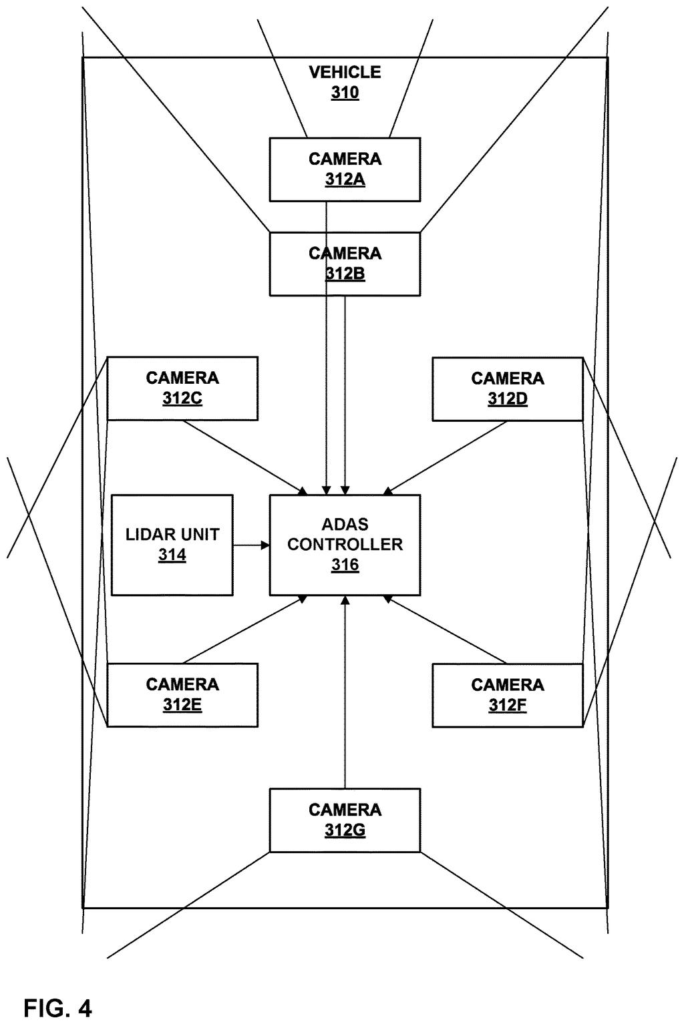
What Qualcomm's camera-note patent actually does
Every time a car's camera records a frame, it doesn't grab the whole picture at once. Most sensors scan from top to bottom, line by line, so the bottom of the image is captured a split second after the top. On a moving car, that tiny gap can bend and smear the scene.
Qualcomm's patent is about keeping that detail from getting lost. When video from a car is saved to train driver assistance AI, the file can carry a short side note, called an SEI message, that describes the camera: how fast it scans, how its lens bends the view (fisheye lenses stretch the edges), and which way it points and where it sits on the car.
Whoever opens the file can then use the picture the way the camera really saw it, instead of tidying it up first and throwing away pixels along the edges.
decoding video data of a bitstream to form decoded video data, the bitstream including the video data and a supplemental enhancement information (SEI) message including one or more camera parameters for a camera used to capture the video data …
Translation: The system reads video files bundled with hidden data detailing the exact camera settings used during filming.
How the camera facts ride along inside video
The patent covers a way to attach camera facts to recorded video. Video files can carry optional side notes called SEI messages (supplemental enhancement information, extra data a player doesn't need in order to show the picture). Claim 1 has a device decode the video, pull camera parameters out of that note, work out the camera's physical capture characteristics, and process the video with those in mind.
The filing describes three kinds of facts:
- Rolling shutter timing: how long the sensor takes to scan from its first pixel to its last, which direction it scans (top to bottom, bottom to top, or side to side), and the delay before the scan starts. One example in the filing is 0.04 seconds.
- Lens distortion: formulas, named Woodscape and Brown-Conrady, that describe how a wide-angle or fisheye lens bends the image. Both are used by well-known driving datasets.
- Camera pose: where the camera sits and which way it points, with rotation written as quaternions (a four-number way to describe a turn that is easy to combine with other turns), a rotation matrix, or Euler angles (yaw, pitch and roll).
The filing gives one worked example. A spinning LIDAR (a laser scanner that measures distance) runs 10 times per second while cameras run at 25 frames per second. With a rolling shutter, the laser sweep closest in time to a pixel depends on both its row and its column, so the scan timing lets the system pair them correctly.
… optical distortion/correction model information represented using one of Woodscape or Brown-Conrady, and/or camera extrinsics information for the camera (e.g., a format in which rotation information is expressed, such as quaternions, 3×3 rotation matrices, or Euler angles) …
Translation: It tracks lens distortion and precise camera angles using specialized mathematical formats.
Why driver-assist training data needs the details
If your car has lane keeping or automatic braking, the software behind it learned from hours of recorded video. This patent aims to make sure that video travels with an accurate description of the camera that shot it. The filing points out that fisheye lenses stretch the edges of a picture, and that straightening the image to look normal throws away pixels. Keeping the raw picture and describing the lens could help a system notice things close to the car, such as a curb or a post during parking.
For Qualcomm, the filing reads as a bid to make camera details a standard part of how car video is stored and shared. It says existing video metadata formats lack rolling shutter timing, these two lens models, and quaternion rotation. A format like this only helps if the people who record the video and the people who train the AI read it the same way, so its value depends on others adopting it.
Qualcomm's 51st filing we've tracked since July in our self-driving sensing race builds on the network handoff safety check and the lane-line positioning work.
Claim 1 covers any device that reads a video file, finds an attached metadata note describing how the camera was set up, and uses that information to process the footage. Nothing in that claim limits it to cars, roads, or safety systems. A phone, a laptop, or a streaming box doing exactly this would read on the claim just as naturally as a vehicle computer would.
The narrower ideas, like correcting for a rolling shutter, modeling lens distortion, or feeding the result into a driver assistance system, only show up in the dependent claims. That means they add protection but do not define the foundation.
The foundation is a broad claim on the general practice of packaging camera setup notes inside a video file and acting on them, and that practice already runs through enormous swaths of consumer electronics. If granted, claim 1 gives Qualcomm a hand on the door of a very wide room.
Get our take in your Top Stories
Liked this breakdown? Add Patentlyze as a preferred source on Google, and our plain-English take shows up more often in your Top Stories the next time Qualcomm patent news breaks.
There are more where this came from
We read every patent application Big Tech publishes and send you the ones worth knowing. Plain English, free, every week.
The drawings
6 drawing sheets from US 2026/0352890 A1 · click any drawing to enlarge


Want this weekly breakdown for a company we don't cover? Patentlyze Pro →
Be the first to weigh in