
Qualcomm Patents Car Camera Technology That Fixes Its Own Positioning Using Nearby Vehicles
Every camera on a self-driving car needs to know exactly where it's pointing, and right now that calibration is a painstaking process. Qualcomm's new patent describes a shortcut: let the car borrow position data from cameras on other vehicles or roadside units nearby.
What Qualcomm's cross-camera calibration actually does for drivers
Ever tried to find a street address using just one blurry photo? It's nearly impossible on its own, but cross-reference two or three photos taken from known spots and you can pin it down quickly. That's roughly the idea here.
Qualcomm's patent describes a system where a car's camera can figure out its own exact position and angle by comparing what it sees with images and location data sent over from other cameras nearby, whether those are on other vehicles, roadside infrastructure boxes, or other sensors on the same car. The overlapping views let software triangulate where your camera must be sitting and which direction it's pointing.
This matters because cameras on driver-assistance systems can drift out of calibration over time, especially after bumps or temperature changes. Instead of waiting for a garage visit, this approach lets the car recalibrate on the fly using data it picks up from the world around it.
… determining, by a processor, third pose information of the camera based on the first image data, the second image data, the third image data, the first pose information, and the second pose information.
Translation: The system calculates the exact position of your car camera by comparing its view with the camera views and locations of nearby vehicles.
How the system lines up overlapping views to find camera position
The patent describes an image-processing method built for vehicle driver-assistance systems. At its core, a processor takes in three streams of visual data simultaneously:
- First image data from the car's own camera, covering whatever scene is in front of it.
- Second image data plus pose information from a first external source (another vehicle or a roadside unit), where the external camera's position and orientation are already known.
- Third image data plus pose information from a second external source, again with known position and orientation.
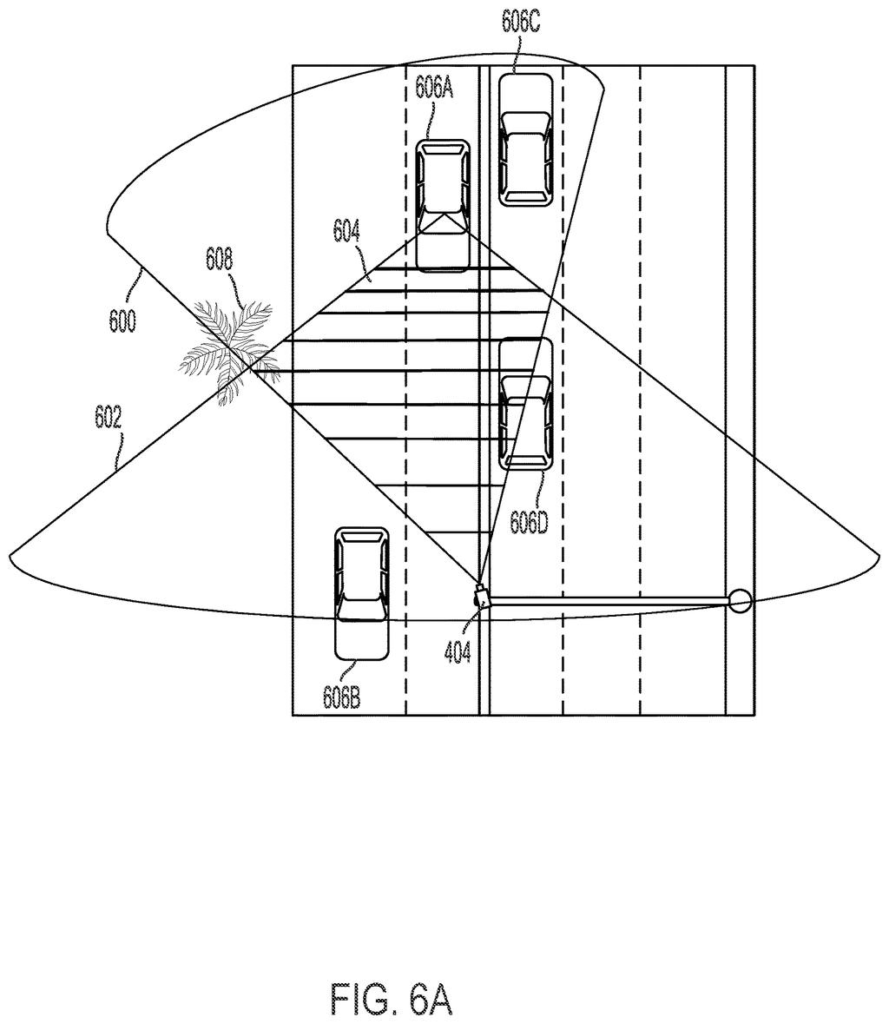
The key requirement is that all three camera views must overlap at least partially. That shared visual content is what gives the algorithm something to work with: if two cameras with known positions both see the same stop sign, and your camera also sees that stop sign, software can calculate where your camera must be and which way it's facing.
Pose information is just the technical term for a camera's position in space combined with the direction it's pointing, essentially its location plus its orientation. By combining the external sources' known poses with the shared scene content, the system computes the third pose, meaning the pose of the vehicle's own camera, without needing manual measurement or a calibration target. The computation is done on-device by a processor in real time.
A field-of-view of the camera overlaps with a fieldof-view of the first source and with a field-of-view of the second source.
Translation: Your camera's field of view overlaps with the views of at least two other nearby image sources.
What this means for the reliability of self-driving camera systems
Driver-assistance and self-driving systems depend heavily on cameras knowing exactly where they sit relative to the road. Even a small drift in a camera's angle can throw off lane-keeping or collision-avoidance calculations. Traditional calibration requires controlled conditions, like driving over a special mat or visiting a service center, which means problems that develop in the field can go uncorrected for a long time.
A system that can recalibrate using data shared from nearby vehicles or roadside infrastructure could make camera-based safety systems more reliable over the life of a vehicle. It also fits neatly into the broader push toward connected vehicles that share sensor data with each other, sometimes called vehicle-to-everything, or V2X, communication.
Qualcomm's 37th filing we've tracked since July in our self-driving sensing race watch builds on one prioritizing dangerous objects and one boxing objects without facing data.
Getting this from patent to dashboard depends on two things that don't fully exist yet: a network of nearby vehicles or roadside devices that share precise location data in real time, and agreed-upon standards so all those devices speak the same language.
The encouraging part is that this is a software and data problem, not a hardware one. Cars already carry the cameras and processors this method needs, so the shortest path to a product runs through communication standards and infrastructure rollout rather than a new chip design.
That makes this a medium-term bet. Accurate cameras are the foundation of any driving assistance system, and recalibrating them automatically without a trip to a shop is a real and practical improvement. But it only becomes useful once enough vehicles and roadside units around you are consistently sharing the right data.
There are more where this came from
We read every patent application Big Tech publishes and send you the ones worth knowing. Plain English, free, every week.
The drawings
8 drawing sheets from US 2026/0278840 A1 · click any drawing to enlarge


Want this weekly breakdown for a company we don't cover? Patentlyze Pro →