
Qualcomm Files Patent for Relaying Car Warnings Around Blind Corners
Buildings block the radio signals cars use to warn each other, so Qualcomm's filing has a roadside box, or even another car, repeat the warning toward the road that can't hear it.
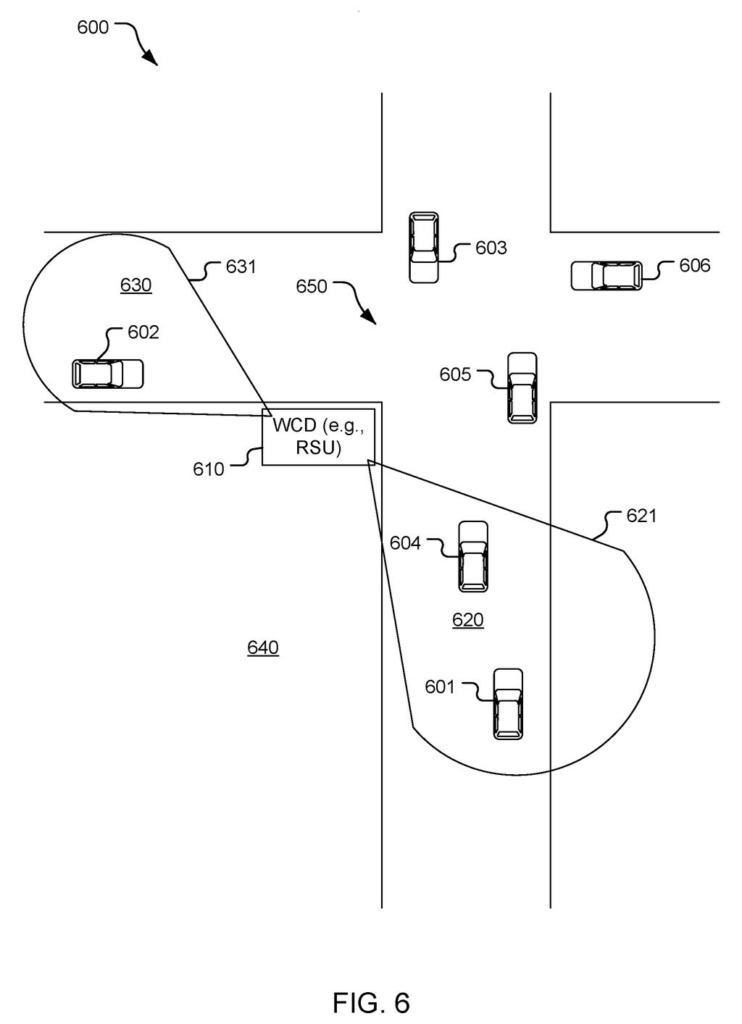
What Qualcomm's blind-corner relay actually does
Imagine you're driving toward an intersection with a big building on the corner. Around that corner, another car is speeding toward the same spot. Your car can't pick up its safety broadcasts because the building blocks the radio signal, so neither of you knows the other is there until it's almost too late.
Qualcomm's filing describes a fix: a device that can see both roads, such as a roadside unit or even another car in the intersection, listens to one road and repeats the warning toward the road that can't hear it. It uses directional antennas, which aim a signal one way instead of everywhere, so the message goes only where it's needed.
The device also decides whether to speak up at all. It can stay quiet if the other car's path won't cross yours, or if another car already passed the message along, so the airwaves don't get clogged.
… selecting at least a second region relative to the wireless communication device based at least in part on the one or more signals being unable to be received in the second region relative to the wireless communication device …
Translation: The device figures out which area is blocked from hearing the original vehicle signal.
How the relay picks which road to warn
Claim 1 covers a device that listens in one direction for signals tied to a vehicle, such as the safety broadcasts cars send out (location, speed, heading, braking status). It then picks a second direction where those signals can't be received, using a condition of that vehicle like its expected path or speed, and sends a message that way.
The filing describes several ways to carry this out:
- Relay or summarize: repeat the original message, bundle messages from several cars into one, or add notes such as which lane a car is in (worked out from a camera) and whether it can talk to other cars.
- Take turns: if several cars could relay the same message, one is chosen and the others stay quiet. A relaying car hands the job off when it loses line of sight.
- Skip when pointless: a safety message stays fresh for only about 100 to 200 milliseconds, so the device holds back if the message would be stale on arrival, or if the road is already crowded with equipped cars.
Claim 11 puts this on hardware with two directional antennas, one for listening and one for sending. The filing also describes a roadside unit sharing live feeds of activity over a cellular network connection, sometimes using simple boxes in place of detailed images to save bandwidth.
What this means for cars at blind intersections
The filing says cars at an intersection may not hear each other until they are very close, which can be too late to use the warning. A relay that passes along alerts well before the corner could give your car, or its driver-assist system, more time to brake or adjust.
The filing also tries to keep the airwaves from jamming up: it cuts duplicate messages, skips stale ones, and adds a note on whether a car can send such alerts itself. That matters for self-driving features, which depend on knowing what is around the bend. It is a patent application, so nothing here says when or whether it shows up on real roads.
This is the 48th Qualcomm filing we've tracked since July in self-driving sensing, building on roadside GPS error catching and phone alerts in danger zones.
Claim 1 is written broadly. It asks for a device that hears a signal about a vehicle in one direction, picks another direction where that signal can't be heard, and sends a message there. The device could be a roadside box or a car, and the claim names no specific radio technology.
The one real condition is the choice step: the direction has to be picked using the vehicle's situation, which the dependent claims spell out as its expected path or speed. As written, a plain repeater that blasts every message in every direction would not match that wording.
The device claim (claim 11) adds two directional antennas, one to listen and one to send. That makes it narrower and easier to picture on actual hardware. Overall the claims describe a sensible fix for a familiar problem: a broad idea with a modest gate in the middle.
Get our take in your Top Stories
Liked this breakdown? Add Patentlyze as a preferred source on Google, and our plain-English take shows up more often in your Top Stories the next time Qualcomm patent news breaks.
There are more where this came from
We read every patent application Big Tech publishes and send you the ones worth knowing. Plain English, free, every week.
The drawings
11 drawing sheets from US 2026/0343194 A1 · click any drawing to enlarge


Show the other 3 sheets


Want this weekly breakdown for a company we don't cover? Patentlyze Pro →
Be the first to weigh in