
Microsoft Files Patent for Sharper Game Graphics That Don't Flicker or Leave Ghost Trails
When a game sharpens its picture using earlier frames, it can leave shimmering edges or smeared ghost trails. Microsoft's patent application tries to fix both by first figuring out what kind of problem each pixel has.
What Microsoft's pixel-sorting sharpener actually does
Imagine you're playing a racing game and a car zips past a lamppost. The edge of the post shimmers, or a faint smear trails behind the car like a ghost. Both glitches show up when a computer takes a lower-detail picture and tries to sharpen it using what it drew a moment ago.
Microsoft's patent application tackles this by sorting every pixel first. The system asks whether a pixel is a jagged edge that benefits from earlier frames, or a spot where the earlier frames would be misleading, such as something that just stepped out from behind a wall.
Based on that sorting, it decides how much of the previous picture to blend into the new one, pixel by pixel. The goal is an image that looks sharper, stays still instead of shimmering, and doesn't smear.
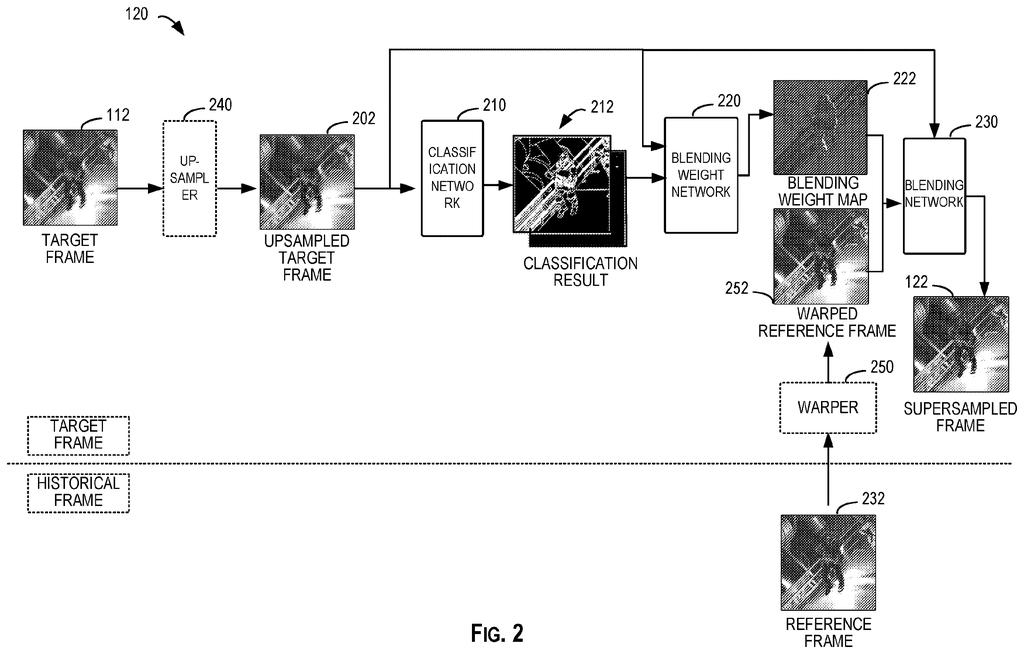
classifying pixels of a target frame into a plurality of pixel categories; determining a blending weight map for a reference frame of the target frame at least based on a result of the classifying …
Translation: The system sorts pixels into groups to figure out how past frames should be mixed in.
How two small networks decide which old pixels to keep
The system takes a frame (the target frame) rendered at lower resolution and builds a higher-resolution version, for example turning 1920 by 1080 pixels into 3840 by 2160. It blends the new frame with a reference frame, usually the sharpened result from the previous frame, so detail builds up over time.
The twist is a two-step design built on two small neural networks (software trained on examples to spot patterns). The first labels each pixel with probabilities across categories:
- Jagged-edge (aliasing) types: edges of shapes, textures, or neither.
- Ghosting types: something newly uncovered, a lighting or shadow change, or neither.
The second network turns those labels into a blending weight map, a grid of numbers saying how much to trust each old pixel. Jagged-edge pixels lean on history to fill in detail. Ghost-prone pixels lean on the new frame. The networks also use depth and motion data from the game engine, plus a running count of how many past frames stayed valid for each pixel; that count resets to zero when something is uncovered.
The filing says splitting the work lets each network stay small, which cuts computing and memory cost compared with one all-in-one model.
The target frame is blended with the reference frame based on the blending weight map, to obtain a supersampled frame corresponding to the target frame.
Translation: It combines the current image with earlier ones to create a sharper final picture.
What cleaner upscaled video means for your games
If you play games or watch computer-rendered video, the payoff would be a picture that looks crisp without shimmering edges or smeared trails behind moving objects. Those are exactly the flaws that make upscaled graphics look fake. Keeping the models small also matters, since this kind of cleanup has to run on every frame without eating into performance.
The filing describes games as the main example, and it leans on depth and motion data that game engines already produce. The examiner's first review rejected the claims as filed, a routine step that is usually followed by amendments, so the final scope is still open.
Microsoft's third filing we've tracked in our GPU rendering work since October follows one pairing upscaling with HDR and one teaching AI to sharpen graphics.
If this works as described, you would notice it in the moments that bug people most: a fence line crawling as you walk past, or a faint smear behind a fast-moving character. Those flaws are small, but they are the first thing your eye catches on a big screen.
The smart part is the order of operations. Deciding what is wrong with a pixel before deciding how much history to trust gives the system a reason for every blend, and it should mean fewer unexplained glitches.
The filing gives no test results, so we can't say how much better the picture gets. Still, it targets a flaw gamers already complain about, and a fix that works would show up on screen without anyone needing to explain it.
Get our take in your Top Stories
Liked this breakdown? Add Patentlyze as a preferred source on Google, and our plain-English take shows up more often in your Top Stories the next time Microsoft patent news breaks.
There are more where this came from
We read every patent application Big Tech publishes and send you the ones worth knowing. Plain English, free, every week.
The drawings
4 drawing sheets from US 2026/0350746 A1 · click any drawing to enlarge


Want this weekly breakdown for a company we don't cover? Patentlyze Pro →
Be the first to weigh in