
Microsoft Files Patent to Make Game Upscaling Work With HDR Visuals
The AI tricks that make games run faster and look sharper mostly stop working once you turn on HDR. A new Microsoft filing describes how to fix that at the operating system level.
What Microsoft's HDR upscaling patent actually does
Right now, the tools that sharpen low-resolution game frames or fill in missing ones are mostly built for standard-range images. Feed them an HDR frame, with its brighter highlights and deeper colors, and you can get odd artifacts, wrong colors, or even a corrupted video signal.
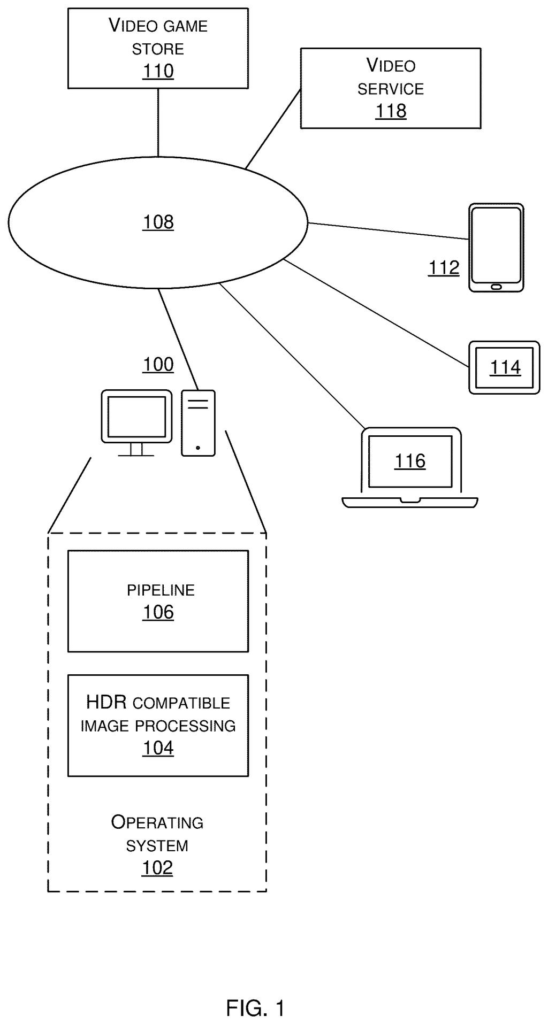
Microsoft's filing describes a small AI model built specifically for HDR images. It sits inside the operating system, grabs frames from the game's drawing pipeline, cleans them up, and hands them back fast enough to keep up with the game.
The idea is that your PC can draw a game at lower resolution to get a smoother frame rate, then have the model fill in the detail without wrecking the HDR look. The same approach can also remove grainy noise from video or create extra frames in between real ones.
… processing the input image to produce an output image, using a machine trained model that is compatible with HDR images, executing at least in part on the accelerator …
Translation: AI upgrades the image quality while fully supporting high dynamic range graphics.
How Microsoft trains its AI on HDR game frames
The claims cover a method where a computer with an accelerator (a chip such as a graphics processor or neural processing unit that handles heavy math) takes an HDR image from a pipeline, runs it through a machine trained model built for HDR, and puts the result back into the pipeline. It has to run at a rate matching or exceeding the pipeline itself, so it never slows the game down.
The model can do three jobs: super resolution (adding detail to a low-resolution frame), denoising (removing grain), or frame generation (inventing in-between frames to raise the frame rate). Separate claims cover this as an operating system feature and as an apparatus that upscales game frames.
The filing spends most of its effort on training. Key pieces:
- Non-linear color space: the filing says the model learns far better when HDR training images are converted from linear color values to a non-linear format, so the system converts incoming frames to match.
- Two-part loss: the model is graded on both pixel-by-pixel accuracy and a perceptual loss (a score of how similar two images look to a person).
- A workaround for the perceptual score: the usual tools for that score only understand standard images, so the HDR images are tone mapped (squeezed into standard range) and resized before being scored.
The example model is small, under 500,000 parameters, and meant to run at 30 frames per second or more.
Why HDR gamers and Windows users may care
If you play HDR games on a Windows PC, this is aimed at letting upscaling and frame generation work without forcing you to choose between smooth performance and HDR picture quality. Because it lives in the operating system, it could in theory help any game or video, not just ones whose makers add support.
The filing also points to power savings: drawing fewer, smaller frames and letting a light model fill in the rest takes less work than rendering everything at full size. That matters on laptops and handheld gaming PCs. Nothing here names a product, so treat it as a description of a technique, not a launch.
Microsoft's second filing we've tracked since October in our GPU rendering race watchlist follows its earlier AI sharpening application.
The big tradeoff is quality versus speed. The model is deliberately tiny, under 500,000 parameters, so it can keep pace with a game running at 30 frames per second or more. A small model has less room to get fine detail exactly right, so tricky scenes with glare or fast motion are where it could slip.
The training shortcut carries a cost too. To grade the model on how images look to a person, Microsoft shrinks and flattens the HDR images into standard range first. Some of the very highlight detail HDR exists to preserve gets lost in that step, at least during training.
Still, the trade reads as sensible. A slightly imperfect upscaler that works in HDR beats one that corrupts colors, and the fix is mostly careful data preparation, which makes this a practical filing rather than an exciting one.
Get our take in your Top Stories
Liked this breakdown? Add Patentlyze as a preferred source on Google, and our plain-English take shows up more often in your Top Stories the next time Microsoft patent news breaks.
There are more where this came from
We read every patent application Big Tech publishes and send you the ones worth knowing. Plain English, free, every week.
The drawings
10 drawing sheets from US 2026/0350747 A1 · click any drawing to enlarge


Show the other 2 sheets


Want this weekly breakdown for a company we don't cover? Patentlyze Pro →
Be the first to weigh in