
Qualcomm Files Patent for Phones That Vibrate in Sync With What's on Screen
Most video has no vibration built in, so a car crash on your phone screen feels like nothing. A new Qualcomm patent application has the device spot the crash a split second early and buzz your hands to match.
What Qualcomm's video-aware vibration idea does
Right now, your phone only buzzes when you tap something, or when the video you're watching came with vibration cues built in by its creators. If it didn't, a car crash or an explosion on screen plays out with nothing for your hands to feel. Qualcomm's patent application tries to fill that gap for any video.
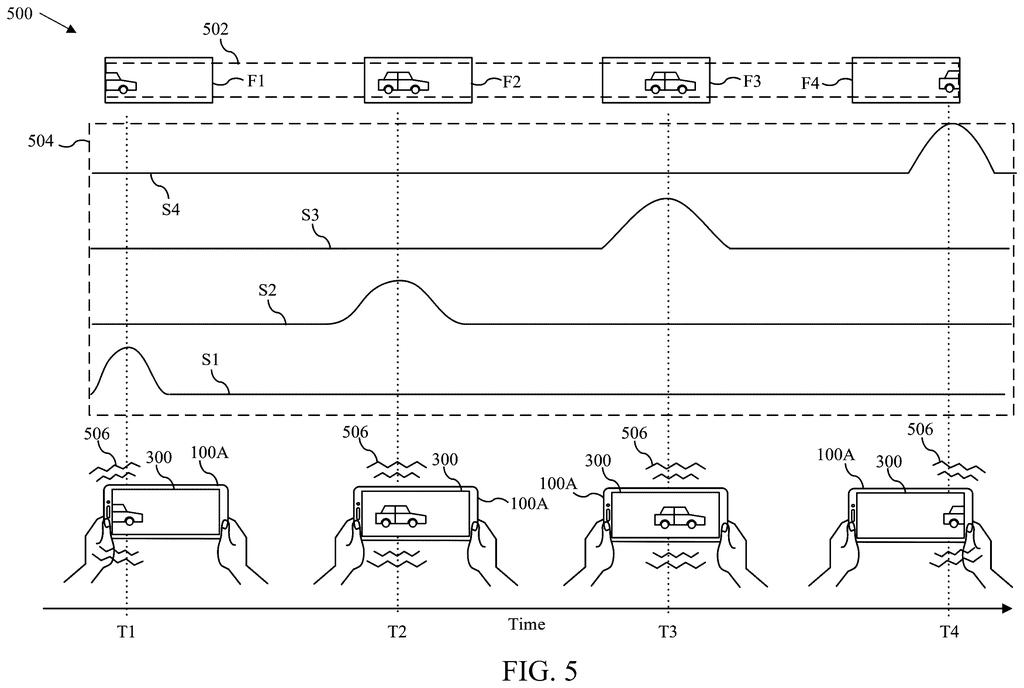
The idea: the device looks a few frames ahead of what you're watching, spots moments like a crash, a gunshot or a car sweeping across the screen, and builds a vibration to match. The buzz lands at the exact moment the scene appears. A car driving left to right could make the left side of your phone vibrate first, then the right.
It also pays attention to how you're holding the phone. If it's sitting on a table, the vibrations switch off. If you grip it with one hand, only the motors near that hand fire. You can even set how touchy it is.
detect a context trigger associated with one or more frames in the sequence of frames, prior to a presentation of the one or more frames during playback of the multimedia content; generate a haptic control signal based on the detected context trigger; and control, based on the generated haptic control signal, one or more haptic actuators to deliver a haptic effect …
Translation: The phone spots a cue in the video beforehand and tells its internal motors to rumble right on time.
How the phone reads frames before they play
The filing describes a device that keeps a stretch of upcoming video frames in memory (a buffer, the short queue a player loads before showing them) and scans them before they are shown. It looks for a context trigger: a movement, an object, an impact or a visual pattern such as flashing lights. A trained AI model can do the detection.
When it finds one, it builds a haptic control signal, which is a set of instructions telling the vibration motors what to do. The signal can set strength, pitch (frequency), length, timing, intensity and where on the device the effect happens. The timing is tied to the frame, so the buzz lands as the scene appears.
The device can also store a library of known triggers, each paired with a default vibration pattern (a baseline haptic profile). If the match is full or partial, it picks that default and adjusts it. An explosion far in the background gets a weaker buzz than one up close on the right side of the frame.
The filing adds several options:
- Touch and grip sensors work out how you're holding the device, and vibrations stop when nobody is touching it, which saves power.
- Four sensitivity levels (L1 to L4) set how closely a scene must match a known trigger.
- Sliders let you cap amplitude, frequency, duration and intensity.
- The motors can sit in a phone or in a separate controller, vest or seat linked by Bluetooth or Wi-Fi.
What this means for watching video on a phone
If this works the way the filing describes, a movie or game wouldn't need to ship with special vibration cues. Any video playing on your phone, tablet, or a connected controller, vest or chair could get touch feedback, because the device works out the moments itself. In one example, the AI step runs on the device's own AI chip, and the buzzing shuts off when nobody is holding it.
Keep expectations modest. An examiner's first review rejected the claims as filed, which is routine at this stage and usually followed by changes. The filing describes a method and names no product. Whether you'd ever use it depends on whether the guesses feel right, which is why the filing includes sensitivity levels and sliders for strength and length.
Qualcomm's 70th filing in cell phone patents we've tracked since May follows work like the clogged speaker detector and the watch-based car finder.
You'd notice this in a chase scene or a battle on your phone, where an explosion on the right would thump the right side of the device. That is a pleasant touch for video that never had any vibration to begin with.
The risk is a phone that buzzes at the wrong moments. A gun held calmly in a drama or a flashing light in a music video could set it off. The sensitivity levels and strength sliders exist because misfires would get irritating fast. The shutoff when you set the phone down also keeps it from draining your battery on buzzes nobody feels.
Bottom line: a fun extra you'd try once and then keep or turn off depending on how well it guesses. If the vibrations match what you see, it makes small-screen video feel bigger. If they don't, you'll mute it within a day.
Get our take in your Top Stories
Liked this breakdown? Add Patentlyze as a preferred source on Google, and our plain-English take shows up more often in your Top Stories the next time Qualcomm patent news breaks.
There are more where this came from
We read every patent application Big Tech publishes and send you the ones worth knowing. Plain English, free, every week.
The drawings
16 drawing sheets from US 2026/0351098 A1 · click any drawing to enlarge


Show the other 8 sheets


Want this weekly breakdown for a company we don't cover? Patentlyze Pro →
Be the first to weigh in