
Qualcomm Files Patent for Phone That Guides You to Your Car Through Your Watch
Your phone knows where your car is, but your wrist is a lot easier to glance at. Qualcomm's patent application has the phone do the math and the watch or glasses do the pointing.
What Qualcomm's phone-to-watch guidance does
Right now, getting your phone to guide you to a parked car means looking down at the screen the whole way. The filing itself calls that distracting and unsafe, since it pulls your attention away from what's around you.
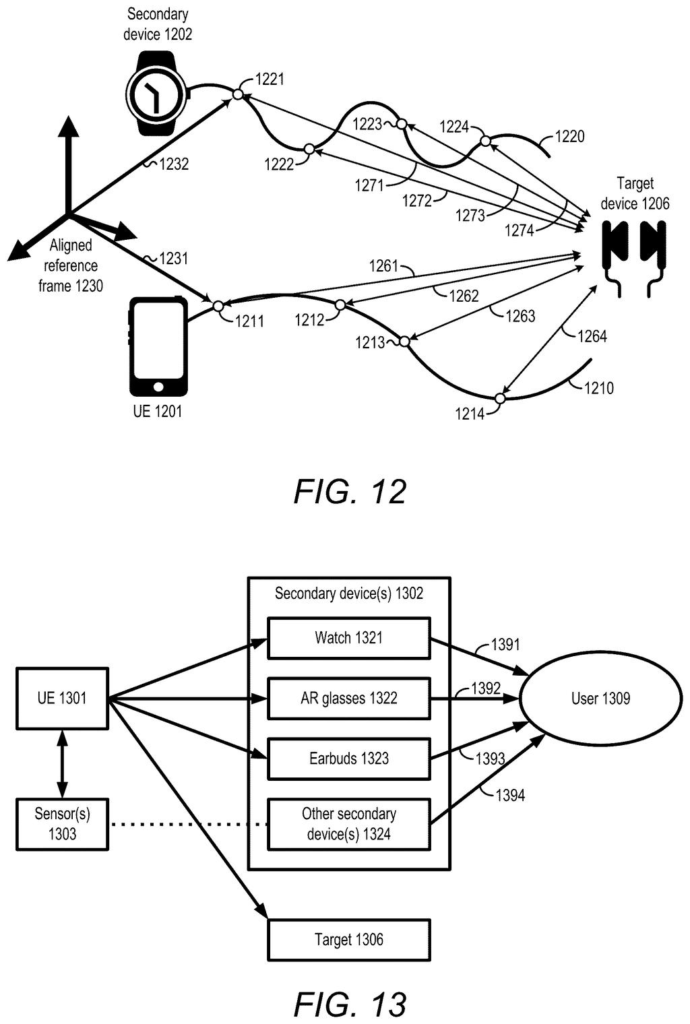
Qualcomm's patent application splits the job. Your phone, which has the stronger radios, sensors and battery, works out where the car is. Your smartwatch or AR glasses, which are easier to glance at, do the guiding. The catch is that the phone in your pocket and the watch on your wrist point in different directions, so the phone has to translate. "The car is to my right" has to become "the car is ahead of you."
The description says a watch might buzz once for a left turn and twice for a right, while glasses could draw an arrow across your view.
determine a location of a target object relative to a second reference frame of a secondary device, based on: the location of the target object relative to a first reference frame of the UE; and a relative alignment between the first reference frame of the UE and the second reference frame of the secondary device; …
Translation: The phone figures out where your car is by combining its own coordinates with how your watch is currently pointed.
How the phone translates a target's position
The first claim covers a phone (the patent calls it a user equipment, or UE) that works out where a target, such as your car or a lost device, sits relative to a secondary device like a smartwatch, AR glasses or fitness tracker. It starts with where the target is relative to the phone, then applies the relative alignment between the two devices (how each one is positioned and pointed, which the filing calls a reference frame). It sends the result to the wearable.
The description gives a worked example. AR glasses sit two feet higher than the phone, and the phone is turned ninety degrees to the left of the user. The phone sees the target ten feet to its right. After translating, it tells the glasses the target is ten feet ahead and two feet down.
Keeping that alignment current is the hard part. The phone can collect baseline motion-sensor data (an inertial measurement unit, or IMU) while the wearable holds still for a few seconds. It then compares motion trends over time so head turns and arm swings don't throw it off, and it recalibrates periodically to correct drift.
Two other independent claims go further. One has the phone decide whether it or the wearable should do the tracking, based on battery level, available sensors and signal quality. The other switches how the wearable talks to you (sound, visuals or vibration) based on noise, distraction, your behavior or low power.
Why your pocket phone and wrist watch split work
If you wear a smartwatch or AR glasses, this is about getting directions without keeping your eyes on a phone. Walking to a parked car or hunting for a lost item is easier when a buzz on your wrist points the way. The filing also covers noisy places: if it's too loud to hear a beep, the guidance can move to vibration or visuals instead.
The design rests on a plain fact about wearables, which have small batteries and modest processing power. Letting the phone do the heavy tracking and the wearable do the telling could spare the wearable's battery. Keep in mind this is a patent application, so it describes an idea, not a product on sale.
Qualcomm's 68th filing in our cell phone patent coverage since May adds to a run that includes a hidden light sensor patent and steadying a shaky camera, all applications we've tracked.
Looking down at a phone while you walk is a small daily hazard, and the filing names it plainly: it pulls your attention away from your surroundings. For people who can't rely on a screen, such as the visually impaired users the description mentions, a well-aimed buzz or beep matters even more.
The fix is sized sensibly for that problem. Turning one phone reading into a nudge on your wrist is a modest job, and the hard part is the geometry. A phone in a pocket and a watch on a swinging arm rarely point the same way. Spending most of the filing on keeping that alignment accurate as you walk is the right place to put the effort.
The add-ons, such as switching between sound, vibration and visuals as conditions change, fit the same everyday problem. Whether any of it ships is unknown, but the problem is common enough that the approach deserves a fair hearing.
Get our take in your Top Stories
Liked this breakdown? Add Patentlyze as a preferred source on Google, and our plain-English take shows up more often in your Top Stories the next time Qualcomm patent news breaks.
There are more where this came from
We read every patent application Big Tech publishes and send you the ones worth knowing. Plain English, free, every week.
The drawings
18 drawing sheets from US 2026/0353340 A1 · click any drawing to enlarge


Show the other 10 sheets


Want this weekly breakdown for a company we don't cover? Patentlyze Pro →
Be the first to weigh in