
Samsung Patents Technology That Tells Your Heartbeat Apart From Your Arm Swing
Wrist heart rate sensors get confused when you move, and Samsung's answer is a laser sensor that measures the shake itself. It then subtracts that shake from your pulse reading.
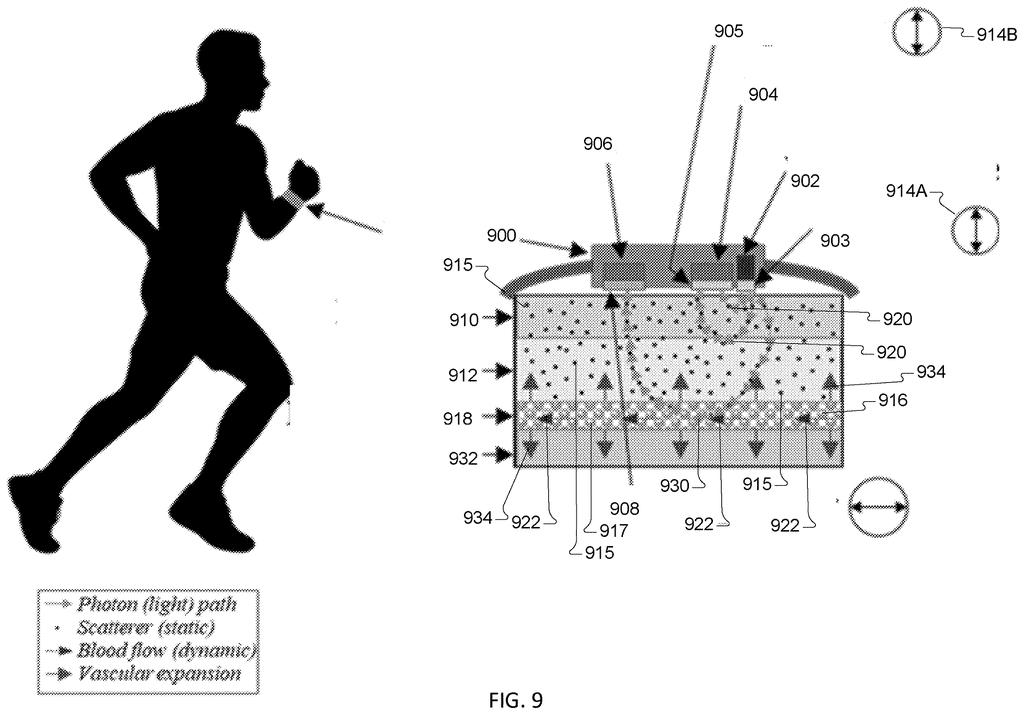
What Samsung's two-receiver laser sensor does
Imagine you're mid-run, arms swinging, and your watch suddenly says your heart rate is far higher than it feels. That's motion at work. Wrist sensors shine light into your skin and read the blood underneath, and all that shaking scrambles the reading. The filing's own background says big movements can throw the estimate off by roughly 5 to 15 beats per minute.
Samsung's filing describes a watch sensor with a laser and two receivers. One receiver sits right next to the laser and mostly catches light bouncing off the surface of your skin, which changes as the watch jiggles. The other sits farther away and catches light that went deeper and scattered off blood vessels.
Software then subtracts the jiggle signal from the pulse signal, so what's left is mostly your heartbeat.
… reducing a motion interference signal within the one or more blood flow signals by filtering the one or more human motion signals out from the one or more blood flow signals …
Translation: It removes your physical movements from the sensor data so they do not mess up the pulse reading.
How the watch separates pulse from arm motion
The core claim covers a two-part sensor. A spatially offset pair (a laser plus a receiver placed some distance away) picks up blood flow signals, meaning light that went under the skin and scattered off blood vessels. A spatially adjacent pair (a laser and a receiver right beside it) picks up motion signals. Software then filters the motion signal out of the blood flow signal and reads the heart rate from what remains.
The hardware trick is polarization, which is the direction light waves vibrate. Light bouncing off the skin surface keeps the laser's polarization, while light that scatters deep inside the body gets scrambled. A cross-polarized filter on the far receiver blocks the surface glare. In the smartwatch drawing, the laser is a coin-shaped disc at the center, with a ring-shaped receiver around it and a second ring farther out.
For the cleanup step, the filing describes an AI model built from two stacked LSTM cells (a kind of AI that remembers what it saw a moment ago). The first reads the blood flow signal. The second reads the motion signal plus the first cell's output. Each passes its memory forward to help the next heart rate estimate, and the model is trained against known heart rates.
The filing also describes other versions: a speckle-pattern version using two image sensors, a setup where two lasers share one detector, and a timing-based version using pulsed lasers.
Apparatuses and methods for laser diffusion-based motion robust heart rate monitoring …
Translation: The patent covers hardware and techniques to track heart rates steadily even while you move around.
Why steadier wrist readings matter for workouts
If it worked, your watch or ring could give a steadier pulse reading during the moments you most want one: sprints, jumping, or a hard gym session. The filing says today's optical sensors can be off by about 5 to 15 beats per minute during large movements. It also says the common fix, adding an accelerometer to estimate motion, costs extra hardware and can fail on very large movements.
In this design the same laser system measures the motion, so it reads the shake right at the skin. The filing says the wearable could be a watch, ring or ear-pod, and it mentions fitness tracking and remote health monitoring. It is a patent application, so nothing in it says Samsung plans to sell this.
Samsung's 32nd filing we've tracked since June in our body-reading wearables watch adds to a run that includes a lens-free health sensor and angled glass that reads fingers.
The software half of this idea could ship fast. Two small AI memory cells reading two signals is a modest program by smartwatch standards.
The hardware half is the holdup. A watch would need a laser, special light filters, and two receivers arranged in rings on the back of the case. That means a new sensor module, so owners of today's watches would not get it through an update.
The filing shows no accuracy results for the new sensor, only the claim that big movements throw current readings off by 5 to 15 beats per minute. The shortest route to a product looks like the version where two lasers share one detector, which the filing says cuts cost. Until someone measures it on real runners, treat it as a design for a future watch or ring.
Get our take in your Top Stories
Liked this breakdown? Add Patentlyze as a preferred source on Google, and our plain-English take shows up more often in your Top Stories the next time Samsung patent news breaks.
There are more where this came from
We read every patent application Big Tech publishes and send you the ones worth knowing. Plain English, free, every week.
The drawings
11 drawing sheets from US 2026/0345021 A1 · click any drawing to enlarge


Show the other 3 sheets


Want this weekly breakdown for a company we don't cover? Patentlyze Pro →
Be the first to weigh in