
Samsung Patents a Distance-Scanning Sensor That Checks Its Own Accuracy While Operating
Every LiDAR sensor drifts a little as its laser signal fluctuates, and those tiny errors add up into wrong distance readings. Samsung's new patent builds a real-time correction system directly into the sensor itself.
What Samsung's self-correcting LiDAR actually does
Imagine you're trying to measure the distance to a wall with a tape measure, but the tape itself keeps stretching slightly as you pull it out. Your reading would be off, and you might not even know it. That's roughly the problem facing LiDAR sensors, which measure distances by timing how long a laser pulse takes to bounce back from an object.
Samsung's patent describes a LiDAR sensor that carries its own built-in reference check. Part of the laser beam gets bounced off a small optical element inside the sensor before it ever reaches the outside world. Because the sensor always knows exactly how far away that internal mirror is, it can measure any drift in its own signal and use that to correct its outward-facing readings on the fly.
The result is a sensor that essentially recalibrates itself continuously, without needing a separate calibration step or external reference target. For any system that depends on precise distance measurement, like a self-driving car or a robot arm, that kind of built-in accuracy check is genuinely useful.
How the optical element generates a live error-correction clock
The patent describes a frequency-modulated continuous-wave (FMCW) LiDAR system, the type that measures distance by comparing the frequency of outgoing and returning laser light rather than just timing a pulse. These systems are popular in automotive and robotics applications because they can measure both distance and velocity at the same time.
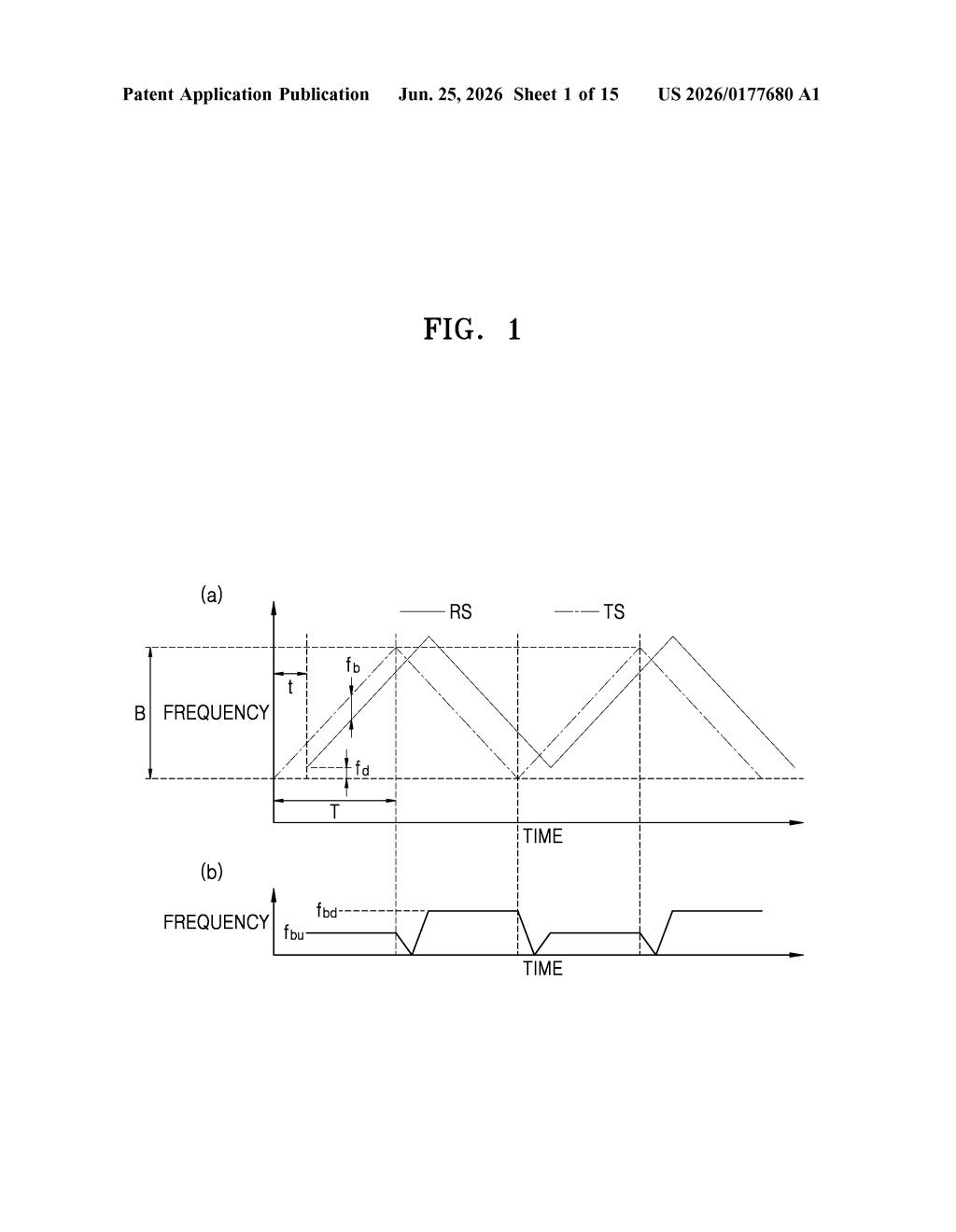
The core innovation is an optical element placed in the beam path between the laser transmitter and the outside world. This element does two things: it lets most of the laser light pass through toward whatever target the sensor is scanning, and it bounces a small portion of the beam back toward the receiver with a known modulation frequency (a predictable frequency tag stamped onto the signal).
The receiver then generates two separate signals:
- A first beat signal from light that traveled to the real target and came back (this carries the actual distance data)
- A second beat signal from the internally reflected reference beam (this carries information about how the laser is currently behaving)
The circuit uses the second beat signal to generate a clock signal, essentially a live readout of any noise or drift in the laser. It then applies that clock to correct the first beat signal before the distance calculation is made. The correction happens continuously, not just at startup or during a separate calibration phase.
What this means for autonomous cars and robotics sensors
LiDAR accuracy degrades when the laser source drifts due to temperature changes, vibration, or electrical noise. In a moving vehicle or a factory robot, all three are constant realities. Today's systems typically handle this with careful hardware engineering or periodic offline calibration, both of which add cost and complexity.
A sensor that corrects itself in real time could be more tolerant of harsh conditions and cheaper to manufacture, since it leans on software correction rather than requiring premium-stability components. For Samsung, which supplies sensors and chips to automotive and consumer electronics customers, this kind of patent signals an investment in the accuracy fundamentals that make LiDAR practical outside of controlled lab environments.
This is solid, specific engineering work on a real problem in LiDAR design. It won't make headlines the way a flashy new product does, but self-referencing calibration is exactly the kind of infrastructure improvement that separates reliable production sensors from finicky prototypes. If Samsung is building toward a serious LiDAR product line for automotive or robotics, patents like this are the foundation.
There are more where this came from
We read every patent application Big Tech publishes and send you the ones worth knowing. Plain English, free, every week.
Want this weekly breakdown for a company we don't cover? Patentlyze Pro →