
Google Files Patent for Voice Typing That Fixes Misheard Names When You Spell Them
Voice typing turns "Khe Chai" into "kitchen," and you usually have to stop and fix it by hand. Google's patent application lets you just spell the name out loud and keeps going.
What Google's spell-it-out voice typing does
Voice typing handles everyday words well, but it stumbles on names it has rarely heard. Say "Khe Chai" and your phone may type "kitchen." Today, fixing that usually means stopping, deleting the wrong word and retyping, or hoping a later cleanup step catches it.
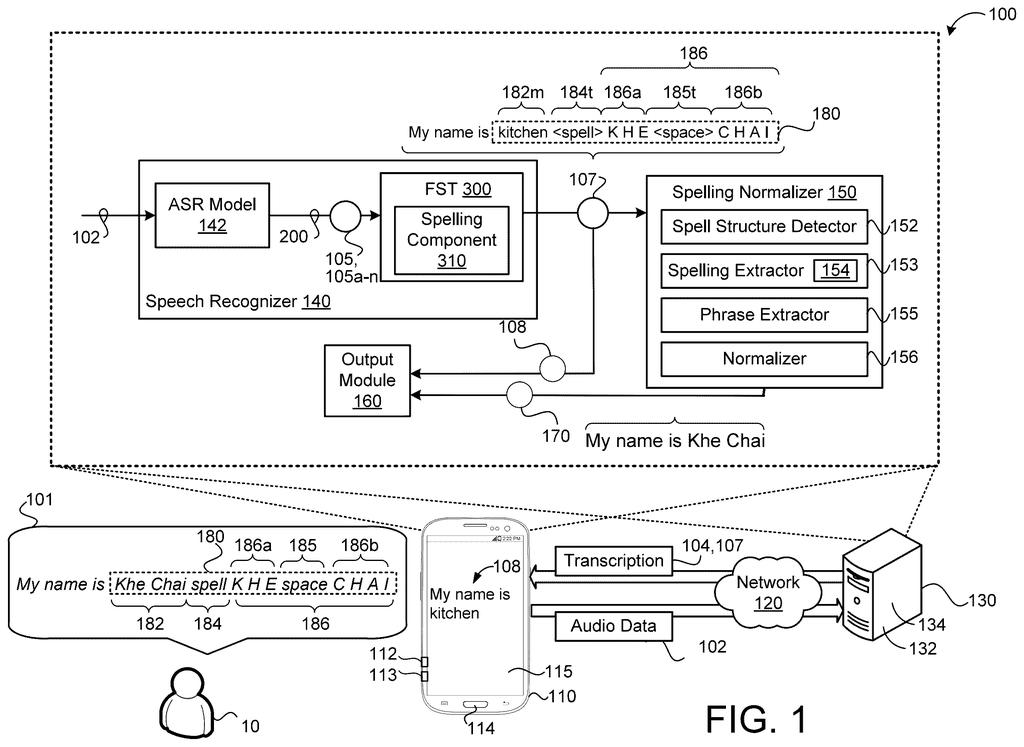
Google's patent application lets you correct it without stopping. You say the name, then spell it out loud: "Khe Chai, spell K H E space C H A I." The system notices the spelling, builds Khe Chai from the letters, and swaps out the wrong word ("kitchen") on its own.
You don't have to switch into a special spelling mode, and you can keep talking right after. If you see the mistake pop up on screen as you speak, you can spell the name then and carry on with your sentence.
receiving audio data characterizing an utterance spoken by a user, the utterance comprising a particular phrase and a sequence of individual characters that provide a correct spelling of the particular phrase spoken after the particular phrase; …
Translation: The system listens to you say a word and then spell it out letter by letter right afterward.
How Google finds and swaps the misheard word
The system listens to your whole sentence and produces a first-draft transcript. When you spell a word aloud, that draft typically holds the wrong guess (kitchen) followed by the letters you spoke (K H E, C H A I).
A component called a weighted finite state transducer (a rule-based pattern matcher that scores possible word sequences) watches for the spelling pattern. It can spot trigger words such as "spell," "as," or "as in," which may come before or after the name. It can also work without trigger words. Spoken commands like "space" become placeholder tokens that get stripped from the final text.
Next, a spelling normalizer pulls out the letters, joins them into words, and capitalizes them. To decide which earlier words to delete, it compares your spelling against several stretches of words that come before the letters, using Levenshtein distance (a count of the fewest single-letter edits needed to turn one string into another). The closest match gets replaced. Per the filing, one pass of calculation covers all the stretch lengths.
The filing also describes saying "double G" for repeated letters, pausing between letters instead of saying "space," and showing the wrong word on screen while you speak, then fixing it once the letters arrive. The corrected text comes out with no extra input from you after you finish talking.
… normalizing the transcription to obtain a final transcription ( 170 ) for the utterance by replacing the extracted misrecognition of the particular phrase with the corrected phrase constructed from the extracted sequence of individual characters.
Translation: It automatically updates the messy first draft with your spelled out version to get the final text right.
What this means for voice typing on your phone
If this works as described, correcting a misheard name could cost you one extra phrase instead of a stop, delete and retype. That matters on a phone, in a car, or on smart glasses, where fiddling with text is a hassle. The filing lists devices ranging from phones to smart speakers, watches and vehicle systems.
It could also help the system learn: the filing says spelling a word it already got right can raise its confidence in recognizing that word later. The application's claims were rejected in the first review, which is routine at this stage, and amendments usually follow, so what it finally covers may be narrower than what was filed.
Google's 65th filing in the voice and speech AI work we've tracked since May adds to a run that includes one giving dubbed videos lip-sync and one adding voice to text chatbots.
The trade here is a little extra talking in return for less editing. You have to say the name, then spell it, which feels slightly odd in the middle of a long sentence, and you need to know to do it. That is a small price next to stopping to fix text by hand.
The risk sits in the guessing step. The system decides which earlier words to delete by finding the closest match to your spelling, so a cluttered sentence or a wild mishearing could make it cut the wrong words. The filing also notes that spoken letters can get heard as ordinary words, and a detector that depends on seeing letters could miss those.
Even so, the trade reads as worth it. A user who sees the error and spells it gets a fix right away, and the cost of a bad guess is a visible typo you would have had to fix anyway.
Get our take in your Top Stories
Liked this breakdown? Add Patentlyze as a preferred source on Google, and our plain-English take shows up more often in your Top Stories the next time Google patent news breaks.
There are more where this came from
We read every patent application Big Tech publishes and send you the ones worth knowing. Plain English, free, every week.
The drawings
7 drawing sheets from US 2026/0350309 A1 · click any drawing to enlarge


Want this weekly breakdown for a company we don't cover? Patentlyze Pro →
Be the first to weigh in