
Google Files Patent to Cut Background Noise Out of Compressed Audio
Google has filed a patent for squeezing audio files by treating your voice and the background racket as two separate things, then spending far less data on the racket.
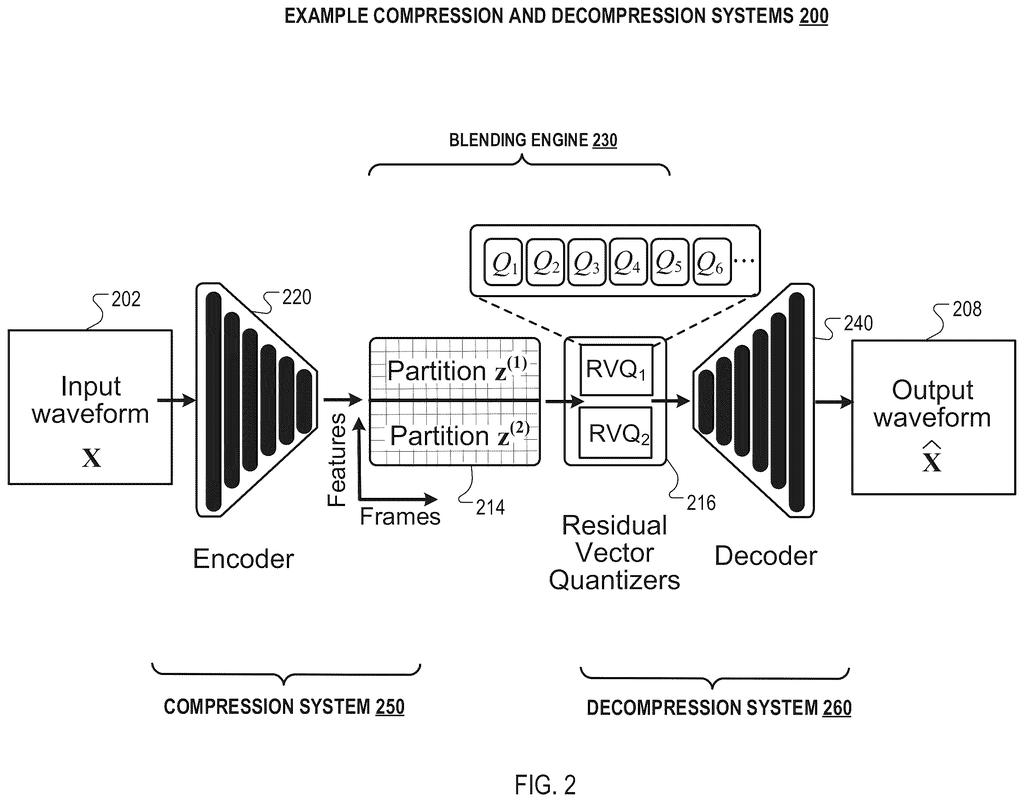
What Google's noise-splitting audio patent does
Imagine you record a voice memo while a leaf blower roars outside. When that recording gets saved or sent, every bit of the roar takes up space, right alongside your words.
Google's filing describes a way to sort a recording into two piles before shrinking it. One pile holds the part you care about, such as speech or music. The other holds the mess: background noise and echo. The system can then drop the noise pile or squeeze it much harder, so the file gets smaller while your voice keeps its quality.
To teach the software to sort this way, Google mixes and matches. It takes the clean part of one recording and the noise from another, then asks the software to rebuild what that combination should sound like. Repeat that over and over, and the software learns which details are voice and which are noise.
… a set of feature dimensions designated as clean feature dimensions that represent an initial audio signal in the audio waveform, and (ii) a set of feature dimensions designated as noise feature dimensions that represent a noisy audio signal in the audio waveform …
Translation: The system separates a recording into two separate data tracks for the main voice and the background sounds.
How Google teaches the system to tell voice from noise
The filing covers a compression pipeline built around an encoder, a neural network (software that learns patterns from examples) that turns an audio recording into an embedding, a list of numbers summarizing the sound. Google divides that list into clean dimensions for the intended speech or music and noise dimensions for background noise and echo.
Next, the system can modify the noise numbers by removing them or scaling them down. It then applies vector quantization (swapping each chunk of numbers for the closest entry in a fixed codebook of patterns) and compresses the result with entropy coding (shorter codes for common patterns), such as arithmetic or Huffman coding. The clean numbers can get a higher bit rate than the noise numbers, with examples of 1.5, 2, 3 or 10 times.
Training is the unusual part:
- Take two recordings, each with its own noise added.
- Encode both, then build a blended list: clean numbers from the first, noise numbers from the second.
- Ask the decoder to produce the first recording's clean sound wearing the second one's noise.
- Adjust both networks based on the error.
The claims also cover sending the compressed stream and decoding it on the other end. The description says either side can run on a phone, a smartwatch or in a data center.
… generating a blended embedding by concatenating: (i) clean feature dimensions from an embedding of the first noisy audio waveform, and (ii) noise feature dimensions from an embedding of the second noisy audio waveform …
Translation: It trains the AI by mixing clean speech from one source with random background noise from another.
Why lighter audio matters for calls and storage
The practical payoff is smaller audio. The filing says the split can cut the storage a recording needs and the data needed to send it over a network, which could matter for calls, voice memos and music you stream or save. Spending most of the data on the part you want to hear is a simple idea, and it should help most when your connection or storage is tight.
There is a side effect for you, too. If the noise numbers are removed or turned down before decoding, the playback comes out as an enhanced version of the original, with less background noise and echo. So the same tool that shrinks a file could also clean it up. The filing describes this as one option, not a promise.
This is the 56th Google patent we've tracked in our voice & speech AI coverage since May, building on filings like one on handling any-length sentences and one on tone-shifting by audience.
The cost of this design is a judgment call baked into software: something has to decide what counts as noise. Whatever gets labeled noise can be thrown away or given a fraction of the bits, so a crying baby in a home video or the hum of a cafe could vanish even if you wanted it.
The software learns from noise Google adds to clean recordings on purpose, so it is only as good as that fake noise is close to real life. The filing gives no test results, so there is no way to tell how it holds up on a windy street.
For speech on calls and voice memos, the trade looks worth it, since few people want the leaf blower saved. For music, where room sound is part of the recording, the same trade is riskier, and the option to squeeze noise instead of deleting it is the sensible hedge.
Get our take in your Top Stories
Liked this breakdown? Add Patentlyze as a preferred source on Google, and our plain-English take shows up more often in your Top Stories the next time Google patent news breaks.
There are more where this came from
We read every patent application Big Tech publishes and send you the ones worth knowing. Plain English, free, every week.
The drawings
8 drawing sheets from US 2026/0341293 A1 · click any drawing to enlarge


Want this weekly breakdown for a company we don't cover? Patentlyze Pro →
Be the first to weigh in