
IBM
IBM · AI / ML · Filed Apr 30, 2025 · USPTO published Nov 12, 2026 · This week's release
IBM Patents a Memory System to Help AI Follow Facts Across Long Texts
IBM's new patent application gives an AI a notebook for long texts, one that remembers which fact came first and follows a trail of clues to the answer.
- Publication number
- US 2026/0359673 A1(US20260359673A1)
- Applicant
- INTERNATIONAL BUSINESS MACHINES CORPORATION
- Filed · Published
- Apr 30, 2025 · Nov 12, 2026
- Inventors
- Payel Das, Sihui Dai, SUBHAJIT CHAUDHURY, Georgios Kollias, Ching-Yun Ko, Aurelie Lozano
- Status when we published
- Waiting for an examiner
- Document
- 20 claims
- US classification
- 706/46
What IBM's MemReasoner memory actually does
Every time you ask a chatbot a question about a long report, it has to dig the right sentences out of a huge pile of text. The longer the pile, the more likely it is to grab the wrong line or make something up.
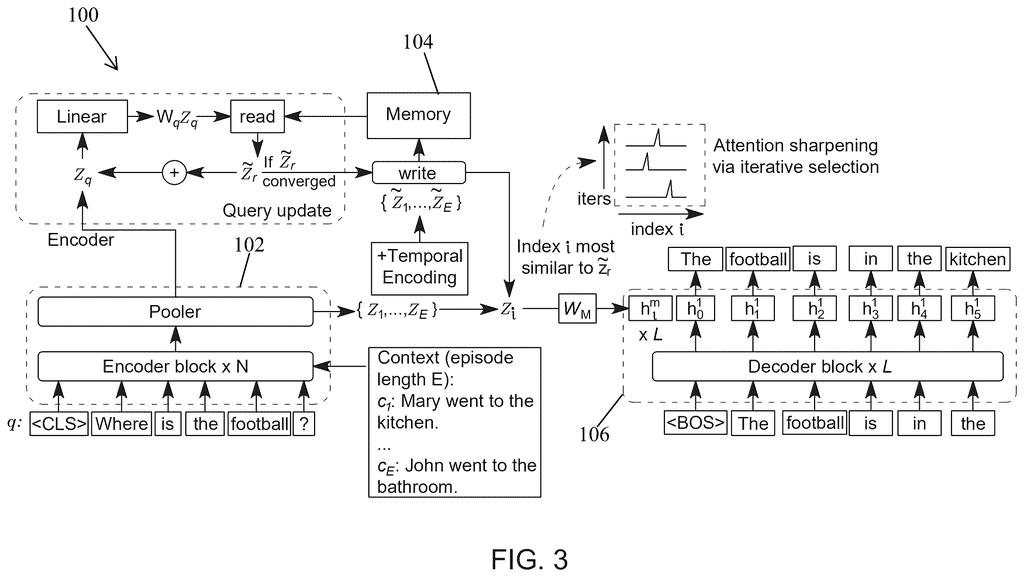
IBM's filing describes a fix: give the AI a separate notebook. As the AI reads, it jots down each sentence in a form it can search later, and it remembers the order the sentences came in. So if a document says 'John is in the bathroom' and later 'John goes to the garden,' the AI knows the garden is the newer fact.
When you ask a question, the AI looks up one note, uses it to sharpen what it is looking for, and looks again. That lets it connect two facts that sit far apart, like following a trail of clues instead of guessing.
writing context encodings to a memory; performing a search over the context encodings; and feeding a decoder results from the search to execute a task …
Translation: It saves text data into a memory, searches through it, and passes the findings to the AI model to finish the job.
How the memory keeps facts in order and hops
The filing describes a design the inventors call MemReasoner. It has three parts: an encoder that turns each sentence into a string of numbers (an encoding, a compact stand-in for the sentence), a separate episodic memory where those encodings are stored, and a decoder that writes the answer.
Two features sit at the center of the claims:
- Temporal encoding: a learned component (the description names a bidirectional gated recurrent unit, a type of network that reads sequences) tags each stored fact with its place in the order, so later facts count as more recent.
- Iterative reads: the system searches the memory with the question, folds what it found back into the question (a query update), and searches again until the result settles or a cap on tries is reached.
Once it finds the best match, it hands the decoder the original, unordered version of that fact, because the filing says the decoder can latch onto the ordering information. An optional step first drops irrelevant lines and re-encodes the shorter list to avoid numerical instability.
Training can use labeled 'supporting facts' (the sentences that actually answer the question) for as little as 1% of examples. In the tests described, a two-step task rose from 38% to 76% accuracy with that 1%, and became near perfect with all of them.
A method for reasoning with a large language model (LLM) includes writing context encodings to an episodic memory and performing a search over the context encodings.
Translation: The system helps AI reason better by saving background information into a special memory and searching it when needed.
Why long documents trip up chatbots today
If you have ever pasted a long document into a chatbot and gotten a confident wrong answer, this is the problem IBM is going after. The filing notes that AI accuracy on question tasks drops sharply as the text gets longer, and that mistakes often come from failing to connect facts spread across the text.
A memory that tracks order and lets the model chase a chain of facts is a direct attempt at that. One caution: the tests in the filing use synthetic puzzles (short statements like 'Mary traveled to the garden' buried in filler text), not real contracts or emails. So treat the results as a promising lab result, not a finished fix.
IBM's 77th filing we've tracked since May in the AI guardrails race watchlist adds to earlier work on prompt quality grading and which words swayed its answer.
Source: US 2026/0359673 A1 at the USPTO (PDF). Full patent text and figures are in the official publication.
Get our take in your Top Stories
Liked this breakdown? Add Patentlyze as a preferred source on Google, and our plain-English take shows up more often in your Top Stories the next time IBM patent news breaks.
Add Patentlyze on Google
One click.
There are more where this came from
We read every patent application Big Tech publishes and send you the ones worth knowing. Plain English, free, every week.
The drawings · 12 sheets
12 drawing sheets from US 2026/0359673 A1 · click any drawing to enlarge


Show the other 4 sheets


More from IBM
All 470 IBM patents →
More in AI assistant & agent
All 413 AI assistant & agent patents →
Amazon
Amazon Patents a Way to Stop AI Chatbots From Copying Your Documents Word for Word
Amazon
Amazon Patents a Hidden System That Catches and Fixes Its Own Automation Errors
OpenAI
OpenAI Patents a Rulebook Its AI Reads Only When a Touchy Topic Comes Up
Amazon
No comments yet