
Apple Patents a Stylus That Knows Whether It's Docked or in Use
Apple is patenting a stylus that behaves differently depending on whether it's sitting in its dock or in your hand — and it has a built-in light source you can see from the outside.
What Apple's context-aware stylus actually does
Imagine picking up a pen and having your computer instantly know you've grabbed it — not because you tapped a button, but because the pen itself detected it was removed from its holder. That's essentially what Apple is describing here.
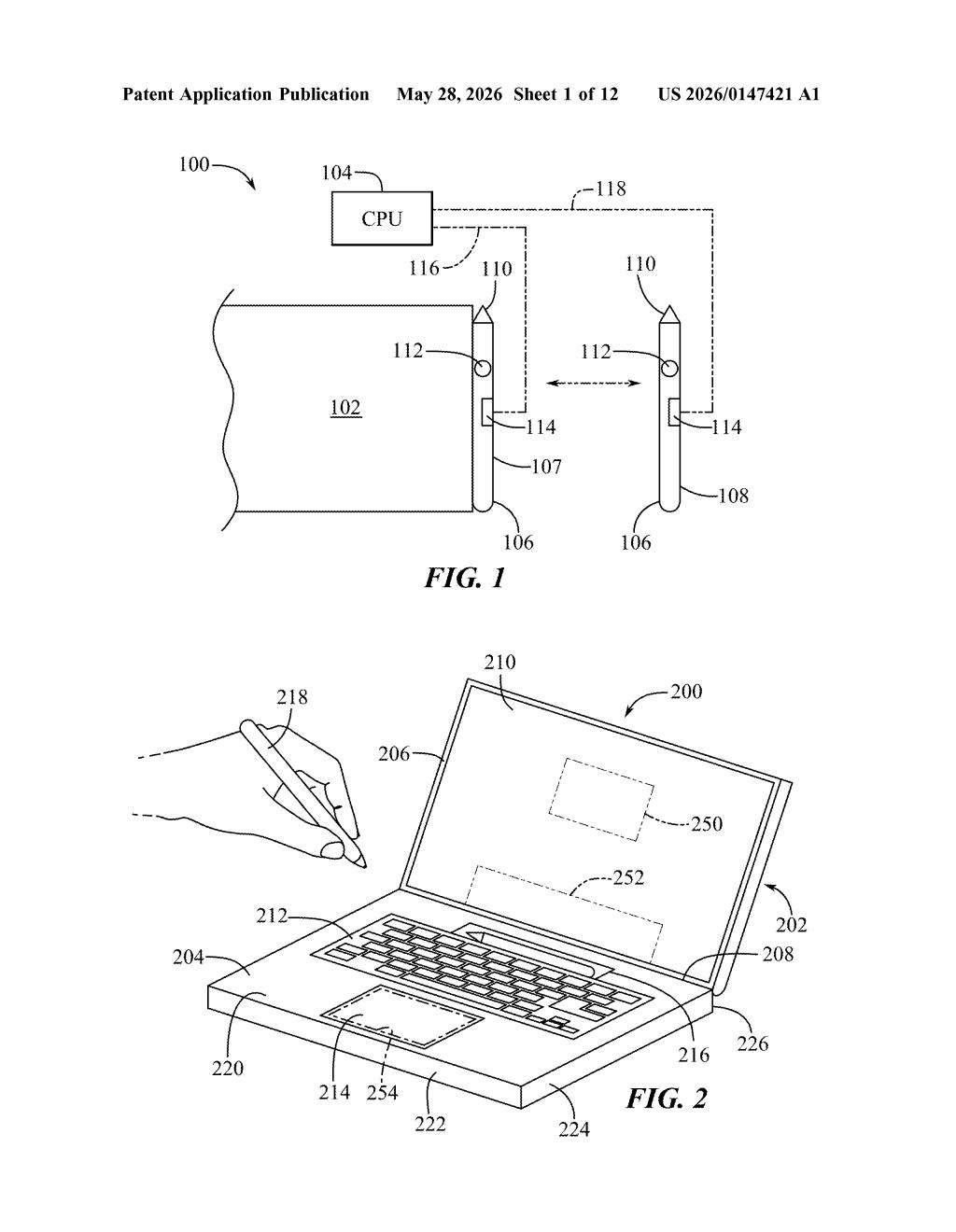
The patent covers a stylus tool that can be mounted directly to a device's housing (think a slot or recess in a keyboard or tablet chassis). When the stylus is sitting in that recess, it produces one type of signal. The moment you pull it out and start using it, it switches to a different signal. Your device knows the context without you having to do anything.
The stylus also has an internal light source visible through part of its outer surface — so it can glow or indicate status visually. Whether that's a charging indicator, an active-mode light, or something else, the patent doesn't pin down. But it's a meaningful detail: this isn't just a passive input stick.
How the stylus switches signals between docked and active states
At its core, this patent describes a two-state stylus system. The stylus has a sensor inside, and what that sensor reports depends on the physical configuration — docked in a chassis recess versus held away from the device.
- Docked state: Stylus is resting in a recess (like a slot in a keyboard housing or tablet edge). Its sensor output produces a designated "first" signal — potentially triggering charging, a sleep mode, or a status update.
- Active state: Stylus is removed. The same sensor now produces a different output, signaling the device that input is imminent or underway.
- Internal light source: The stylus contains a light that's visible through its outer surface — suggesting status indication (charging, paired, active) baked into the hardware itself.
The elongated body and tip design is consistent with a traditional stylus form factor — pen-like, with a functional tip for screen input. The key engineering insight is using the physical relationship between the tool and the chassis as an input signal itself, not just tracking what the pen draws on screen.
This kind of proximity-aware docking has echoes of how the Apple Pencil 2 attaches magnetically to an iPad for charging — but this patent goes further by making the docked/undocked state an explicit, differentiated signal output that software can act on.
What this means for Apple Pencil and iPad ergonomics
For iPad and stylus users, this could mean genuinely seamless context switching — your device entering a drawing mode the instant you lift the pen, or locking input when you stow it, without any tap or menu interaction. That kind of frictionless UX is exactly where Apple tends to invest.
The internal light source is the more curious detail. It implies Apple is thinking about the stylus as a visible, expressive object — not just a transparent input device. Combined with the docking awareness, this hints at a more integrated stylus ecosystem, possibly for a future iPad or MacBook variant where the pen has a proper home rather than just magnetically clinging to the side.
This is a focused, practical patent — not a moonshot. The two-state sensor logic is genuinely useful UX engineering, and the built-in light source suggests Apple wants the stylus to communicate status visibly. It's worth paying attention to as a signal that Apple is still actively iterating on the Apple Pencil experience, even if this specific implementation may never ship in this exact form.
There are more where this came from
We read every patent application Big Tech publishes and send you the ones worth knowing. Plain English, free, every week.
Want this weekly breakdown for a company we don't cover? Patentlyze Pro →