
Samsung Patents Mid-Stream Codec Switching for Broadcast Audio
Samsung is patenting a way for a Bluetooth audio transmitter to silently renegotiate how it compresses audio — mid-stream, without dropping the connection — by sending a precisely timed instruction to every listener at once.
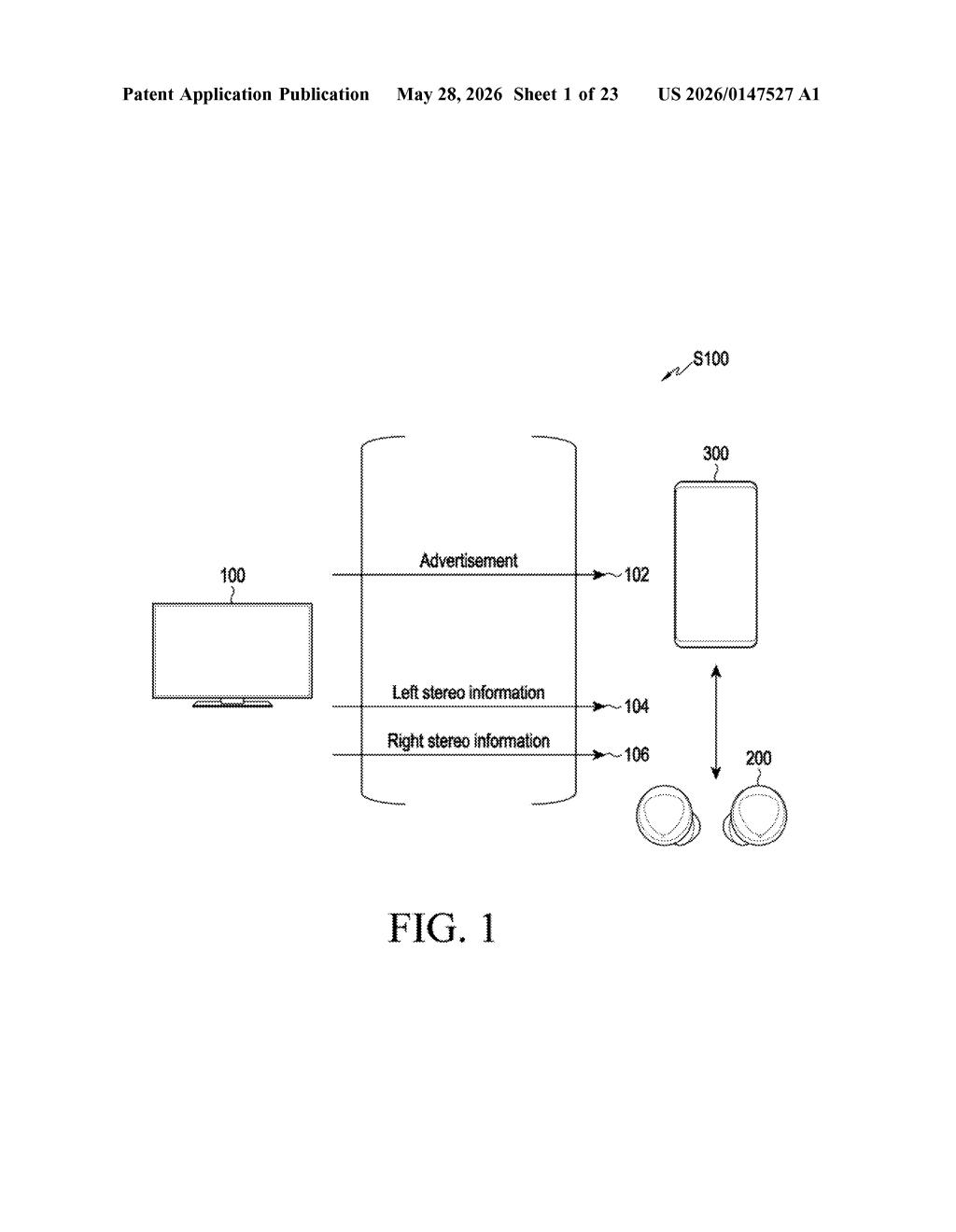
What Samsung's live codec-swap system actually does
Imagine you're in a crowded airport and your wireless earbuds are picking up a gate announcement broadcast over Bluetooth. The audio starts crisp, but as more devices connect and interference builds, the system needs to dial back quality to stay reliable. Normally, that kind of switch would cause a glitch or require a full reconnect.
Samsung's patent describes a way to handle this on the fly. The device doing the broadcasting — say, a TV, a PA system, or a phone — detects that conditions have changed and decides to switch to a different audio codec (the recipe for how audio is compressed and decoded). Instead of just switching and hoping everyone keeps up, it sends a control packet that tells every receiver: "At exactly this moment, switch to the new codec."
The result is a coordinated handoff. Every listening device gets the heads-up with a specific timestamp, so they all flip over at the same time. No gap, no crackle, no reconnect needed.
How the control packet coordinates the codec handoff
The patent covers a method for dynamic codec reconfiguration of a Bluetooth LE Audio broadcast stream — the kind used in the Auracast standard, which lets one transmitter send audio to an unlimited number of receivers simultaneously.
The transmitter detects an event — this could be a change in network congestion, a shift in required audio quality (e.g., switching from music to speech), a battery-saving trigger, or a change in the number of active receivers. Based on that event, it selects a new codec configuration (different bitrate, different codec type, or different parameters) and calculates timing information — essentially a future timestamp at which the switch should happen.
It then broadcasts a control packet containing both the new codec spec and the timing information to all connected receivers. Each receiver reads the packet, prepares its decoder for the new configuration, and switches over at exactly the specified time.
- First codec config: what's currently in use
- Second codec config: the target configuration after the switch
- Timing information: the synchronized moment all receivers flip over
- Control packet: the broadcast message carrying both pieces of information
The key insight is that this all happens while audio is still streaming — there's no teardown-and-reconnect cycle.
What this means for Bluetooth broadcast audio quality
Bluetooth LE Audio's Auracast broadcast mode is designed for public venues — airports, cinemas, gyms, hearing loops. In those environments, conditions change constantly, and the ability to adjust codec parameters without interrupting the stream is genuinely useful infrastructure. Right now, a codec mismatch or renegotiation in a broadcast context typically means a disruption for every single listener at once, which is a bigger problem than it is for a one-to-one headphone connection.
For Samsung's earbuds and televisions — both of which support Auracast — this kind of graceful fallback mechanism could mean more stable audio in challenging RF environments. It's also relevant to accessibility use cases, where hearing-aid users rely on broadcast audio and any dropout is more than just annoying.
This is a focused, practical patent solving a real coordination problem in Bluetooth broadcast audio. It's not a splashy AI feature — it's the kind of careful infrastructure work that makes wireless audio actually reliable in the multi-device scenarios Auracast is designed for. Worth watching if you follow Samsung's audio hardware or the Auracast ecosystem.
There are more where this came from
We read every patent application Big Tech publishes and send you the ones worth knowing. Plain English, free, every week.
Want this weekly breakdown for a company we don't cover? Patentlyze Pro →