
Samsung Patents a LUT-Driven Ray Tracing Denoiser for Real-Time Rendering
Samsung is rethinking how to clean up noisy ray-traced images — not by running a full neural network at render time, but by baking the smarts into a lookup table that can do the job faster and cheaper.
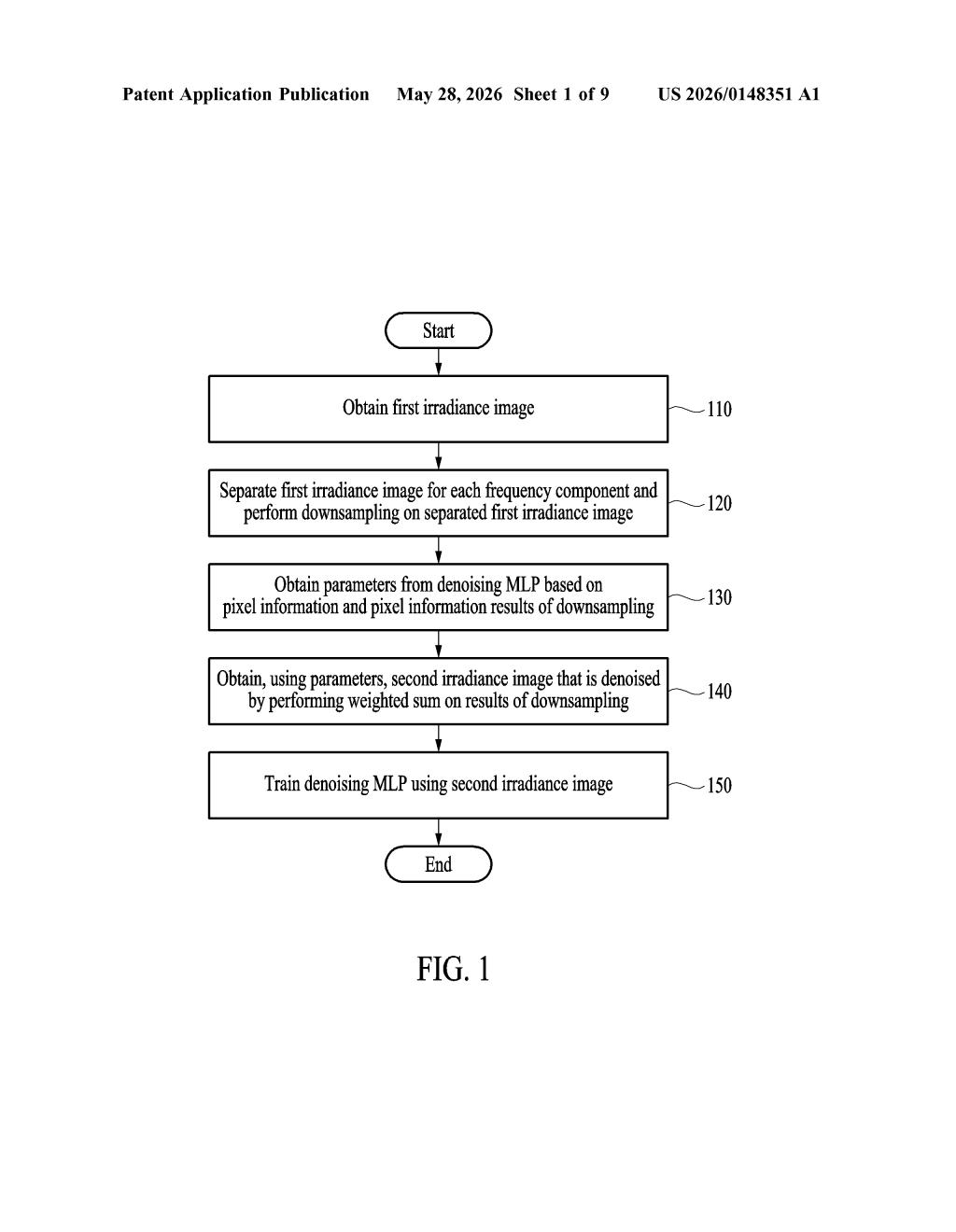
What Samsung's frequency-split ray tracing denoiser does
Imagine you're playing a game with realistic reflections and lighting — that's ray tracing. The problem is, to keep frame rates reasonable, GPUs don't fire enough light rays, which leaves the image looking grainy and noisy. Something has to clean it up before you see it.
Most modern denoisers use a neural network running live on the GPU every single frame. That costs power and time. Samsung's approach is different: it pre-trains a small network, then compresses what it learned into a lookup table (basically a big reference chart). At render time, the GPU just consults the table instead of doing full AI inference — much faster and lighter.
The system also splits the image into high-frequency and low-frequency parts (sharp edges vs. soft lighting gradients), cleans them separately, then stitches everything back together. The result is a denoised frame that can be produced without the usual neural-network overhead.
How the LUT pipeline filters across frequency bands
The pipeline starts by taking the raw irradiance image — the lighting data from the ray tracer before surface color is applied — and splitting it by frequency. Think of it like separating a blurry background wash from crisp foreground detail; high-frequency components carry edges and fine structure, low-frequency ones carry broad lighting gradients.
Each frequency band gets downsampled independently (reduced in resolution), producing two smaller images that are easier to process. A denoising LUT — a lookup table generated by pre-training a small MLP (Multi-Layer Perceptron, a simple neural network) — then produces per-pixel filter weights based on pixel metadata and the two downsampled images. Those weights are used in a weighted sum that blends the two frequency bands into a single cleaned-up irradiance image.
The cleaned image is then upscaled back to full resolution using a second LUT (the upscaling LUT), avoiding another live neural network pass. Finally, the upscaled result is multiplied by the albedo image (the base surface-color layer) to reconstruct the full shaded frame.
The key engineering trade-off here is clear:
- Pre-training the MLP offline is expensive, but it happens once
- Converting the trained MLP to a LUT makes inference nearly free at runtime
- Frequency separation lets the filter target noise where it actually lives
What this means for real-time GPU rendering in Samsung devices
For Samsung, this matters most in the context of mobile and mid-range GPU hardware — devices where running a full denoising neural network every frame would eat battery life or cause thermal throttling. By offloading the intelligence into lookup tables that were compiled offline, the actual per-frame work becomes a table lookup and some arithmetic, which is far friendlier to constrained hardware.
If this shows up in Samsung's Exynos GPU stack or its gaming-oriented displays, it could mean better ray tracing quality on Galaxy phones or TVs without the power hit. It's also relevant to any Samsung chip IP licensed to third parties. The frequency-split approach isn't new in academic denoising research, but packaging it into a hardware-friendly LUT pipeline for real-time use is a practical engineering move worth watching.
This is solid, unglamorous GPU engineering — the kind of incremental optimization work that actually ships in products. Samsung isn't reinventing ray tracing denoising; it's making an existing idea (frequency decomposition + learned filters) cheap enough to run on power-constrained hardware. That's genuinely useful, especially as ray tracing creeps into mobile and consumer display silicon.
There are more where this came from
We read every patent application Big Tech publishes and send you the ones worth knowing. Plain English, free, every week.
Want this weekly breakdown for a company we don't cover? Patentlyze Pro →