
Adobe Patents a System That Generates Content When Real-World Events Happen
Adobe is patenting a system where a server watches the internet for real-world events, then automatically kicks your device's on-device AI into gear to generate relevant content — no manual prompt required.
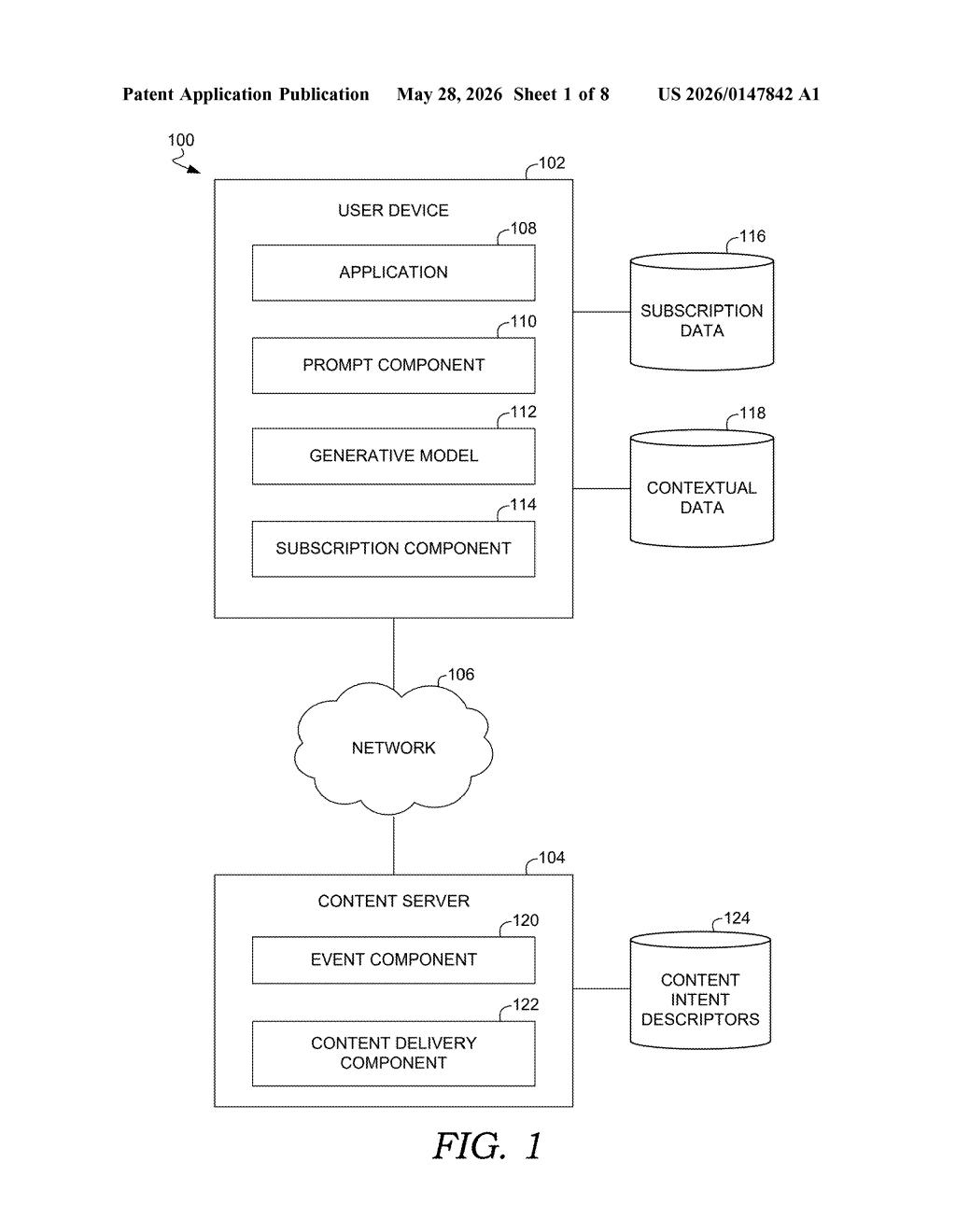
What Adobe's event-triggered AI content system actually does
Imagine you're a social media manager for a sports brand. A big game just ended, and instead of scrambling to write a post, your device already has a draft ready — tailored to that specific outcome and your brand's voice. That's roughly what Adobe is building here.
The system works in two parts. A server monitors online sources for events — think news, sports scores, trending topics. When it spots something relevant, it bundles that event information with a content intent descriptor (basically a set of instructions about what your brand is trying to say) and sends it to your device.
Your device then takes that bundle, mixes in any personal context it already knows about you or your preferences, builds a prompt, and feeds it to a local AI model running directly on your device. The result: a piece of digital content that reflects both the real-world moment and your predefined creative goals — generated without your having to lift a finger.
How the server detects events and feeds on-device AI
The patent describes a client-server architecture with a clear division of labor. On the server side, an event component continuously scans online sources to detect external occurrences — things happening in the real world. Critically, the server also runs a sentiment filter: it only forwards events it classifies as positive or neutral, deliberately suppressing negative events from triggering content generation (a sensible guardrail for brand safety).
The server pairs the event data with a content intent descriptor — a data object that encodes the intended purpose and objectives of the content to be created. Think of it as a standing brief: it tells the system what your brand cares about, what tone to use, and what goals a piece of content should serve.
On the device side, the system receives that bundled data and combines it with on-device contextual data (local signals like user preferences or subscription settings) to construct a prompt. That prompt goes into a generative model running locally on the device — not a cloud API call — which produces the actual content item.
A few notable design choices stand out:
- Prompt construction happens on-device, which means personal context never has to leave the device
- Subscription data on the device can gate whether content generation happens at all
- The server can optionally pre-process the event + intent data before sending, giving it flexibility to offload some reasoning server-side
What this means for automated marketing and content tools
For anyone building content workflows at scale — marketers, media companies, social teams — this describes a pipeline where real-world moments automatically become content, with the brand's voice baked in from the start. The content intent descriptor concept is the interesting piece: it's a structured way to encode brand strategy so an AI can act on it autonomously, without a human writing a fresh prompt every time.
The on-device inference angle is also worth noting. Running the generative model locally rather than hitting a remote API has real privacy and latency benefits, and it fits Adobe's broader push to embed AI into creative tools that professionals already trust. If this lands in something like Express or Firefly, it could meaningfully compress the time between "something happened" and "we have content ready to post."
This is a genuinely interesting systems patent because it solves a real workflow problem — the gap between a newsworthy moment and a brand's ability to respond to it — while making smart architectural choices around on-device inference and sentiment gating. The content intent descriptor framing is the conceptual hook worth watching; if Adobe operationalizes that as a product primitive, it could become a meaningful differentiator in the automated content space.
There are more where this came from
We read every patent application Big Tech publishes and send you the ones worth knowing. Plain English, free, every week.
Want this weekly breakdown for a company we don't cover? Patentlyze Pro →