
Apple's New Patent Quietly Widens the Target After a Missed Gesture
Missed a tap in visionOS because your pinch landed slightly off? Apple is patenting a system that quietly widens the target zone on your second attempt, so a near-miss becomes a hit.
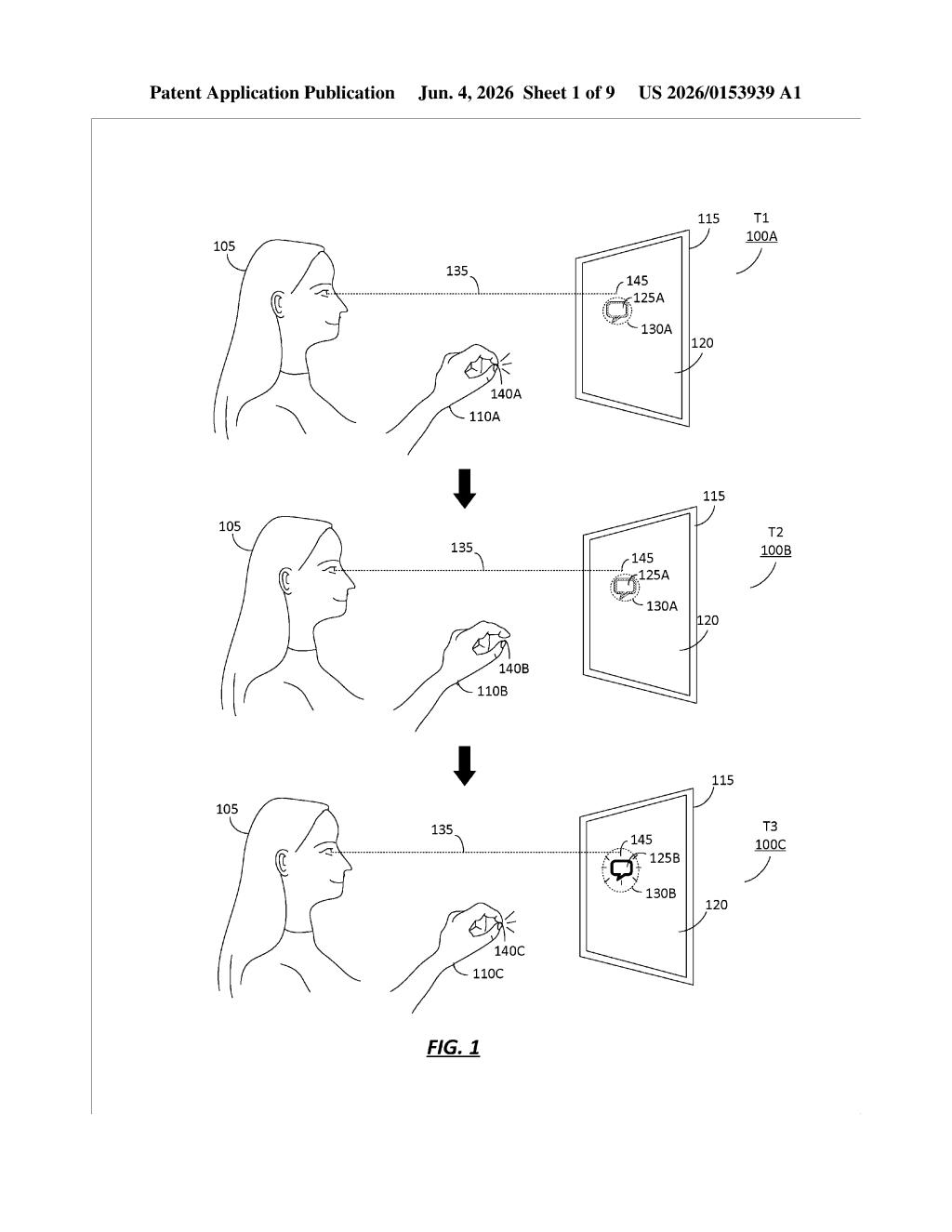
What Apple's forgiving gesture detection actually does
Imagine trying to tap a small button while wearing Apple Vision Pro — your pinch gesture lands just outside the target, and nothing happens. That's a frustrating dead end that forces you to try again from scratch with no guarantee of success.
Apple's new patent describes a system that learns from that failure in real time. When your first gesture almost hits a UI button but misses, the system remembers the attempt. If you try again within a short window of time, the device applies a more forgiving set of rules — effectively expanding the invisible hit zone around the button so your second attempt is much more likely to register.
You don't have to do anything differently. The system detects that you're retrying, and silently adjusts on your behalf. It's the spatial computing equivalent of a touchscreen auto-correcting a mistyped letter — the kind of small, invisible fix that makes an interface feel fluid instead of frustrating.
How Apple expands the target zone on a repeated gesture
The patent describes a two-pass gesture evaluation system built on top of Apple's existing hand tracking pipeline.
First attempt: The system detects a gesture (like a pinch) and checks two things — whether the hand motion itself is valid, and whether your gaze target (where your eyes are pointed) lands inside the designated hit region of a UI element. If the gaze target misses the region, the input is rejected.
Second attempt: If a second instance of the same gesture is detected within a threshold time window, the system switches to a different, more permissive set of heuristics. Specifically, it evaluates the second gesture against a modified (enlarged) target region for the same UI component — meaning your gaze doesn't have to be as precise for the action to fire.
The claim also distinguishes between two failure modes from the first attempt:
- The gaze target missed the UI element's hit zone entirely
- The gesture motion itself was malformed or incomplete
Different retry logic can apply depending on which type of failure was detected. The underlying mechanism relies on continuously buffered hand tracking data and a per-gesture state machine that tracks whether a retry is eligible.
What this means for Vision Pro's tap-to-click accuracy
For Apple Vision Pro — and any future spatial computing headset Apple ships — gesture accuracy is the entire input model. Unlike a mouse with a large cursor or a touchscreen with fat-finger correction baked in for decades, hand tracking in 3D space is genuinely hard to aim. A patent like this directly addresses one of the most cited frustrations with visionOS: small UI targets that require unnatural precision from floating hands.
This approach is also smart from a design philosophy standpoint. Rather than making all UI targets permanently larger (which would clutter the visual layout), Apple's system keeps the displayed hit zone unchanged and only expands it contextually when a retry is detected. That preserves design intent while reducing user friction — a tradeoff that will matter a lot as visionOS matures.
This is exactly the kind of unglamorous, high-impact polish work that separates a usable spatial interface from a demo. Gesture input forgiveness has been a solved problem on touchscreens since iOS 1 — it's overdue for 3D hand tracking, and Apple filing a dedicated patent suggests they're treating it as a first-class engineering problem, not an afterthought.
There are more where this came from
We read every patent application Big Tech publishes and send you the ones worth knowing. Plain English, free, every week.
Want this weekly breakdown for a company we don't cover? Patentlyze Pro →