
Sony Patents a Spring-Mounted Speaker Design to Keep Controller Audio Consistent
Sony is patenting a way to keep the speaker in a game controller pressed firmly against its housing — using a carefully placed elastic cushion that avoids the speaker's electrical contacts. It's a small mechanical detail with a real acoustic payoff.
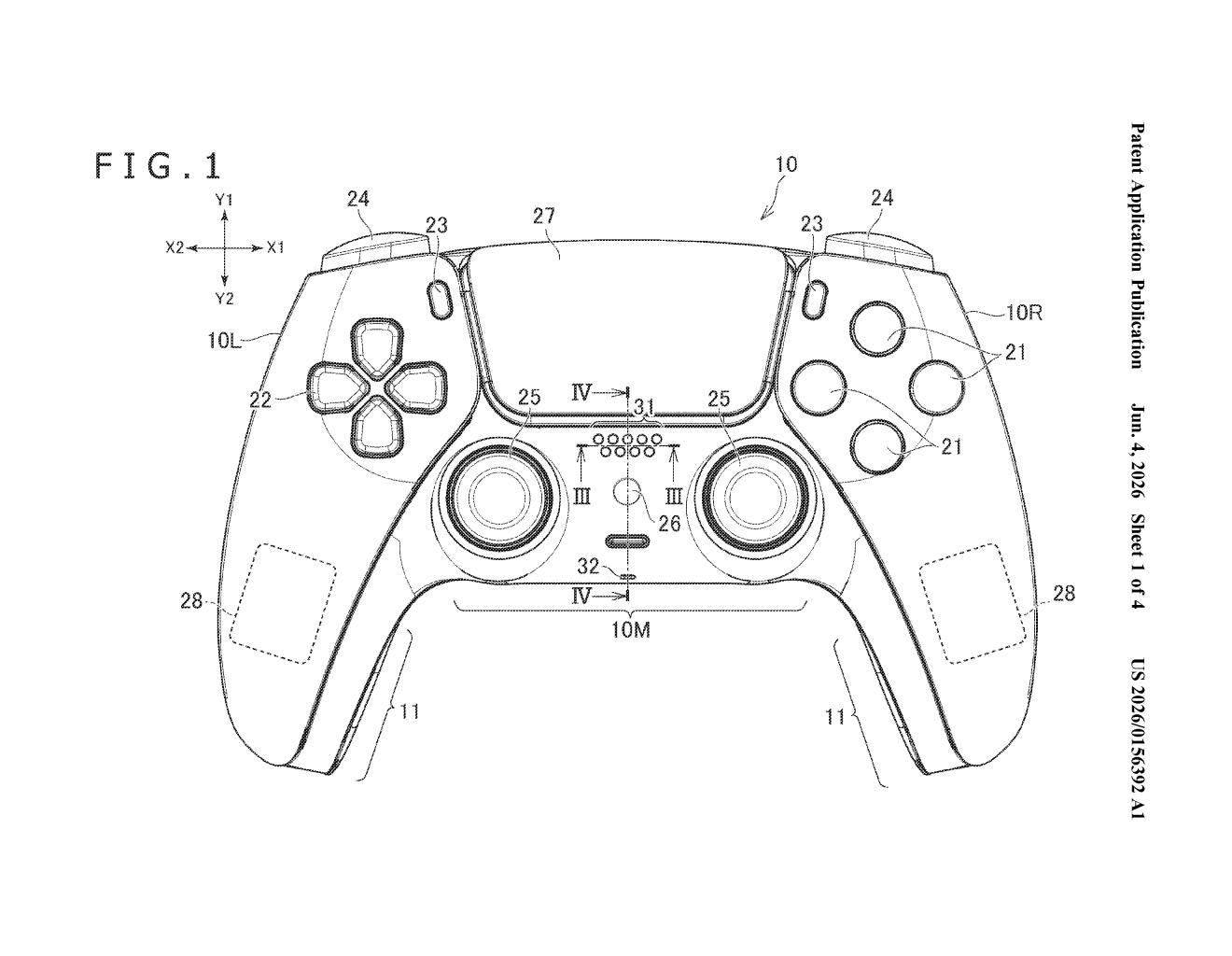
What Sony's elastic speaker mount actually does
Imagine the speaker inside your DualSense controller rattling loose over time — or sitting slightly crooked in its housing after a hard drop. Even tiny shifts in position can change how the speaker sounds, because the gap between the speaker and the hole it projects through affects the audio.
Sony's patent describes a fix: a small elastic component (think a precisely shaped rubber or foam pad) that sits underneath the speaker and pushes it upward, pressing it snugly against the rim of the opening it projects sound through. The clever part is that the pad is shaped to avoid the speaker's electrical terminal — the little connector that carries the audio signal — so it doesn't interfere with the wiring.
The result is that the speaker stays in a consistent position regardless of vibration, drops, or manufacturing tolerances. Your controller's built-in speaker should sound the same on day one as it does two years later.
How the elastic member holds the speaker in place
The patent covers a speaker-mounting architecture for a compact electronic device — almost certainly a game controller. The system has four main components:
- Speaker: a driver with a front face (pointed toward the sound output hole) and a rear face, plus a terminal section (the electrical connector for audio signal).
- Storage member / frame: a plastic housing that forms a sealed chamber around the speaker, with a precisely sized opening in the wall for sound to exit.
- Bottom member: a base plate that closes off the chamber from the rear, giving the elastic component something solid to push against.
- Elastic member: a rubber or foam pad that sits between the bottom member and the speaker's rear surface, acts as a spring, and pushes the speaker forward so it seats flush against the edge of the sound-output opening.
The key constraint is that the elastic member is geometrically positioned to avoid contact with the speaker's terminal section. This prevents the mounting pad from deforming or stressing the electrical connection — which could cause intermittent audio or damage over time.
By keeping the speaker pressed against a fixed reference point (the opening edge), the acoustic seal stays consistent, suppressing variation in output frequency response caused by positional drift.
What this means for PlayStation controller hardware
For Sony's PlayStation hardware team, consistent speaker quality in controllers matters more than it might seem. The DualSense's built-in speaker is a deliberate part of the game experience — developers use it for haptic audio cues, UI sounds, and immersive effects. If the speaker shifts even slightly in its housing, the acoustic chamber changes shape, and the frequency response drifts. That's the problem this patent solves at the manufacturing level.
This is fundamentally a quality-control and durability patent, not a new audio feature. But it signals that Sony is engineering the controller's speaker mounting with enough precision to treat positional consistency as a patentable problem — which suggests the speaker's role in the DualSense (or a successor) is not shrinking.
This is about as unglamorous as patents get — it's a rubber pad holding a speaker in place. But the fact that Sony filed it suggests the DualSense speaker is precise enough that even small positional shifts are audible and worth solving at the mechanical design stage. If you care about PlayStation hardware quality, this is a good sign: Sony is sweating the small stuff.
There are more where this came from
We read every patent application Big Tech publishes and send you the ones worth knowing. Plain English, free, every week.
Want this weekly breakdown for a company we don't cover? Patentlyze Pro →