
Sony Patents a System That Drops Redundant Game Streams When Players See the Same Screen
When two players in the same game are looking at the same scene, why render and stream it twice? Sony's new patent proposes cutting the redundant feed the moment the system detects that both screens look alike.
What Sony's duplicate-frame detection actually does
Imagine you and a friend are playing a co-op game together on the same TV — one of you is running the game locally on a PlayStation, and the other is connected via cloud streaming. For a good chunk of the session, you're both looking at exactly the same view: the same cutscene, the same shared map, the same menu screen.
Right now, your console is still generating two separate video feeds — one locally, one from a remote server — even when they're pixel-for-pixel identical. That's wasted processing power and wasted bandwidth.
Sony's patent describes a system that compares the two video outputs in real time. When it detects they're similar enough to be redundant, it quietly stops displaying one of them and just shows the other. When the views diverge again — say, you and your friend split up — it kicks both feeds back in. It's a small optimization with real consequences for performance and server costs.
How the system compares local and remote video outputs
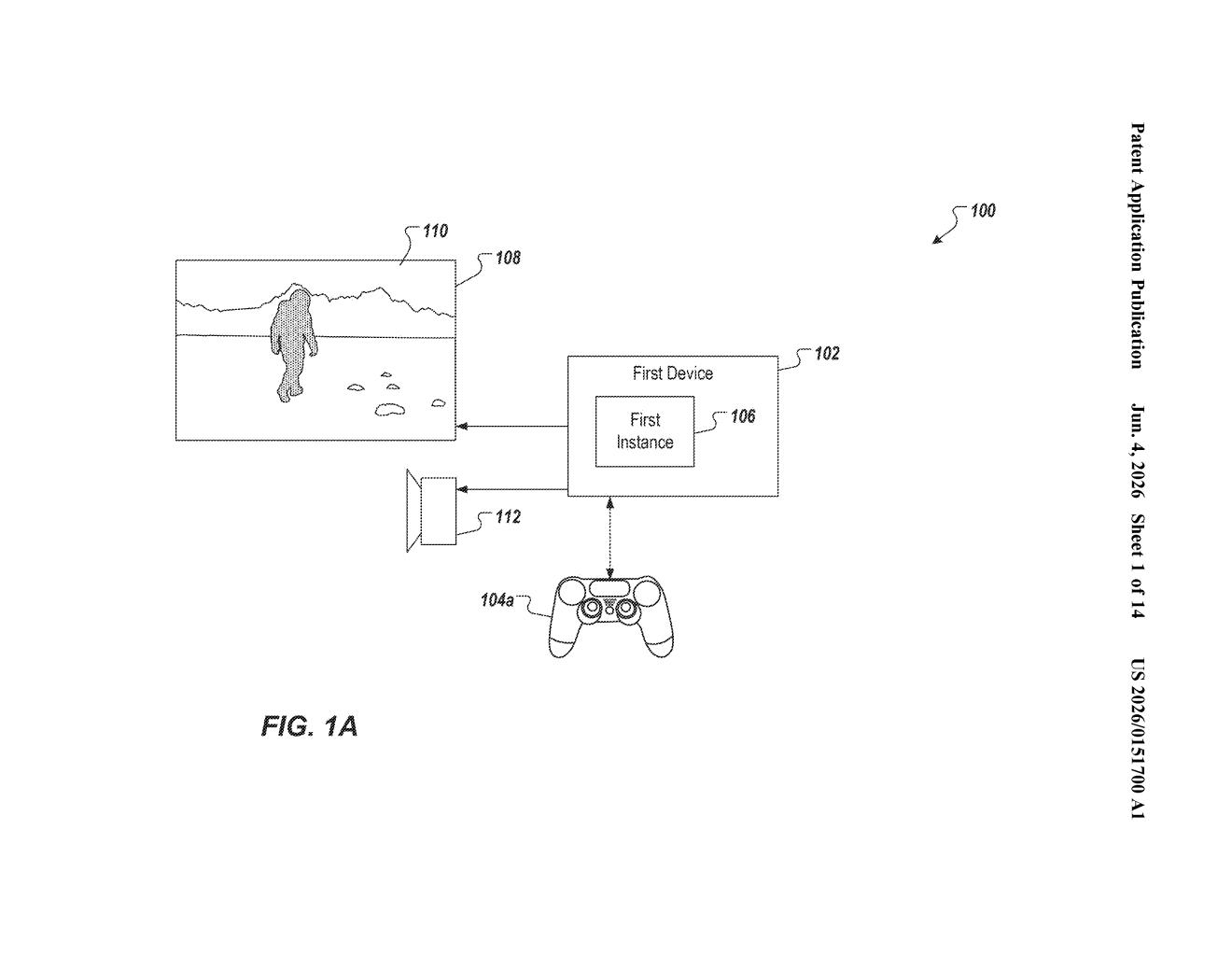
The patent covers a setup where a first game instance runs locally on a PlayStation device and a second instance runs on a remote server (think PlayStation's cloud infrastructure), with both instances responding to separate controllers attached to the same local device — a classic local co-op or couch co-op scenario extended into cloud gaming.
The core mechanism is a frame-similarity check: the system computes a "degree of similarity" between the video output of the local instance and the video output of the remote instance. When that similarity score meets or exceeds a configured threshold, the system treats the two streams as effectively identical and implements a modification — stopping display of one feed and routing the other to the screen instead.
The claim language is careful to say "at least partially in response," which leaves room for additional conditions beyond just visual similarity (latency thresholds, for instance, could also trigger the switch). The system can presumably reverse the modification when the two video outputs diverge again — for example, when the players split into different areas of a game world.
- Local instance: runs on the PlayStation device, driven by controller one
- Remote instance: runs server-side, driven by controller two via the same device
- Similarity engine: compares the two video outputs frame-by-frame or periodically
- Modification layer: drops one stream and displays the other when outputs match
What this means for PlayStation cloud co-op sessions
Cloud gaming is expensive to run at scale — every rendered frame streamed from a data center has a cost in compute and bandwidth. Sony's PlayStation Cloud (previously PlayStation Now, now integrated into PS Plus Premium) is a direct competitor to Xbox Cloud Gaming and GeForce NOW, and any system that reduces the number of simultaneous streams needed per session is meaningful infrastructure savings.
For you as a player, this could mean more stable performance in co-op sessions — fewer frames being decoded on your console, less network load, and potentially lower latency on the stream that actually matters. It's the kind of background optimization you'd never notice when it's working, which is usually the sign of a good engineering decision.
This is a genuinely clever piece of systems engineering. It's not a flashy AI feature, but it tackles a real and expensive inefficiency in cloud-assisted co-op gaming. The fact that Sony is thinking about frame-level similarity as a trigger for stream management suggests they're optimizing their cloud gaming infrastructure seriously — and that PlayStation co-op over cloud is a scenario they're actively engineering around.
There are more where this came from
We read every patent application Big Tech publishes and send you the ones worth knowing. Plain English, free, every week.
Want this weekly breakdown for a company we don't cover? Patentlyze Pro →