
AI Profile System Syncs User Data With Interaction History
Google is patenting a system that builds a written profile of you from your app activity — and, crucially, automatically revises that profile if you go back and delete or edit anything.
What Google's self-updating AI profile actually does
Imagine you've been using Google's AI assistant for months. It has quietly learned that you prefer vegetarian recipes, tend to book morning flights, and read a lot about personal finance. That knowledge lives somewhere — and it shapes every answer the assistant gives you.
This patent is about how Google keeps that picture of you accurate. The system watches your interactions across apps and devices, turns them into a plain-English description of who you are, and feeds that description into its AI every time you ask something. So far, so familiar.
The clever bit is what happens when you change something. If you delete a Google Maps search or remove a Calendar entry, the system uses a stored map between your activity and the AI's notes about you to automatically walk back whatever it inferred. Your AI profile updates itself to forget what you told it to forget — rather than silently holding onto stale impressions of you.
How the reverse-lookup maps behavior to AI conditioning text
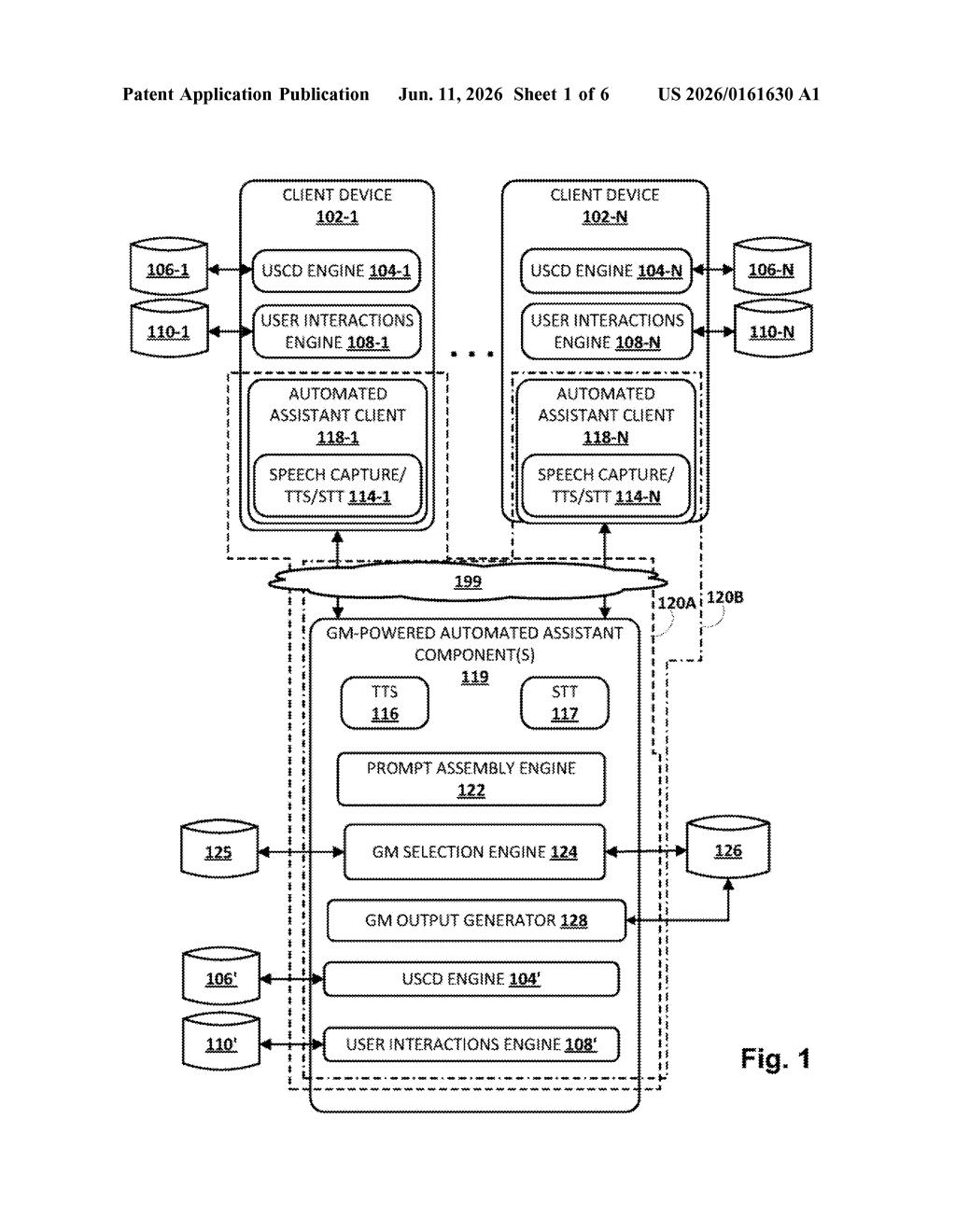
The patent describes a system Google calls user-specific conditioning data (USCD) — essentially a structured block of natural-language text that summarizes who you are as a user. Think of it as a short biography assembled by an algorithm, written in plain English, and quietly attached to every prompt you send to a generative AI.
Here's how the pipeline works:
- Your interactions across Google apps (searches, calendar entries, purchases, location history, etc.) are logged in data sources.
- The system translates those interactions into updates to specific sections of your USCD — for example, inferring a dietary preference or a commuting pattern.
- Crucially, it also stores a mapping between each raw interaction and the USCD text it produced — a kind of receipts ledger.
- If you later delete or alter an interaction, the system uses those mappings as a reverse lookup to find exactly which parts of your USCD were built from that interaction, then revises them accordingly.
The assembled USCD is then injected into the prompt sent to the generative model (like Gemini), so the AI's response is tailored to your inferred attributes without you having to re-explain yourself every time. The reverse-lookup mechanism is the novel piece: most personalization systems update forward but have no clean way to un-learn specific inputs when a user revokes them.
What this means for Google AI personalization and privacy
For everyday users, this is a direct response to a real frustration: AI assistants that seem to "remember" things you thought you'd deleted. By tying inferences back to their source data, Google is building an architecture where your privacy controls actually propagate into the AI layer — not just the storage layer. That's a meaningful step, even if the patent doesn't guarantee the feature ships that way.
For Google strategically, this is also about making Gemini-style AI feel less like a generic chatbot and more like a personal assistant that genuinely knows your context. The more accurately the USCD reflects your current preferences, the more useful every AI interaction becomes — which keeps you inside Google's ecosystem rather than reaching for a competitor.
This patent is doing something legitimately useful: building a privacy control into the personalization layer itself, not just bolting it on afterward. The reverse-lookup mechanism is the real idea here, and it addresses a problem that will only grow as AI assistants become more embedded in daily life. Whether Google ships this cleanly or buries the controls three menus deep is a different question — but the architectural thinking is sound.
There are more where this came from
We read every patent application Big Tech publishes and send you the ones worth knowing. Plain English, free, every week.
Want this weekly breakdown for a company we don't cover? Patentlyze Pro →