
Google Patents Smart Glasses That Automatically Correct for Your Eyeglass Prescription
Nearly half of adults wear prescription glasses, and that's always been an awkward problem for AR headsets. Google's new patent describes a way for an AR device to read your prescription — automatically — and adjust what it shows you accordingly.
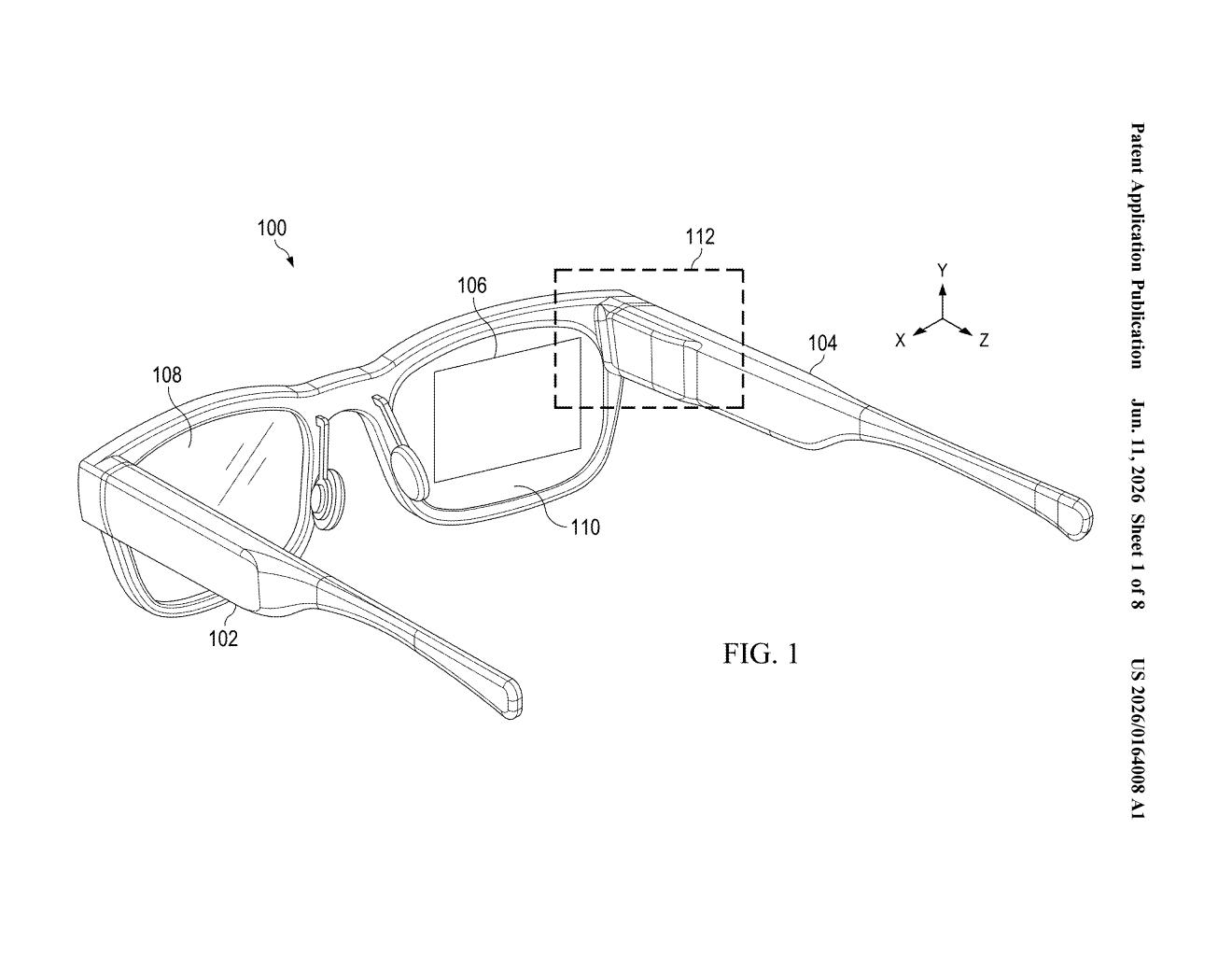
What Google's prescription-aware AR display actually does
Imagine putting on a pair of AR glasses over your regular prescription lenses, but instead of seeing a blurry, distorted digital overlay, the headset quietly figures out your prescription and sharpens everything to match your vision. That's the core idea here.
Google's patent describes three ways the headset can learn your prescription: your eye doctor's office sends it electronically, a nearly invisible marking printed on the lens (using ink only the headset's camera can see) is scanned automatically, or the device figures out your prescription on its own by analyzing how light reflects off your lenses.
Once the headset knows your prescription, it adjusts the projector and optics so the digital images it shows you are pre-corrected for your specific vision. No manual setup, no guesswork — the glasses handle it the moment you put them on.
How the headset reads and applies your lens prescription
The patent covers a near-eye display device (think AR glasses) that houses a projector and an optical system to beam imagery toward the wearer's eye — passing through any corrective lens the person is wearing in the process. The problem: prescription lenses warp and shift light in ways that can distort that projected image.
To fix this, the device needs to know your prescription, and the patent outlines three acquisition methods:
- Electronic transmission — prescription data is sent wirelessly from an external source (your optometrist's system, for example) to the headset.
- Near-infrared ink marking — a tiny, nearly invisible code is printed on the corrective lens itself, and the headset's gaze-tracking camera (the infrared camera that follows where your eye is looking) doubles as a reader to decode it.
- Glint analysis — the gaze-tracking camera fires infrared light and measures how the reflections (glints) bounce off the lens surface; the pattern of those reflections lets the device infer the prescription without any pre-encoded data.
With the prescription in hand, the headset calibrates the projector output, the optical path, and the gaze-tracking system itself — since corrective lenses also shift where your eye appears to be looking, which matters for any interface controlled by eye movement.
What this means for AR glasses and the 200M people who wear glasses
About 200 million Americans wear prescription eyewear, and it's one of the most-cited reasons people find current AR and VR headsets uncomfortable or impractical. A headset that handles your prescription automatically — without requiring custom prescription inserts or a trip to a specialized optician — removes a real barrier to adoption.
This patent is also notable because it extends the fix beyond just the display image. By recalibrating the gaze-tracking system using prescription data, Google is addressing a subtler issue: AR interfaces that respond to where you're looking need to account for the fact that your corrective lenses make your eyes appear slightly off from where they actually are. Getting that wrong means the whole eye-controlled interface misfires.
This is genuinely useful, practical engineering — not a flashy concept. Prescription compatibility is a well-documented friction point for every AR headset on the market, and Google is tackling it with three different fallback methods, which suggests real engineering commitment rather than a paper patent. The gaze-tracking recalibration angle is the most underappreciated piece: fixing the display image without also fixing eye-tracking would only solve half the problem.
There are more where this came from
We read every patent application Big Tech publishes and send you the ones worth knowing. Plain English, free, every week.
Want this weekly breakdown for a company we don't cover? Patentlyze Pro →