
Google Patent Targets Photo Noise Reduction Where Human Eyes Actually Detect It
Your eyes are not a perfect sensor, and Google wants your phone's camera to know that. A new Google patent describes a noise-reduction system that figures out which parts of a photo look grainy to a human, then skips the parts that don't, saving processing power without you ever noticing the difference.
How Google's eye-aware photo cleanup decides what to fix
Imagine you take a photo in a dim restaurant. The image is grainy, but here's the thing: your eyes are much better at spotting grain in some places (like a face in the center) than in others (like a dark, blurry background in the corner). Cleaning up every pixel equally wastes a lot of effort on patches you'd never notice anyway.
Google's patent describes a system that first maps out where noise actually bothers a human viewer, then uses a built-in "workload budget" to decide how many patches it has time to clean up. It prioritizes the ones your eyes would catch, and skips the rest.
The result is a faster process that still looks great to you, because the spots that got skipped were never going to bother you in the first place. It's less about doing less work, and more about doing the right work.
How the perception model picks which tiles get processed
The patent describes a pipeline with three main stages:
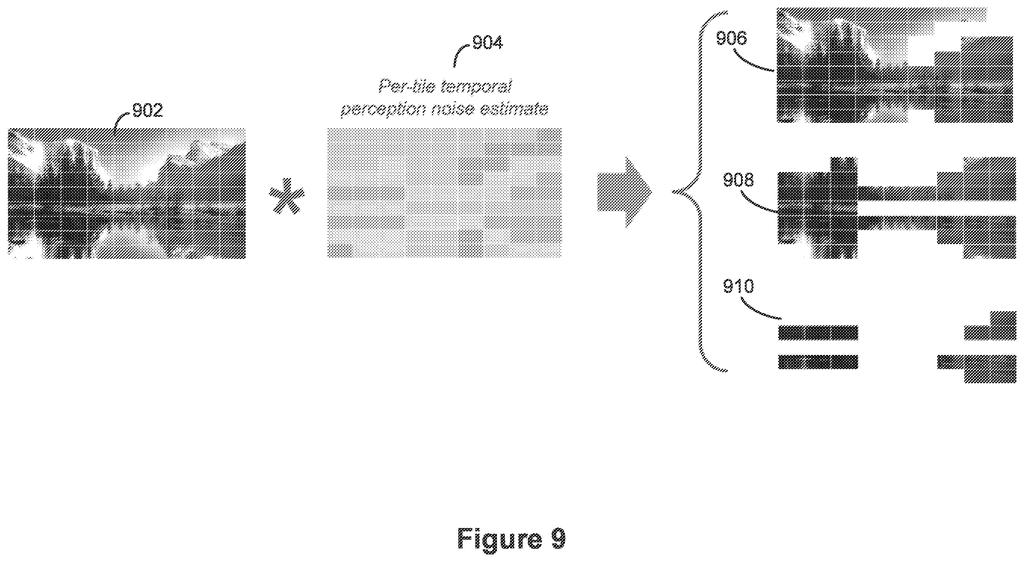
- Human perception model: The image is divided into a grid of small patches called tiles. A model inspired by how human vision works scores each tile for how noticeable its grain or noise would be to a real person. Brighter areas, faces, and high-contrast edges tend to score high; dark, uniform, or peripheral regions score low.
- Workload budget manager: A separate component decides how many tiles the system has time and processing power to clean up. This is essentially a resource cap that keeps the camera from overloading the chip.
- Selective noise reduction: Only the tiles with the highest perception scores, up to the budget limit, get sent through the actual noise-reduction process. The rest are left as-is.
The cleaned tiles are then stitched back together with the untouched ones to form what the patent calls a perception-optimized image, which is then shown on the device display.
The key insight is that treating noise reduction as a ranked, budget-constrained selection problem rather than a uniform filter is both more efficient and, from a viewer's standpoint, indistinguishable from cleaning the whole frame.
What this means for Pixel camera speed and quality
Camera processing is one of the heaviest jobs a phone chip handles, and noise reduction is a big part of that load. By skipping work the viewer won't miss, Google could make its Pixel cameras process shots faster, run cooler, or save battery without any visible drop in quality. That trade-off gets especially valuable in burst shooting or video, where frames need to be processed in rapid succession.
This also hints at a broader philosophy in Google's camera engineering: model the viewer, not just the image. Rather than chasing raw technical perfection in every pixel, the system optimizes for what you will actually perceive. That's a meaningful shift, and one that could make everyday photos feel snappier.
This is genuinely clever engineering, not a flashy feature. The idea of modeling human visual perception to prioritize processing work is well-established in video compression, but applying it this deliberately to still-image noise reduction in a mobile camera pipeline is a smart, practical move. If it ships in a future Pixel, most users will never know it's there, which is exactly the point.
Get our take in your Top Stories
Liked this breakdown? Add Patentlyze as a preferred source on Google, and our plain-English take shows up more often in your Top Stories the next time Google patent news breaks.
There are more where this came from
We read every patent application Big Tech publishes and send you the ones worth knowing. Plain English, free, every week.
The drawings
11 drawing sheets from US 2026/0212460 A1 · click any drawing to enlarge


Show the other 3 sheets


Want this weekly breakdown for a company we don't cover? Patentlyze Pro →